
Wisconsin Hunting Regulations, Fall 2026-Spring 2027
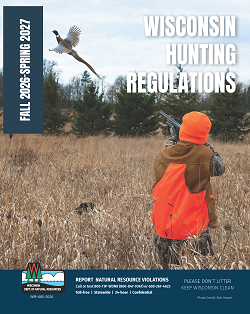
The Fall 2026-Spring 2027 Wisconsin Hunting Regulations are now available for hunters to look through. In addition to this web version of the regulations, a print copy is available at most license agent locations. Both versions contain the same information.
To use the online regulations, you must first choose a Section or click the "View All Regulations" button to see everything. You may then choose a Subsection to narrow your search and then press the View Regulation button to display the regulatory information you selected. If you'd like to see all info related to a section, select the first option ("-") to see everything under that section. You may also press Reset for a brand new search.
Please be aware that hunters are responsible for reading and following all the hunting regulations. Regulations that apply to all species are found within the "General Hunting" and "Licensing Requirements" sections, meanwhile species-specific regulations are found in the respective species sections.
Deer Hunting Regulations
*Be aware that the general hunting regulations also apply, in addition to the species-specific regulations below. Read the info in the General and Licensing Requirements section in the Wisconsin Hunting Regulations.
Baiting and Feeding Deer Regulations
Scents
Scents that are used only to attract deer by odor may be used for hunting deer statewide, but the scent may not be placed or deposited in a manner that makes it accessible for consumption by deer. Scents measuring greater than two ounces shall be removed daily at the end of shooting hours. Scent quantities of two ounces or less do not need to be removed daily and may be placed, used or deposited in any manner for hunting deer.
Natural Vegetation And Plantings
Hunting with the aid of material deposited by natural vegetation, material found solely as a result of normal agricultural or gardening practices or with the aid of crops planted and left standing as wildlife food plots is legal. It is illegal to establish or maintain food plots/plantings on DNR-owned or -managed lands.
Baiting
It is illegal to place, use or hunt deer over bait or feed material in many counties. Visit the Baiting and Feeding Regulations webpage for a map of prohibited locations. Check the map frequently as changes can occur throughout the season. For the remainder of the state, baiting for hunting purposes is allowed only under the following conditions:
Baiting Amount
On each contiguous parcel of land under the same ownership, up to two gallons of bait may be placed in total if the parcel is less than 40 acres. If the parcel is 40 acres or more, two gallons may be placed per every 40 acres. Bait may be spread out or divided into more than one pile as long as the total amount of bait or feed material is not more than two gallons per 40 acres.
Bait Placement
It is illegal to:
- Place a baiting site within 100 yards of another baiting site.
- Hunt within 100 yards of more than two gallons of bait on the same parcel of land.
- Place a baiting site within 50 yards of any trail, road or campsite used by the public or within 100 yards of a roadway having a posted speed limit of 45 mph or more.
- Place feed at a deer feeding site that is known to be used by bear or elk.
Timing
It is illegal to:
- Place, use or hunt over bait or feed for hunting purposes during the closed deer season, except bait may be placed starting at midnight the day prior to the archery deer season opener. Baiting must stop at the close of all deer seasons.
- Hunt over bait or a feeding site that is in violation of these regulations unless the area is completely free of bait or feed material for at least 10 consecutive days prior to hunting, pursuing animals or dog training.
Note: Removal of unlawfully placed bait or feed material does not preclude the issuance of a citation for the original placement of unlawful baiting or feeding material.
Content
It is illegal to:
Place, use or hunt over any bait or feed material that:
- Contains any animal part or animal byproduct. Animal parts and byproducts include honey, bones, fish, meat, solid animal fat, animal carcasses and parts of animal carcasses but do not include liquid scents.
- Is contained in or deposited by a feeder that is designed to deposit or replenish feed automatically, mechanically or by gravity.
- Contains or is contained within metal, paper, plastic, glass, wood or other similar processed materials. This does not apply to scent materials.
Group Hunting Law
It is illegal to kill game for another person except during a firearm deer season when a member of a group deer hunting party may kill a deer for another member of the party. However, junior antlerless deer harvest authorizations may only be filled by the person to whom the authorizations are issued. Group hunting is not legal for persons hunting with bows and crossbows. All participants must be licensed, and each must possess a firearm or airgun. Members of a group deer hunting party should also agree in advance that a harvest authorization holder is willing to use their authorization number to register a deer killed by another member of the party.
- A group deer hunting party must be two or more hunters who are hunting together within sight or voice contact at all times. Temporary loss of voice or visual contact for a reasonable time due to terrain or weather conditions is acceptable. Hunters may not kill deer for persons who are not out actively hunting with the party.
- Hunters in a group hunting party may not use cellular phones, special free radio communications or other mechanical or electronic amplifying devices (except hearing aids) to establish contact with the person for whom the deer is killed.
- People participating only as deer drivers are not required to possess firearms or hunting licenses.
- Adults may not hunt deer with firearms or airguns during the youth gun deer hunt.
- While group hunting, a mentor may not fill any of their mentee’s deer harvest authorizations.
Possession and Sale of Deer
It is illegal to:
- Possess any deer from which the antlers have been removed, broken or altered so as to make determination of the legality of the deer impossible. Any such deer is considered an illegal deer if taken during a season for hunting only antlerless deer.
- Possess a deer carcass unless the hunter possesses the appropriate proof of a deer harvest authorization.
- Sell, purchase, barter or offer to sell, purchase or barter any deer or deer part, except that the head, skin (not in spotted coat) and antlers (not in velvet) of any deer may be sold or bartered when these parts are separated from the rest of the carcass.
- Possess deer that are entirely white except for the hooves, tarsal glands, head and parts of the head unless special written authorization is obtained from the department.
Note: Deer with antlers in velvet or in spotted coat may be harvested during the open deer season. The velvet antlers and spotted hide may not be sold or transferred to another person. Albino and all-white deer may not be harvested.
Special Hunts
Youth And Disabled Gun Deer Hunt
- Open only to people 15 years of age and younger who possess a gun deer license or persons who hold a valid Class A, B (issued for more than one year), C or D disabled permit.
- This hunt occurs statewide in all areas open for hunting.
- Youth hunters must be accompanied by an adult parent or guardian, even if the youth is 14 or 15 years old and holds a hunter education certificate. One adult may not accompany more than two youth hunters at the same time.
- All other hunting regulations apply, including highly visible clothing requirements for all hunters except waterfowl hunters.
- Hunting mentorship rules apply to all youth age 11 and under and to any youth who has not completed hunter education.
Gun Deer Hunt For Hunters With Disabilities
Special gun deer hunting opportunities on sponsored properties are available to hunters with disabilities who hold a Class A, C or D disabled permit or holders of a Class B permit that is issued for longer than one year and that authorizes hunting or shooting from a stationary vehicle. A gun deer license and a sponsor are required.
- Special rules apply to Class A and C disability permit holders. Please visit the DNR's Deer Hunting for Hunters with Disabilities webpage to learn more.
- Disabled hunters who wish to participate must contact a hunt sponsor before Sept. 15. Visit the DNR's Deer Hunting for Hunters with Disabilities webpage after Aug. 1 for sponsor contact information.
- The valid authorizations for the gun hunt for hunters with disabilities are as follows:
- Gun buck deer harvest authorization
- Bonus antlerless deer harvest authorization
- Farmland antlerless deer harvest authorizations
- Note: Anyone participating in this hunt may use one Farmland (Zone 2) antlerless deer harvest authorization to take an antlerless deer in any unit statewide. Additionally, if the disabled hunter has also purchased an archery/crossbow license, they may take one additional antlerless deer during this hunt.
- Farmland antlerless deer harvest authorizations
- During this special hunt on sponsored properties, the hunter may use the Farmland (Zone 2) antlerless deer harvest authorization on either land type regardless of the land type designated on the authorization. If the hunter does not fill the authorization during this hunt, they must use the authorization to harvest an antlerless deer during the other deer seasons only on the land type specified.
Health Advisories (Lead, PFAS And CWD)
Chronic Wasting Disease
Hunters Help Monitor CWD and Reduce Risk of Spread
Chronic wasting disease (CWD) is a contagious neurological disease which has been found in wild deer and captive deer/elk in Wisconsin. It is caused by a misfolded protein (prion) and is always fatal. It can be spread through direct animal to animal contact, or even through the environment contaminated with bodily fluids or infected tissue from decomposed carcass parts.
Hunters can help monitor CWD and reduce risk of spread by:
- Continuing to hunt, especially in areas where CWD has been detected.
- Properly disposing of their deer carcass waste.
- Following baiting and feeding rules and choosing not to bait deer where it is allowed.
- Having their deer tested for CWD in priority sampling areas.
To learn more, visit the DNR's CWD webpage.
Venison: What Hunters Should Know
Cooking does not deactivate CWD prions. CWD prions can be found in the muscle tissue in late-stage deer with the disease.
There have been no reported cases of CWD in people. As a precaution, the Wisconsin Department of Health Services recommends that venison from deer harvested in CWD affected areas not be consumed or distributed to others until test results show that CWD was not detected in the harvested animal.
For additional recommendations on the safe handling of venison, visit the DNR's Carcass Movement, Processing and Disposal webpage.
Use GoWild to Submit Your CWD Sampling Data Online
Save time by using the online CWD form. Find a link to the form in your registration confirmation email or in your Go Wild harvest history when submitting your sample at a CWD sampling location. Submitting your deer for CWD sampling does not fulfill the registration requirements. Register first, then submit for sampling.
Looking For Carcass Disposal or CWD Sampling Locations?
Visit the DNR's Sampling for CWD webpage to find a map of these resources. Some locations will have both sampling and disposal available.
Check Your Deer's CWD Test Results
Check your deer’s CWD test results online! Log into your Go Wild account and navigate to your harvest history, or visit the DNR's CWD Test Results webpage.
Consumption Advisory for Deer Harvested Within a 5-Mile Radius of the Town of Stella in Oneida County
The Wisconsin Department of Health Services has issued a PFAS-based consumption advisory for deer harvested in this area: do not consume more than one meal per month of muscle tissue (venison) and do not eat liver.
PFAS are a group of human-made chemicals used for decades in numerous products. These contaminants have made their way into the environment in a variety of ways. These chemicals are known to accumulate in the human body, posing several risks to human health including certain cancers, liver damage and decreased fertility.
Potential Lead in Venison
Lead is toxic to humans, even in very low amounts. Children under 6 years old and pregnant women face the highest risk of health problems if exposed. The Wisconsin Department of Health Services recommends using caution when consuming venison harvested with lead ammunition. For more information, visit the DNR's Safely Eating Venison webpage.
Turkey Season Dates and Bag Limits
| Fall Season | Area/Period | Dates | Bag Limit |
| Fall 2026 | Statewide | Sept. 12-Jan. 3, 2027 | One turkey of any age or sex per harvest authorization. |
| Spring Season | Area/Period | Dates | Bag Limit |
| Youth 2027 | The turkey zone for which the harvest authorization was issued | April 17-18 | One bearded or male turkey per hunter. |
| Spring 2027 | Period A | April 21-27 | One bearded or male turkey per harvest authorization. |
| Spring 2027 | Period B | April 28-May 4 | One bearded or male turkey per harvest authorization. |
| Spring 2027 | Period C | May 5-11 | One bearded or male turkey per harvest authorization. |
| Spring 2027 | Period D | May 12-18 | One bearded or male turkey per harvest authorization. |
| Spring 2027 | Period E | May 19-25 | One bearded or male turkey per harvest authorization. |
| Spring 2027 | Period F | May 26-June 1 | One bearded or male turkey per harvest authorization. |
Licensing Requirements
Licenses/Stamps/Harvest Authorizations
What You Need To Hunt Turkey:
- Spring turkey hunting license, if hunting in spring.
- Fall turkey license, if hunting in fall.
- Wild turkey stamp (valid for spring and fall).
- An unfilled turkey harvest authorization valid for the season, period and zone you are hunting.
Note: A person is considered to be hunting turkey if they possess a firearm, airgun, crossbow or bow and arrow and turkey decoys or a turkey call during an open turkey season.