
Wisconsin Hunting Regulations, Fall 2026-Spring 2027
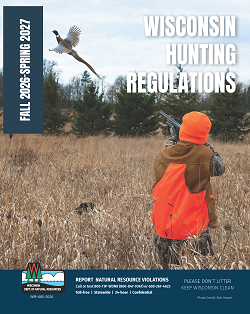
The Fall 2026-Spring 2027 Wisconsin Hunting Regulations are now available for hunters to look through. In addition to this web version of the regulations, a print copy is available at most license agent locations. Both versions contain the same information.
To use the online regulations, you must first choose a Section or click the "View All Regulations" button to see everything. You may then choose a Subsection to narrow your search and then press the View Regulation button to display the regulatory information you selected. If you'd like to see all info related to a section, select the first option ("-") to see everything under that section. You may also press Reset for a brand new search.
Please be aware that hunters are responsible for reading and following all the hunting regulations. Regulations that apply to all species are found within the "General Hunting" and "Licensing Requirements" sections, meanwhile species-specific regulations are found in the respective species sections.
General Hunting Definitions
Accompany
Within visual and voice contact without the aid of any mechanical or electronic amplifying device other than a hearing aid.
Afield
An area where hunting can legally occur, such as fields, forests or similar areas.
Aggregate Daily Bag Limit
The maximum number of migratory game birds permitted to be taken by one person in any one day, when the person hunts in more than one zone or state and/or more than one species for which a combined daily bag limit is prescribed. The aggregate daily bag limit is equal to the largest daily bag limit prescribed for any one species or for any one zone or state in which the taking occurs.
Buck Deer
A deer with at least one antler that is three inches or longer in length.
Daily Bag Limit
The total number of a particular game species that a person may harvest in one day, regardless of how long or often that person hunted that day.
Firearm
Any weapon that uses gun powder, including black powder or black powder substitutes for muzzleloaders.
Highway
The entire width between the boundary lines of every public road, but does not include private roads and driveways.
Migratory Game Birds
Any bird which is migratory and for which an open season has been prescribed.
Point Of Kill
The location at which a light is used to illuminate, identify and kill an animal. It does not include shining a light for the purpose of searching for wild animals whose specific location the hunter does not yet know.
Possession Limit
The maximum number of a game species that a person may possess at-large, including all game stored or controlled by a person, regardless of the proximity to the location of storage.
Public-Access Land
Lands open to hunting that are owned, under easement to, or leased by federal, state, county or municipal government. Managed Forest Law lands, Forest Crop Law lands, public utilities lands and lands acquired with state stewardship funds that are open to hunting are also considered public-access lands.
Public Road
Roads shown on the current official highway map available from the Department of Transportation for public use. This does not include private roads or driveways.
Roadway
The portion of the highway which is improved or ordinarily used for vehicle travel, excluding the berm or shoulder.
Take
To legally kill or harvest under the authority of a license and appropriate harvest authorization.
Unprotected Species
Mammals and birds that can be hunted year-round without bag limits or shooting hours restrictions, including starling, English (house) sparrow, chukar partridge, coturnix quail, feral pigeon, opossum, skunk, weasel, woodchuck, porcupine and all other wild mammals not specifically mentioned in the hunting and trapping regulation pamphlets and not listed as an endangered, threatened or protected species. See the Protected Species webpage for more information. The DNR does not regulate the take of non-wild animals (e.g. feral pigeons and hogs).
Vehicle
Any device, motorized or not, in, upon or by which any person or property is or may be transported or towed upon a highway or other roadway. For example, cars, trucks, tractors, ATVs, UTVs, trailers, bikes and similar devices.
Waterfowl
Ducks, geese, brant, mergansers, coots and gallinules.
Weapons and Ammunition
Weapons
It is illegal to:
- Hunt with any means other than a rifle, shotgun, handgun, muzzleloader, airgun, bow and arrow, crossbow (min. draw weight of 100 lbs.) or falconry.
- Hunt with a machine gun or other fully automatic weapon.
- Hunt a migratory game bird with or while in possession of a shotgun larger than 10 gauge.
- Possess or use any firearm for hunting if you are a felon or have been prohibited from possessing a firearm under Wisconsin law. A hunting license does not authorize a felon to possess a firearm for hunting.
- Shoot a firearm (airgun does not apply) within 100 yards of a building devoted to human occupancy while on lands the hunter does not own, including public lands and public waters, without the permission of the owner or occupant of the building.
Ammunition
It is illegal to:
- Use, possess or have under control of any of the following while hunting:
- Shot shells containing shot larger than T, except when hunting for furbearing animals when buckshot may be used, and migratory birds where F may be used
- Any tracer or incendiary ammunition that is not a distress flare.
- Any bullet, arrow or bolt that is designed or modified to explode or deliver poisons or drugs.
- Hunt a game bird with any ammunition other than an arrow, bolt or shot shell that consists of more than one projectile.
- Hunt a deer, bear or elk with any ammunition other than an arrow, bolt or bullet that is a single projectile of an expanding design.
- Hunt game birds or wild turkey with lead or other toxic shot while on federal waterfowl production areas (WPAs).
Reasonable Equipment
It is illegal to hunt with any weapon or ammunition that is of inherent design or used in such a manner as to not be reasonably capable of reducing a target wild animal to possession.
Muzzleloaders
Muzzleloaders may be used statewide during any firearm deer season. During the muzzleloader-only deer season, all muzzleloaders must shoot a projectile loaded only from the muzzle. Black powder revolvers are not legal during the muzzleloader-only season because they are capable of being loaded by the cylinder instead of the muzzle.
Handguns
It is illegal to:
- Possess a concealed handgun unless authorized by a concealed carry license or other authorization to possess a concealed firearm.
- Hunt with a handgun, including muzzleloading handguns, if under age 18.
Short-Barreled Shotgun Or Rifle
Rifles must have an overall minimum length of 26 inches with a 16-inch minimum barrel length. Shotguns must have an overall minimum length of 26 inches with an 18-inch minimum barrel length unless the user has a federal license to possess a “short-barreled” rifle or shotgun.
Bows, Arrows And Crossbows
Crossbow and bow and arrows may be used by any person hunting under the authority of a gun license during any firearm season (i.e., small game, gun deer or muzzleloader for deer season). Bows and crossbows are legal for any person to use for hunting wild turkey under the authority of a turkey hunting license or for hunting migratory birds and small game under the authority of a small game hunting license and non-resident furbearer license. A crossbow is not legal to hunt under the authority of an archery license, and bow and arrow is not legal to hunt under the authority of a crossbow license.
Bow and arrow may be used to hunt small game and migratory birds under the authority of an archery license, and a crossbow may be used to hunt small game and migratory birds under the authority of a crossbow license.
Arms Transportation
All firearms (excluding handguns) must be unloaded when inside any vehicle, whether moving or stationary, and must be unloaded when on any moving vehicle. It is legal to shoot from a wagon or trailer if it is not attached to a motor vehicle while hunting. All crossbows must be unloaded if cocked while inside or on a moving vehicle.
Note: A loaded firearm may be placed on, but not inside, a vehicle that is stationary. All firearms, bows and crossbows must be unloaded when inside or on any motor-driven boat while the motor is running. A firearm is considered unloaded if the shell or cartridge is removed from the chamber and any clip, magazine or cylinder that is attached to the firearm is empty, the cap or primer is removed from a percussion muzzleloader, the flashpan of a flint lock muzzleloader is cleaned of powder or the battery is disconnected and removed from an electronic-ignition system muzzleloader.
Qualified persons with disabilities with the permit authority to shoot from a stationary vehicle must have all firearms (other than handguns) unloaded while the vehicle is in motion.
It is illegal to:
- Place, possess or transport a cocked crossbow inside or on a motorized vehicle unless it is unloaded (bolt removed).
- Load a firearm other than a handgun while inside a motor vehicle or to discharge any firearm or airgun, including handguns, inside or from any moving or stationary vehicle except for certain disabled hunters with proper permits.
Use Of Devices
It is illegal to:
- Hunt any animal with the aid of any aircraft, including unmanned aircraft or drones.
- Use, or possess with the intent to use, laser sights while hunting except by Class C visually disabled permit holders.
- Use or hunt with a suppressor or silencer, unless the hunter possesses the proper federal firearm license that authorizes possession and use of the device.
Hunting Near Roadways
It is illegal to:
- Hunt within 50 feet of the roadway’s center.
- Discharge a firearm or airgun, shoot a bolt or an arrow from a bow or crossbow:
- From or across a highway.
- Within 50 feet of the roadway’s center.
The above prohibitions apply to all public roads.
Note: Certain exceptions are allowed for Class A and Class B shoot from vehicle disabled permit holders, and for hunting small game or turkeys from dirt or gravel roads with shotguns loaded with fine shot. Visit the Permits for People with Disabilities webpage for more information.
Shining and Night Hunting
Shining
It is illegal to:
- Use or possess with intent to use, a light, including vehicle headlights, for shining any wild animal while hunting or in possession of a firearm, bow and arrow or crossbow. This includes laser sights on firearms, bows and crossbows. Exceptions apply for Class C disabled permit holders and for hunting certain small game. See “Night Hunting” section below.
- Use or possess with intent to use, a light, including vehicle headlights, for shining wild animals between the hours of 10 p.m. and 7 a.m. from Sept. 15 to Dec. 31 whether or not in possession of a firearm, bow or crossbow.
Note: Check with the local sheriff’s department or local officials for local shining restrictions.
Night Hunting
Unprotected species (as well as coyote, fox and raccoon) may be hunted without shooting hour restrictions except if hunting with a bow or crossbow during certain times of the year. If hunting for these species with a bow or crossbow during the bear and archery/crossbow deer seasons, shooting hours apply. Visit the Calculating Shooting Hours webpage for more information, as well as links to the base shooting hours for each species.
Use of lights: A flashlight or firearm-mounted light may be used at the point of kill while hunting on foot for coyote, raccoon, fox or unprotected species. Lights may not be used to shine for these animals while in possession of firearm, bow or crossbow.
Taking of Game
It is illegal to:
- Take or possess any deer or wild animal that has been lawfully obtained by someone else without having that person’s consent.
- Not immediately kill all game taken and make it part of the daily bag.
- While afield, possess game killed by another unless accompanied by the original harvester.
- Possess game taken by another unless able to provide the registration confirmation number, name and address or customer ID of the holder of the harvest authorization.
- Gift game to any person while afield. All game given as a gift remains counted toward the daily bag limit of the holder of the harvest authorization.
- Carelessly waste game. The hunter must make every reasonable effort to retrieve all game that is killed or crippled. Until such effort is made, the game shall be included in the daily bag limit.
Note: This rule does not allow hunters to trespass without permission of the landowner nor to shoot game beyond legal shooting hours.