
Wisconsin Hunting Regulations, Fall 2026-Spring 2027
The Fall 2026-Spring 2027 Wisconsin Hunting Regulations are now available for hunters to look through. In addition to this web version of the regulations, a print copy is available at most license agent locations. Both versions contain the same information.
To use the online regulations, you must first choose a Section or click the "View All Regulations" button to see everything. You may then choose a Subsection to narrow your search and then press the View Regulation button to display the regulatory information you selected. If you'd like to see all info related to a section, select the first option ("-") to see everything under that section. You may also press Reset for a brand new search.
Please be aware that hunters are responsible for reading and following all the hunting regulations. Regulations that apply to all species are found within the "General Hunting" and "Licensing Requirements" sections, meanwhile species-specific regulations are found in the respective species sections.
Migratory Game Birds: Season Dates And Bag Limits
Migratory Game Bird Seasons
| Species | Dates | Daily Bag Limit |
| Early Teal* | Sept. 1-9 | 6 |
| Early Goose | Sept. 1-15 | 5 Canada, 20 snow, blue or Ross |
| Rail (Virginia and Sora) | Sept. 1-Nov. 9 | 25 |
| Snipe | Sept. 1-Nov. 9 | 8 |
| Common Gallinule | Sept. 1-Nov. 9 | 15 |
| Mourning Dove | Sept. 1-Nov. 29 | 15 |
| Youth Waterfowl | Sept. 19-20 | Same as regular duck season |
| Woodcock | Sept. 19-Nov. 2 | 3 |
*Please double check the shooting hours for early teal, because early teal has a different set of shooting hours than the other waterfowl species.
Regular Duck Season
Regular Duck Season Bag Limits: 6 ducks, to include not more than 4 mallards (2 hens), 2 black ducks, 3 pintail, 2 canvasbacks, 2 redheads, 3 wood ducks and scaup as outlined below. For species of ducks not listed, such as teal and ring-necks, the combined total with all other species may not exceed 6 ducks. In addition, 5 mergansers to include not more than 2 hooded mergansers.
| Zone | Dates | Daily Bag Limit |
| Northern Duck Zone | Sept. 26-Nov. 24 | 2 scaup/day: Sept. 26-Nov. 9 1 scaup/day: Nov. 10-24 |
| Southern Duck Zone | Oct. 3-11; Oct. 17-Dec. 6 | 1 scaup/day: Oct. 3-11 and Oct. 17-22 2 scaup/day: Oct. 23-Dec. 6 |
| Open Water Zone | Oct. 17-Dec. 15 | 2 scaup/day: Oct. 17- Nov. 30 1 scaup/day: Dec. 1-15 |
| Coot | *Same as duck zone you are hunting | 15 |
Regular Goose Season
| Zone | Dates | Daily Bag Limit |
| Northern Goose Zone | Sept. 16-Dec. 16 |
|
| Southern Goose Zone | Sept. 16-Oct. 11; Oct. 17-Dec. 6; Dec. 19-Jan. 2, 2027 |
|
| Mississippi River Zone | Oct. 3-Oct. 11; Oct. 17-Jan. 5, 2027 |
|
Licensing Requirements
Licenses, Stamps And Permits
To Lawfully Hunt Migratory Game Birds, You Must Obtain And Carry With You:
- A small game license
- A Wisconsin Waterfowl stamp if hunting waterfowl
- A Federal Migratory Bird Stamp if hunting waterfowl. Either a physical or digital stamp is acceptable
Note: Neither the state nor federal stamps are required if under the age of 16 or hunting coot, common gallinule, rails, mourning dove or woodcock.
A Canada Goose Permit, if hunting Canada geese in either the early or regular Canada goose season.
All required license stamps and permits may be purchased through Go Wild. See the Forms of Proof webpage for more information.
Management Zones and Units
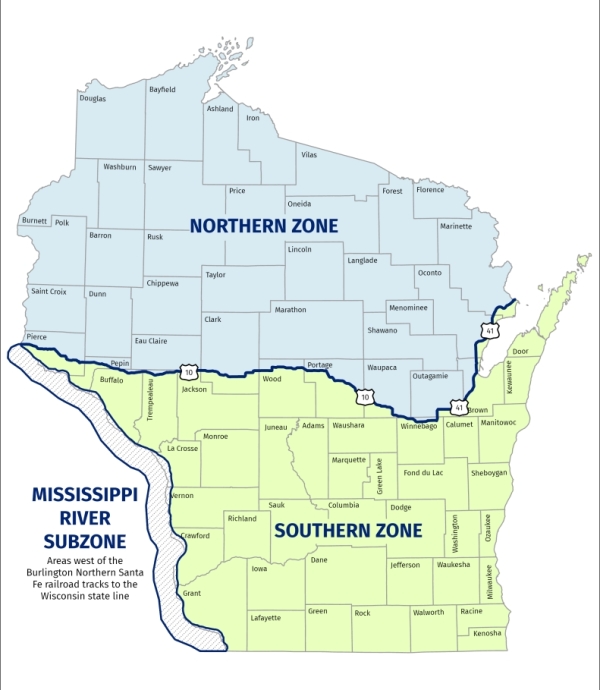
Canada Goose Zones
Duck Zones
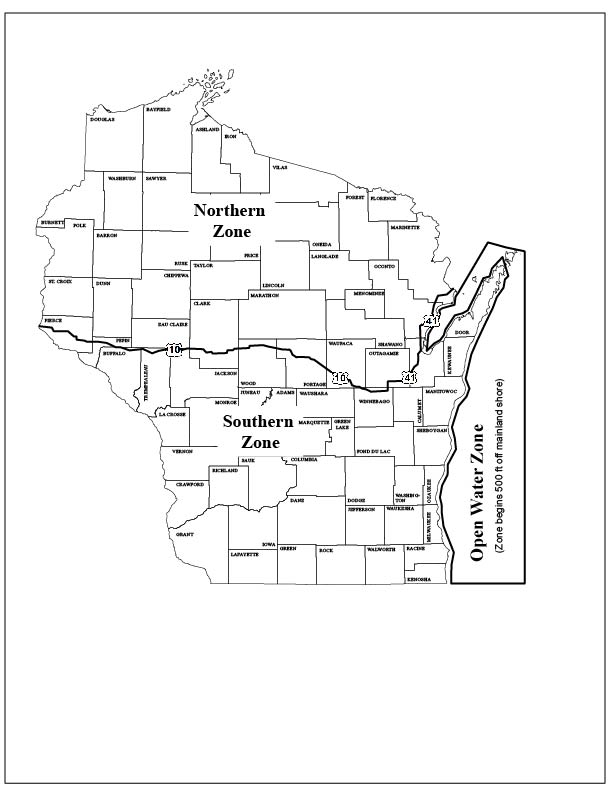
*For both the Canada goose and duck zones, the northern and southern zones are divided by U.S. Highways 10 and 41.
Registration and HIP
Waterfowl hunters are required to register for the Harvest Information Program (HIP) when they buy their license.
Registering is easy and free, and it is required by law if you intend to hunt the following species:
- Ducks and geese
- Sora and Virginia Rail
- Snipe
- Woodcock
- Mourning Dove
- Coot and Moorhen
- Mergansers
Registering doesn't necessarily mean a hunter will be selected to provide data or a sample of their harvest's wing. More information on HIP can be found at the U.S. Fish and Wildlife Service's Migratory Bird Harvest Surveys webpage.
Note: The harvest information collected is used for no other purpose than management of migratory game birds.
Open Water Restrictions
Waterbodies With Restrictions
It is illegal to hunt waterfowl in open water from or with the aid of any blind including any boat, canoe, raft, contrivance or similar device except as described below:
| Waterbody | Distance From Shore | Must Blinds Be Anchored? | Must Blinds Be Removed Daily? |
| Lake Pepin and Grant County Portions of the Mississippi River | No minimum distance | Yes | Yes |
| All Other Mississippi River Areas | Max. 100 ft. | Yes | Yes |
| Big Green Lake, Great Lakes and Green Bay | Min. 500 ft. | No | Yes |
| Other lakes* listed in the paragraph below this table | Min. 500 ft. | Yes | Yes |
*These lakes include: Beaver Dam Lake (excluding Rakes and Trestle Works bays), in Dodge County; Castle Rock Lake (south of railroad bridge and Cty. G) in Adams and Juneau counties; Fence Lake in Vilas County; Grindstone Lake in Sawyer County; Lake Puckaway (waters west of the west end of the dredge bank, excluding waters east of the west end of the dredge bank) in Marquette and Green Lake counties; Lake Winnebago in Calumet, Fond du Lac and Winnebago counties; Lake Wisconsin (north of railroad bridge) in Sauk and Columbia counties; Lake Wissota (south of Cty. S and north of Cty. X) in Chippewa County; North Twin Lake in Vilas County; Petenwell Flowage (north of State Hwy. 21 and south of State Hwy. 73) in Adams, Juneau and Wood counties; Shawano Lake in Shawano county; and Trout Lake in Vilas County.
Open Water Restrictions
- Hunters may hunt in open water with the aid of blinds if any of the following applies:
- Any part of the boat or blind is located within 3 feet of any shoreline, including islands.
- Any part of the boat or blind is located within 3 feet of a naturally occurring and unmanipulated growth of vegetation rooted to the navigable waterway’s bed or shoreline. The vegetation must conceal at least 50% of the hunter and boat or blind when viewed from at least one direction. Vegetation now includes stumps and trees.
- Hunters possessing a Class A or B Disabled Permit may hunt only far enough from emergent vegetation to maintain the minimum depth of water necessary for operation of the boat. These blinds should be removed daily at the close of shooting hours.
- Open water restrictions do not prohibit legal jump shooting activities from a non-motorized boat on narrow streams where shooting shore to shore is possible.
- You may hunt in any open water area provided you are standing on the bottom without the aid of a blind.