
Wisconsin Hunting Regulations, Fall 2026-Spring 2027
The Fall 2026-Spring 2027 Wisconsin Hunting Regulations are now available for hunters to look through. In addition to this web version of the regulations, a print copy is available at most license agent locations. Both versions contain the same information.
To use the online regulations, you must first choose a Section or click the "View All Regulations" button to see everything. You may then choose a Subsection to narrow your search and then press the View Regulation button to display the regulatory information you selected. If you'd like to see all info related to a section, select the first option ("-") to see everything under that section. You may also press Reset for a brand new search.
Please be aware that hunters are responsible for reading and following all the hunting regulations. Regulations that apply to all species are found within the "General Hunting" and "Licensing Requirements" sections, meanwhile species-specific regulations are found in the respective species sections.
Use of Dogs For Hunting
Dogs may not be used to hunt elk or deer. Dogs are legal to use for hunting small game mammals, game birds, furbearing animals, bears, migratory game birds and unprotected species. Dogs may be used for hunting wild turkeys only during the fall season.
Note: Dogs kept on a leash may be used to follow a blood trail in order to locate a wounded game animal as long as the trackers do not possess a firearm, airgun, bow or crossbow.
- Dogs may not kill any wild animal.
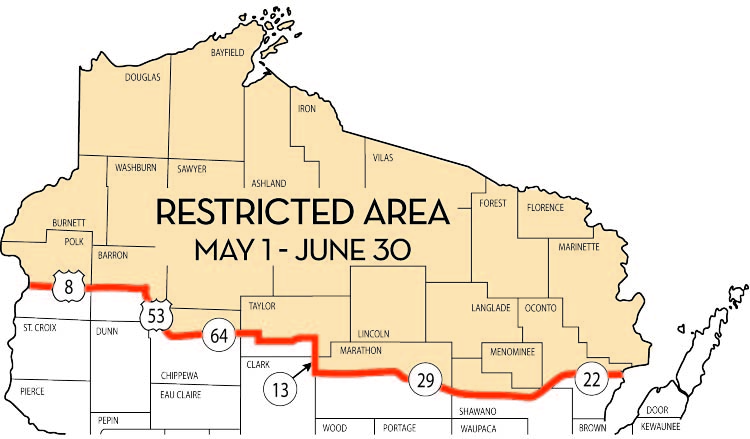
- Dogs may not hunt or pursue any free-roaming wild animal from May 1 – June 30 in the portion of the state north of the highways shown on the map below, except as authorized for raccoon and rabbit dog trials or training under the authority of a dog trial or training license.
- Dogs are considered private property and are protected by law. Only conservation wardens may kill dogs chasing deer. Owners may be held responsible for damage their dogs cause.
- A dog that is actively engaged in a legal hunting activity, including training, is not considered to be running at-large as long as the dog is monitored or supervised by a person and the dog is on land that is open to hunting or on land on which the person has obtained permission to hunt or to train a dog.
- A dog allowed to run on lands without permission is considered to be running at-large and may be taken into custody by a humane officer or law enforcement officer.
Dog Training Restrictions Area
Highly Visible Clothing
When and where a firearm deer season is in progress, it is illegal to hunt any game, except waterfowl, unless at least 50% of the hunter’s outer clothing above the waist is colored blaze orange or fluorescent pink. A hat or other head covering, if worn, must be at least 50% blaze orange or fluorescent pink. Faded or stained blaze orange or fluorescent pink clothing is unsafe and may not meet legal requirements. Although not as visible, camo-blaze is legal if 50% or more of the material is blaze orange or fluorescent pink. The DNR recommends 100% solid blaze orange or fluorescent pink.
Note: Highly visible clothing requirements do not apply to those hunters participating in legal night hunting (e.g., raccoon) from 30 minutes after sunset to 30 minutes before sunrise.
Protected Species
Hunting protected species, such as cougar, badger, jackrabbit, moose, flying squirrel and wolf, is prohibited. See Ch. NR 10.02 for details.
License Fees
All licenses, stamps and permits can be purchased on Go Wild.
Please see the individual species sections for more information on specific licensing requirements.
| Waterfowl Hunting | Resident | Nonresident |
| Small game hunting license (See small game section for junior and mentored hunting options) | $18 | $90 |
| State waterfowl stamp | $12 | $12 |
| Federal waterfowl stamp | $28.50 | $28.50 |
| Early goose permit | $3 | $3 |
| Regular goose permit | $3 | $3 |
| Turkey Hunting | Resident | Nonresident |
| Fall turkey hunting license | $15 | $65 |
| Spring turkey hunting license | $15 | $65 |
| Bonus harvest authorizations | $10 | $15 |
| Wild turkey stamp | $5.25 | $5.25 |
| Deer Hunting | Resident | Nonresident |
| Gun deer license | $24 | $200 |
| Junior gun deer license | $20 | $36 (purchase junior sports license) |
| Archery license | $24 | $200 |
| Crossbow license | $24 | $200 |
| Junior crossbow license | $20 | $77 (purchase junior conservation patron license) |
| Archery or crossbow upgrade | $3 | $3 |
| Bonus antlerless harvest authorizations | $12 | $20 |
| Mentored gun deer, archery or crossbow ($7 for 11 years old or younger, regular price for ages 12 and up) | $7 | $7 |
| Small Game and Upland Bird Hunting | Resident | Nonresident |
| Small game hunting license | $18 | $90 |
| Junior small game license ages 12–17 | $9 | $36 (purchase junior sports license) |
| Mentored small game license | $7 | $7 |
| Senior citizen small game license (65+) | $9 | N/A |
| Resident armed forces fishing/small game license | Free (Available to Wisconsin residents, active-duty armed forces stationed in or outside of Wisconsin or on furlough or leave. State stamps are included.) | N/A |
| 5-day small game license | N/A | $60 |
| Pheasant stamp | $10 | $10 |
| Mentored pheasant stamp | $4.50 | $4.50 |
| Bobcat application | $6 | $6 |
| Nonresident furbearer hunting license | N/A | $165 |
| Bear Hunting | Resident | Nonresident |
| Bear application | $4.50 | $4.50 |
| Hunting license for those drawn in limited draw | $49 | $251 |
| Elk Hunting | Resident | Nonresident |
| Elk application | $10 | N/A |
| Hunting license for those drawn in limited draw | $49 | N/A |
| Combination Licenses | Resident | Nonresident |
| Conservation patron license | $165 | $620 |
| Conservation patron junior license | $75 | $77 |
| Conservation patron Purple Heart license | $10 | $161 |
| Sports license (Sports license includes fishing, small game and gun deer hunting licenses) | $60 | $295 |
| Junior sports license (Sports license includes fishing, small game and gun deer hunting licenses) | $35 | $36 |
*See the Conservation Patron License webpage for full list of items included with a patron license
Reduced License Fees
Youth ages 11 and younger, first-time hunters and those who have not hunted in the preceding 10 years are eligible to purchase hunting licenses at a reduced fee. Resident hunters who recruit three first-time hunters, trappers or anglers are also eligible for reduced fees. For more information on license options, visit the Permits, Licenses and Registrations webpage.
Hunter Education Requirement
Persons born on or after Jan. 1, 1973, must present one of the following to purchase any hunting license:
- Their Wisconsin hunter education certificate.
- Proof of a hunter safety course recognized by the department from another state, province or country.
- A Wisconsin hunting license from a previous year that has the hunter safety number printed on it.
- Proof of successful completion of basic training in the U.S. Armed Forces, Reserves or National Guard.
If a person has not completed hunter education, that hunter may only obtain a license that requires hunting with a mentor in compliance with the Hunting Mentorship Program.
A parent or guardian who is at least 18 years of age must accompany hunters who are ages 12 to 13 and who have completed hunter education. Accompanied means within sight and voice contact without the aid of any mechanical or electronic amplifying device other than a hearing aid. Persons under the age of 12 may not hunt unless participating in a DNR Learn to Hunt event or the Hunting Mentorship Program. Persons under age 18 may not possess firearms for non-hunting purposes unless accompanied by an adult, except that persons ages 14–17 who have completed hunter education can possess legal shotguns and rifles without being accompanied by an adult.
Hunting Mentorship Program
The Hunting Mentorship Program allows hunters of any age to obtain a hunting license and hunt without first completing a hunter education course, with the following requirements:
- The hunter must: 1) hunt within arm’s reach of a mentor, regardless of age; 2) possess appropriate hunting license(s), permit(s) and tag(s); and 3) comply with all hunting laws, seasons and bag limits.
- The mentor must: 1) be at least 18 years old; 2) be a hunter education graduate, unless born before Jan. 1, 1973, or have completed basic training with the Armed Forces; 3) be the hunter’s parent or guardian or have the permission of the hunter’s parent or guardian before acting as a mentor for the hunter if the hunter is under the age of 18; 4) possess a current Wisconsin hunting license (the type of license does not matter unless attempting to harvest game); and 5) must only serve as a mentor for one mentee at a time.
Note: Mentors are exempt from the need for a hunting license if: 1) hunting on a licensed bird or deer hunting preserve; 2) hunting on land the mentor owns or occupies.
For a species for which the mentor does not require a license to hunt, both the hunter and the mentor may possess a weapon while participating in the hunting mentorship program. Adults may not hunt ducks during the youth waterfowl hunt. For more information on the Hunter Mentorship Program, visit the Mentored Hunting webpage.
Armed Forces Members
People who provide proof of successfully completing basic training in the U.S. Armed Forces, Reserves or National Guard are exempt from hunter education requirements.