
Wisconsin Hunting Regulations, Fall 2026-Spring 2027
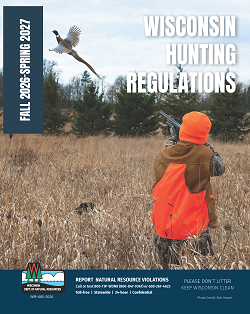
The Fall 2026-Spring 2027 Wisconsin Hunting Regulations are now available for hunters to look through. In addition to this web version of the regulations, a print copy is available at most license agent locations. Both versions contain the same information.
To use the online regulations, you must first choose a Section or click the "View All Regulations" button to see everything. You may then choose a Subsection to narrow your search and then press the View Regulation button to display the regulatory information you selected. If you'd like to see all info related to a section, select the first option ("-") to see everything under that section. You may also press Reset for a brand new search.
Please be aware that hunters are responsible for reading and following all the hunting regulations. Regulations that apply to all species are found within the "General Hunting" and "Licensing Requirements" sections, meanwhile species-specific regulations are found in the respective species sections.
Migratory Game Bird Hunting Regulations
*Be aware that the general hunting regulations also apply, in addition to the species-specific regulations below. Read the info in the General and Licensing Requirements section in the Wisconsin Hunting Regulations.
Guns and Ammunition
While pursuing migratory game birds, it is illegal to:
- Methods
- Hunt with anything other than a shotgun fired from the shoulder, bow and arrow, crossbow or by falconry.
- Other Methods
- Take migratory game birds with a trap, snare, net, rifle, pistol/handgun, swivel gun, shotgun chambered for a shell larger than 10 gauge, punt gun, battery gun, machine gun, fishhook, poison, drug, explosive or stupefying substance or possess any shot shells larger than 10 gauge.
- Shotgun Capacity
- Hunt with a shotgun capable of holding more than 3 shells (magazine and chamber combined), unless it is plugged with a one-piece filler that cannot be removed without disassembling the gun.
- Shot Type
- Possess or use any type of lead or toxic shot when hunting ducks, geese, brant, snipe, rails, coot and common gallinule.
- Possess or use any type of lead or toxic shot while hunting mourning dove on DNR-managed land.
- Note: Only non-toxic sizes BB, BBB, T, F or smaller are legal. Only non-toxic shot may be possessed or used for hunting migratory and upland game bird species, including wild turkey, on all national wildlife refuges and federal waterfowl production areas.
Structures, Boats and Vehicles
While pursuing migratory game birds, it is illegal to:
- Hunt from any pier, dam, dock, breakwater or similar artificial structure.
- Note: Class A Disabled Hunting Permit holders are exempt.
- Hunt from a sink box (a low floating device that has a depression affording the hunter, a means of concealment beneath the surface of the water).
- Hunt or shoot from any moving boat other than those propelled by paddle, oars or pole. Motorboats and sailboats must have their motors completely shut off and/or the sail furled and its progress ceased before loading or discharging a firearm.
- Establish a waterfowl blind on state property, including the bed of any navigable lake, prior to 7 days before the waterfowl season or to leave it established beyond 7 days after the close of the waterfowl season.
- Occupy or use any blind left on state property during the season unless permanently affixed with lettering 1 square inch or larger that is readily visible and legible at all times and that identifies the owner’s name, address in the English language and DNR customer ID number in the English language.
- Take migratory game birds from or with the aid or use of any vehicle (not including boats) except by that paraplegics and persons missing one or both legs may take from any stationary motor vehicle or stationary motor-driven land conveyance.
- Use in any manner any air, water or motor-driven land conveyance, including any unmanned aircraft or drones, for the purposes of concentrating, driving, rallying or stirring up any migratory game bird to put them in the range of hunters.
Devices
While pursuing migratory game birds, it is illegal to:
- Hunt with decoys that are:
- Placed beyond 200 feet from the cover in which the hunter is located.
- Placed in the water prior to 1 hour before the opening of waterfowl shooting hours.
- Left in the water more than 20 minutes after the close of waterfowl shooting hours.
- Left in the water unattended. Decoys may be left unattended on dry land.
- Living, regardless of distance from the hunter.
Note: All live, tame or captive ducks and geese shall be removed for a period of 10 consecutive days prior to hunting and confined within an enclosure that substantially reduces the audibility of their calls and that totally conceals such birds from the sight of migratory wild waterfowl.
- Hunt with or while in possession of:
- Electronic bird calls.
- Recordings or imitations of bird calls while hunting waterfowl.
General Restrictions
Daily Bag Limit
- It is illegal to take or attempt to take more than the daily bag or aggregate daily bag limit.
Possession Limit
It is illegal to:
- Possess more than 3 times the daily bag limit.
- Possess more than the daily bag limit while at or in transit between locations where the game birds were harvested and the hunter’s temporary or permanent abode.
Retrieval
It is illegal to kill or cripple any game bird without making every reasonable effort to retrieve such bird. Until every reasonable effort is made, crippled birds shall be included in the daily bag. Crippled birds should be immediately pursued to prevent loss of the bird.
Open Water Retrieval
Crippled birds that fall or move into open water should be immediately pursued. A hunter may shoot crippled birds from a boat propelled by paddle, oars or pole. A shotgun may be uncased but may not be loaded or discharged while in a boat with the motor running and until all forward motion from the motor has ceased.
Retrieval In Refuges
Dead or crippled game may be retrieved from any refuge or closed area by hand either without a firearm, with an unloaded firearm which is enclosed in a proper carrying case or with the aid of a dog unless posted to prohibit public entry.
Tagging
- It is illegal to give, put or leave any migratory game birds at any place or in the possession of another person unless the birds are tagged by the hunter with the:
- Hunter’s signature.
- Hunter’s address.
- Total number of birds involved by species and dates that the birds were killed.
- No person or business may receive or have in custody any migratory game birds belonging to another person unless such birds are properly tagged and a record of such receipt is kept by the person or business.
Possession Of Live Birds
Wounded birds reduced to possession shall be immediately killed and included in the daily bag limit.
Shipment
It is illegal to ship migratory game birds unless the package is marked on the outside with the:
- Name and address of the person sending the birds.
- Name and address of the person to whom the birds are being sent.
- Number of birds, by species, contained in the package.
Transportation
Migratory game birds may be field dressed before they are transported from the field. However, the head or one fully feathered wing must remain attached to all migratory game birds while in the field or being transported from the field to the person’s permanent abode.
Note: This includes birds being transported between a hunting cabin, camp, motel or other temporary abode to the person’s permanent abode or preservation facility.
Baiting
A baited area refers to any area on which salt, grain or other feed has been placed, exposed, deposited or scattered, if it could serve as an attractant or lure for migratory game birds to, on or over areas where hunters are attempting to take them. An area is considered baited for 10 days after complete removal of bait. While pursuing migratory game birds:
- It is illegal to hunt waterfowl, coots or mourning dove by the method or aid of baiting on or over any baited area where a person knows or reasonably should know that the area is or has been baited.
- It is legal to hunt over crops that have been planted as a result of normal agricultural planting, normal agricultural harvest or fields post-harvest.
- It is legal to hunt mourning dove over manipulated agricultural crops or wildlife food plots. Manipulation may not include the distributing or scattering of seeds, grains or other feed after the seed or grain has been harvested or removed from the field where it was grown.
For more information, visit the Baiting and Feeding Regulations webpage and scroll down to “Species Information.” For federal waterfowl and dove baiting regulations, visit the U.S. Fish and Wildlife Service website at fws.gov.
Special Hunts
Youth Waterfowl Season
- Only persons age 15 and younger may participate in the youth waterfowl hunt.
- Youth participants may harvest any lawful species of waterfowl, including geese.
- All hunters must be accompanied by an adult mentor aged 18 years or older.
- The adult mentor may not accompany more than 1 youth hunter, except that an adult may accompany 2 youth hunters if at least one of the youth hunters is age 12–15 and has completed a hunter education safety course.
- The mentor may only harvest geese during this season as long as the goose season is open and they possess a Canada Goose Permit appropriate for the season being hunted.
- Registration through the Harvest Information Program (HIP) is required.
- All license and stamp requirements are waived for eligible youth waterfowl hunters.
- All other regulations including shooting hours, blind and ammunition restrictions, daily bag limits and hunting mentorship rules will apply.
Health Advisories (PFAS PCBs)
Other Important Information
Viral Hemorrhagic Septicemia (VHS): To prevent the spread of VHS, a viral disease that affects fish, water must be drained from all boats, boat trailers and equipment immediately after exiting the water and before leaving the bank or shore of all waters statewide.
Highly Pathogenic Avian Influenza (HPAI): The virus was detected in many species of waterfowl this year. HPAI does not pose a food safety risk. However, recommendation for hunters in light of the presence of this virus are available on the DNR's Waterfowl Hunting webpage.
Bird Bands: If you obtain a bird band, visit the USGS' Banded Bird Encounter Reporting webpage to report the date and location of recovery and to receive information on your banded bird.
Importation: For information regarding the importation of migratory game birds killed in another country, hunters should consult 50 CFR 20.61 § 20.66. A copy can be obtained from the U.S. Fish and Wildlife Service by contacting 5600 American Blvd. West, Suite 990, Bloomington, MN 55437-1458, call 612-713-5320 or visit fws.gov.
Health Advisories
Contaminants such as PCBs and mercury build up in the body over time. Health problems linked to PCBs and mercury range from effects like poor balance or problems with memory, to a slight increase in your risk of a more serious disease like diabetes or cancer. Health professionals recommend limiting your exposure to PCBs and mercury in your diet as much as possible. The U.S. Food and Drug Administration standard for PCBs in poultry is 3 parts per million calculated on a fat basis.
PFAS are a group of human-made chemicals used for decades in numerous products. These contaminants have made their way into the environment in a variety of ways. These chemicals are known to accumulate in the human body, posing several risks to human health, including certain cancers, liver damage and decreased fertility.
The Wisconsin Department of Health Services has issued the following health advice to protect you from exposure to PFAS, PCBs and mercury in waterfowl taken in the following areas:
| Lower Green Bay from Longtail Point across to Point au Sable and south to the mouth of the Fox River | Mallards: Do Not Eat |
| Green Bay from the city of Marinette across to Sturgeon Bay and south to Longtail Point | Mallards: 1 meal per month Wood ducks: 1 meal per week |
| Lower Fox River from Lake Winnebago at Neenah and Menasha downstream, including Little Lake Butte des Morts, to the northeast city limits of Kaukauna | Remove all skin and visible fat prior to cooking dabbling ducks using these waters. |
| Lower Fox River from the De Pere Dam to the river’s mouth at Green Bay and lower Green Bay south of a line from Point Sauble west to the west shore of Green Bay | Consumption of dabbling ducks should be limited to 1 meal/week for children and women of child-bearing years. |
| Sheboygan River from Sheboygan Falls downstream to the river’s mouth at Lake Michigan | Remove all skin and visible fat prior to cooking Canada geese using the Sheboygan River. |
| Sheboygan Harbor | No one should eat lesser scaup (bluebills) using this water. |
| Milwaukee River from Highway 167 (Thiensville) upstream to Lime Kiln Dam at Grafton and Cedar Creek from the Milwaukee River up to Bridge Road in the Village of Cedarburg | No one should eat mallard ducks using this water. |
| Milwaukee Harbor | No one should eat black ducks, mallards, ruddy ducks or any diving ducks using this water. |
| Waters in the City of Cedarburg | No one should eat Canada geese using these waters. |
| Whitewater Lake and Rice Lake, Walworth County | Consumption of Canada geese should be limited to one meal per month. |
Upland Bird Season Dates and Bag Limits
| Species | Daily Bag | Area | Dates (except as noted) |
| Pheasant | One rooster daily on opening weekend; two roosters daily for remainder of season. | Statewide | Oct. 17 (9 a.m.)-Jan. 3, 2027 |
| Bobwhite quail | 5 | Statewide | Oct. 17 (9 a.m.)-Dec. 9 |
| Ruffed grouse | 5 | Zone A | Sept. 12-Jan. 3, 2027 |
| Ruffed grouse | 2 | Zone B | Oct. 17-Dec. 8 |
| Gray (Hungarian) partridge | 3 | Statewide (CLOSED in Clark, Marathon and Taylor counties) | Oct. 17 (9 a.m.)-Jan. 3, 2027 |
| Sharp-tailed grouse | The limit for sharp-tailed grouse is one per carcass tag issued. | Zone-specific permits | *No season in 2026 |
| Crow | 15 | Statewide | Nov. 21-March 24, 2027 |
Possession limit is equal to three times the daily bag limit.
Licensing Requirements
Licenses/Stamps/Permits
What You Need To Hunt Upland Game Birds:
- Small game license
- Pheasant stamp if hunting pheasant
- Sharp-tailed grouse permit if hunting sharp-tailed grouse