
Wisconsin Hunting Regulations, Fall 2026-Spring 2027
The Fall 2026-Spring 2027 Wisconsin Hunting Regulations are now available for hunters to look through. In addition to this web version of the regulations, a print copy is available at most license agent locations. Both versions contain the same information.
To use the online regulations, you must first choose a Section or click the "View All Regulations" button to see everything. You may then choose a Subsection to narrow your search and then press the View Regulation button to display the regulatory information you selected. If you'd like to see all info related to a section, select the first option ("-") to see everything under that section. You may also press Reset for a brand new search.
Please be aware that hunters are responsible for reading and following all the hunting regulations. Regulations that apply to all species are found within the "General Hunting" and "Licensing Requirements" sections, meanwhile species-specific regulations are found in the respective species sections.
Licensing Requirements
What You Need To Hunt Bear:
- A Class A bear license (See the Forms of Proof webpage for more information).
- A paper carcass tag.
- No license is required for a person to bait bear for hunting or training purposes, to train a dog to track or trail bear or to assist a licensed bear hunter in hunting bear by tracking or trailing bear.
Management Zones and Units
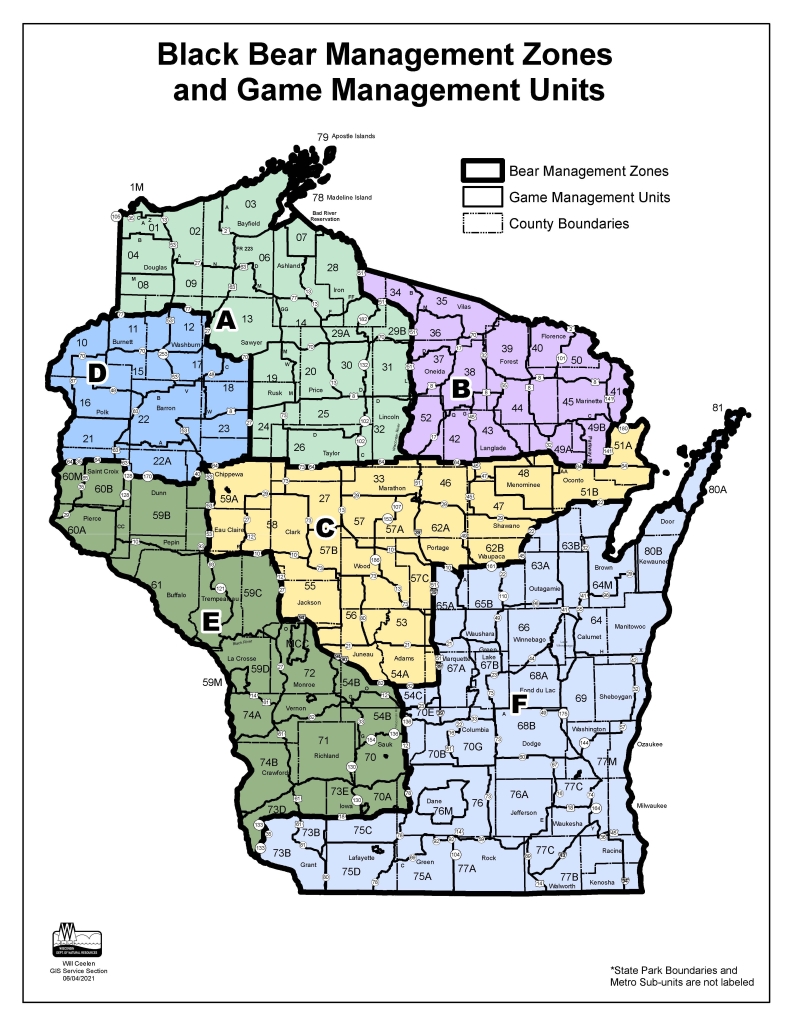
Hunters will need the zone and game management unit (GMU) when registering a harvested bear.
A downloadable version of the bear management units is also available.
Registration and Tooth Submission
Mandatory Bear Registration And Tooth Submission
There are two required steps all successful bear hunters must complete.
First, successful hunters must electronically register bears they harvest in the county of kill or in an adjoining county, by 5 p.m. the day after recovery. Register a bear in one of three ways:
- Go to gamereg.wi.gov (fastest and easiest method).
- Call 844-426-3734 (844-GAME-REG).
- Visit an in-person station. Go to the Bear Registration webpage to find a list.
Once registration is complete, the GameReg system will issue a confirmation number for the hunter’s records. Once the bear is registered, keep the carcass tag with the meat until all meat has been consumed.
Second, successful hunters are required to provide two upper pre-molar teeth by the Oct. 15 deadline.
Instructions for collection of the teeth will be mailed to hunters who draw Class A licenses. To find instructions online, visit the Bear Registration webpage.
After samples are analyzed, bear age results will be available in Go Wild.
If a hunter does not have DNR-provided materials, the hunter should write their name, customer ID number and registration confirmation number on a piece of paper and affix the teeth to it with tape. Enclose this in an envelope and mail to:
Bear Tooth
107 Sutliff Ave
Rhinelander, WI 54501
Validation and Tagging
Validation And Tagging
- The hunter is required to possess a paper carcass tag while bear hunting. Electronic copies of carcass tags are not accepted.
- Immediately upon killing a bear, validate the paper carcass tag by removing the bottom portion (the “validation stub”).
- If you leave it, tag it! You may not leave the bear carcass unless the validated carcass tag is attached to it. In other words, attach the tag with string or other fastener as soon as you plan to leave the carcass.
- Carcass tags must be kept intact and legible; consider protecting the tag inside a zip-top plastic bag.
- It is illegal to:
- Possess or transport a bear carcass unless also in possession of the validated carcass tag.
- Possess while afield a validated bear carcass tag unless that person is also in possession of the legally killed bear corresponding to it.
- Possess while hunting or afield more than one copy of a unique carcass tag.
- Possess, borrow or loan another’s license, permit or tag.
- If a backup shooter kills a bear that was shot, but not killed, by the Class A bear license holder, it is still the Class A bear license holder’s responsibility to validate that carcass tag.
Bear Hunting Regulations
*Be aware that the general hunting regulations also apply, in addition to the species-specific regulations below. Read the info in the General and Licensing Requirements section in the Wisconsin Hunting Regulations.
Field Dressing
- The hunter may divide the carcass prior to registering the bear.
- A person who divides the bear while afield:
- May not allow the bear to be stored or transported with any other bear that has been divided prior to registration.
- May not divide any bear in a manner that does not keep one part of the bear intact to allow it to be measured in a straight line from the tip of the nose to the base of the tail to determine it was an adult bear of 42 inches or greater.
Transport
While afield, it is illegal to possess or transport another hunter’s bear, even after it has been registered, unless accompanied by the person issued the carcass tag that has been attached to the bear, except that anyone may still transport another person’s registered bear on a public road or possess it at a residence, home, camp or business.
Backup Shooters
Backup shooters must adhere to the following rules:
- May only shoot if the Class A bear license holder possesses an unused bear carcass tag valid for the zone being hunted.
- May only shoot for the purpose of killing a bear that was shot but not killed by a Class A bear license holder.
- May only shoot if killing the bear is necessary to protect the safety of the members of the hunting party or others.
Dog Training And Use
Dogs may be trained by pursuing bear statewide on lands open to public hunting or on private lands with permission from July 1–Aug. 31. It is legal to train dogs in Zones A, B and D during the season when hunting bear with aid of dogs is open.
While hunting bear, or training dogs to pursue bear during the open season for hunting bear, it is illegal to:
- Train dogs to pursue bear before or after established shooting hours (except when training dogs from July 1 – Aug. 31, these hours do not apply).
- Hunt bear with dogs in Zones C, E and F.
- Hunt, train dogs or pursue bear with a dog that is not tattooed or wearing a collar displaying the owner’s name and address.
- Hunt, train dogs or pursue bear with more than 6 dogs in a single pack, regardless of the number of bear hunters or the dog’s ownership.
Note: Dogs that fall out of the chase may be replaced, but no more than 6 dogs may be used to pursue bear.
Baiting
Bait may only be used for hunting or training bear dogs if the following rules are followed:
- Bait may only be placed beginning April 15 through the last day of the bear season.
- No more than 10 gallons may be used at any bait site, including liquid scent.
- Bait must be enclosed in a hollow log, a hole in the ground or stump which is capped with unprocessed or naturally occurring materials such as logs or rocks to prevent deer from accessing the materials. This does not apply to liquid scents.
- Hunters are encouraged to minimize or avoid the use of chocolate in bait. Chocolate is toxic and can be lethal to bears and other wildlife, especially cubs.
- Bait may not contain or be contained within metal, paper, plastic, glass, processed wood or other similar processed materials, except that a processed wood bottom may be affixed to a hollow log or stump using adhesive, nails or screws for the purpose of containing bear bait or feed.
- Bait may not contain any animal parts or by-products. Animal parts or by-products include honey, bones, fish, meat, solid animal fat, animal carcasses and bacon grease but does not include liquid scents or cheese.
- Automatic, mechanical or gravity feeders designed to automatically deposit or replenish bait may not be used.
- Bait may not be placed within 50 yards of any established or maintained trail, road or campsite or within 100 yards of a roadway having a posted speed limit of 45 MPH or more.
- When the bait site is checked or re-baited, all bait that has been uncovered must again be enclosed and made inaccessible to deer.
- No person may hunt bear or train dogs over bait that is in violation of these regulations, unless the area is completely free of bait or feed material for at least 10 consecutive days prior to hunting, pursuing animals or dog training. Removal of unlawfully placed bait or feed material does not preclude the issuance of a citation for the original placement of the unlawful baiting or feeding material.
Other Restrictions
Hunters may not:
- Hunt, shoot or molest any bear in a den.
- Hunt bear in any dump or sanitary landfill.
- Kill a cub or any adult bear accompanied by a cub or cubs.
Note: An adult bear is any bear 42 inches or greater in length from the tip of the nose to the base of the tail.