
Wisconsin Hunting Regulations, Fall 2026-Spring 2027
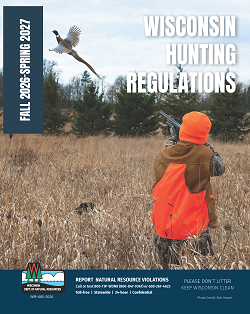
The Fall 2026-Spring 2027 Wisconsin Hunting Regulations are now available for hunters to look through. In addition to this web version of the regulations, a print copy is available at most license agent locations. Both versions contain the same information.
To use the online regulations, you must first choose a Section or click the "View All Regulations" button to see everything. You may then choose a Subsection to narrow your search and then press the View Regulation button to display the regulatory information you selected. If you'd like to see all info related to a section, select the first option ("-") to see everything under that section. You may also press Reset for a brand new search.
Please be aware that hunters are responsible for reading and following all the hunting regulations. Regulations that apply to all species are found within the "General Hunting" and "Licensing Requirements" sections, meanwhile species-specific regulations are found in the respective species sections.
Wisconsin Residency
A person must have maintained a permanent residence in Wisconsin for 30 consecutive days immediately before purchasing a license. Domiciliary intent is required. Evidence of domiciliary intent includes where the person votes, pays personal state income taxes or obtains a driver’s license or state ID. Mere presence in the state for a 30-day period and/or ownership of property is not sufficient to establish residency.
Note: Nonresidents under 18 who have a parent who is a Wisconsin resident may purchase licenses at resident prices.
Nonresident Students Attending School In Wisconsin Or Armed Forces Members
If you are a nonresident attending high school or a university in Wisconsin, a foreign citizen residing in the state and attending a Wisconsin high school or agricultural short course or you are a non-resident who is an active member of armed forces stationed in Wisconsin, please contact your nearest DNR service center for more information on licenses that may be available to you.
Permit Application Deadlines
| Species | Application Due Date | Drawing Date |
| Elk | May 31 | Early June |
| Bobcat | Aug. 1 | Mid-September |
| Sharp-tailed Grouse* | Aug. 1 | September |
| Spring Turkey | Dec. 10 | Early January |
| Bear | Dec. 10 | Early February |
*When permits are available.
To check on your drawing status, visit Go Wild.
Forms of Proof
The following are considered forms of licenses, state stamps, permits and harvest authorizations:
- A paper copy
- An authenticated Wisconsin driver’s license
- A DNR-issued Go Wild Conservation Card
- A digital PDF file issued by the department and displayed on an electronic device
For more information about acceptable forms of proof including example pictures, visit the Conservation Card webpage.
Note: Photo images of paper licenses on a cell phone do not serve as a valid proof of license. It is illegal to use or carry another hunter’s license, tags, permits or harvest authorizations while engaged in hunting.
Transfers of Approvals/Preference Points
A person who has been awarded certain hunting approvals may transfer the approvals in certain circumstances. The table below outlines what types of approvals are eligible to be transferred and the circumstances in which each may be transferred.
| Type of Approvals | To A Minor | To Persons With Disabilities* | To Active Duty/Purple Heart | Upon Death To A Minor |
| Bear License | Yes | Yes | Yes | Yes |
| Spring Turkey License | Yes | Yes | No | Yes |
| Sharp-tailed Grouse Permit** | Yes | Yes | No | Yes |
| Elk License | Yes | Yes | No | Yes |
| Preference Points | No | No | No | Yes |
*Persons with disabilities must hold a valid Class A, B C or D disability permit.
**When permits are issued.
Approvals not listed in this table are not eligible for transfer. For more information on these types of transfers, including eligibility requirements and deadlines, visit the Permit Transfer webpage.
Landowner Exceptions
- A landowner is required to have a license to hunt deer, bear, turkey, game birds, migratory game birds and bobcats. The owner or occupant of any land and members of their family may, without a license and subject to all other restrictions except seasons, hunt or trap on their own property for beaver, fox, coyote, raccoon, woodchuck, rabbit and squirrel year-round, and unprotected species causing damage or a nuisance, and may sell the skins of these species.
- Family members who do not live with the owner or occupant of the land may also hunt or trap certain species without a license on this land only if they are siblings or children of the owner or occupant and are under the age of 18.
- Mentorship rules apply to youth ages 11 and under.
- Grackles, red-winged blackbirds and cowbirds are protected species and may not be hunted for recreational purposes. They may be killed on private lands without a hunting license or federal permit only if they are causing damage or are about to cause damage to trees, crops, livestock or wildlife, or if they are concentrated in large numbers that may constitute a health hazard or other nuisance. Crows may also be killed without a federal permit and outside the normal crow season in these situations. Non-toxic shot is required when shooting crows outside the normal season and when shooting grackles, red-winged blackbirds and cowbirds which are causing damage or a nuisance. For more information, visit the Nuisance Wildlife webpage.