
Forest Products
Forestry
The forest products industry is a cornerstone of Wisconsin’s economy and a leading sector within the state’s manufacturing landscape. It accounts for over 11% of all manufacturing jobs in Wisconsin. Nationally, Wisconsin ranks among one of the top ten states in forestry employment and in production value, highlighting both the industry’s role in job creation and the substantial economic of its forest-based products.
The annual value of goods produced by Wisconsin’s forest industry in 2023 exceeds $27 billion, representing approximately 3.2% of the state’s gross domestic product. The sector directly employs around 56,000 people. When accounting for indirect and induced effects, such as inter-industry transactions and household spending, the industry supports an additional 68,500 jobs and generates another $14.4 billion in output. Over 124,500 jobs and $41.4 billion in economic activity are linked to Wisconsin’s forest products industry.
Forest Products Studies
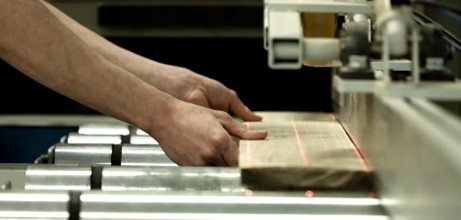
Value-Added Wood Manufacturing Industry
Value-added wood manufacturing transforms primary wood products, such as lumber or veneer, into higher value products including flooring, cabinetry and furniture. This is a crucial sector of the state’s forest economy, supporting over 21,000 jobs and about $5.0 billion in production in 2023. Wisconsin’s value-added wood industry was surveyed in 2018 to understand economic impacts, markets and needs of this industry.
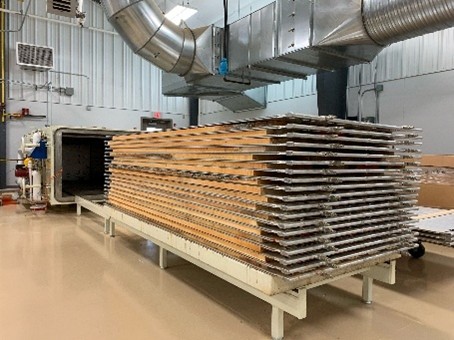
Comparing Vacuum and Conventional Drying Effects on Coloration of Hard Maple Lumber
Properly drying lumber is a crucial step in ensuring its utility for wood products. This study found that vacuum kiln-drying, using low temperature in a low oxygen environment, produces light-colored hard maple in a significantly shorter drying time, and with less variability, than does conventional steam kiln-drying.
Comparing Vacuum and Conventional Drying Effects on Coloration of Hard Maple Lumber
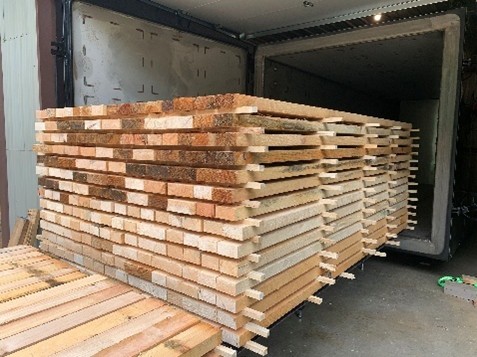
Understanding Vacuum Drying Technologies for Commercial Lumber
Vacuum drying offers a faster, potentially more energy-efficient alternative to conventional steam kilns for drying lumber. This study details the process, equipment, benefits and challenges of vacuum drying, especially its suitability for high-value or hard-to-dry wood species. Results of the study are helping manufacturers evaluate whether vacuum drying aligns with their operational goals and highlight the need for standard practices in the industry.
Understanding Vacuum Drying Technologies for Commercial Lumber
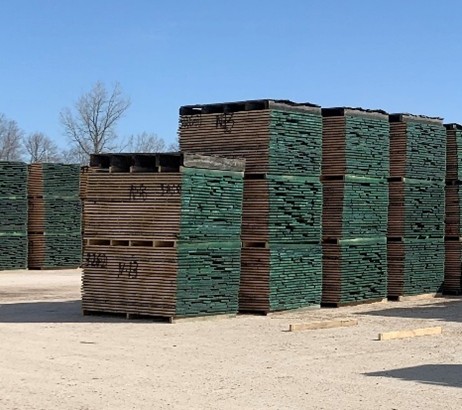
Effects of End Coatings on Defects During Air-Drying of Lumber
For over 100 years, the sawmill industry has applied end coatings to logs and lumber to reduce drying defects. Lumber dries from the surface toward the center of a board. Because of this, surface cells lose moisture and shrink sooner than interior cells, resulting in drying stresses which may produce surface or end checks. This study explores how different end coatings affect the development of drying defects in lumber, particularly end checks and splits during air-drying. Insights gleaned from this study guide small-scale lumber producers in choosing effective and practical end coatings to reduce drying-related losses.
Effects of End Coatings on Defects During Air-Drying of Lumber
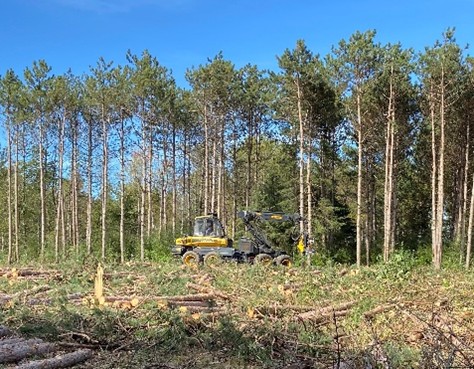
Forestry and the Wisconsin Economy
The economic impact of Wisconsin’s forest products industry is substantial. One of the state’s leading manufacturing sectors, its effects are transferred to other sectors of the economy during interindustry transactions and household spending. For every 10 jobs in the forest products industry, an additional 12 jobs were created in other sectors of the economy. In 2023, it was the number one employer in seven counties: Florence, Marathon, Price, Rusk, Taylor, Trempealeau and Winnebago.
Paper manufacturing alone contributes $1.9 billion to Wisconsin’s GDP, followed by paperboard container manufacturing ($1.1B), sanitary product manufacturing ($1.1B) and paper bag and treated paper manufacturing ($840M). Over $3.3 billion in tax revenue is generated for the state.