
Wisconsin Trapping Regulations, Fall 2026-Spring 2027
The Fall 2026-Spring 2027 Wisconsin Trapping Regulations are now available for trappers to look through. In addition to this web version of the regulations, a print copy is available at most license agent locations. Both versions contain the same information.
To use the online regulations, you must first choose a Section or click the "View All Regulations" button to see everything. You may then choose a Subsection to narrow your search and then press the View Regulation button to display the regulatory information you selected. If you'd like to see all info related to a section, select the first option ("-") to see everything under that section. You may also press Reset for a brand new search.
Please be aware that trappers are responsible for reading and following all the hunting regulations. Please read all sections in their entirety, as some of the information to trap a specific species may fall within multiple sections.
Raccoon
Season Dates
The following season dates are valid statewide:
Resident Raccoon: Oct. 17, 2026 – Feb. 15, 2027
Nonresident Raccoon: Oct. 31, 2026 – Feb. 15, 2027
Bag Limits
No bag limit statewide.
Note: During the closed season for raccoon, licensed trappers may retain for salvage any raccoons taken incidentally while trapping for beaver in the portions of the state open for beaver trapping. See rules listed under “trap size and placement restrictions” on the DNR's Body Grip Trap webpage.
Mississippi River Zone
Federal Lands: On federal lands within the Mississippi River Zone, the raccoon season opens when the muskrat and mink seasons open.
Application and License Requirements
What you need to trap a raccoon:
- A current and valid trapping authorization in required unless exempt under landowner provisions. See the Landowner Provisions section of the DNR's License and Permit webpage for more information.
Fox (Red and Grey)
Season Dates
The following season dates are valid statewide:
Red and Gray Fox: Oct. 17, 2026 – Feb. 15, 2027
Bag Limits
No bag limit statewide.
Mississippi River Zone
Federal Lands: On federal lands within the Mississippi River Zone, the fox season opens when the muskrat and mink seasons open.
Application and License Requirements
What you need to trap a red or gray fox:
- A current and valid trapping authorization in required unless exempt under landowner provisions. See the Landowner Provisions section of the DNR's License and Permit webpage for more information.
Fisher and Otter
Season Dates
Fisher
- All Zones: Oct. 17, 2026 – Jan. 3, 2027
Otter
- North Zone: Nov. 7, 2026 – April 30, 2027
- South Zone: Nov. 7, 2026 – March 31, 2027
Federal Lands: On federal lands within the Mississippi River Zone, the otter season does not open until the muskrat and mink seasons open. Federal rules do not allow trapping on federal refuge lands after March 15.
Zone Map
Bobcat, fisher and otter use the same management zone map. Check out the Management Zone Map for Bobcat, Fisher and Otter. There are two zones for these species, a northern zone (north of highway 64) and a southern zone (south of highway 64).
Note: If the annual harvest quota for bobcat, fisher or river otter is reached before the respective season end date, the season may close early. It is the hunter or trapper’s responsibility to determine the status of a bobcat, fisher or river otter season prior to attempting to hunt or trap in a particular zone. Call the hotline at 855-299-9653 for harvest number updates. Information on early season closures or trapping in general can be found on DNR's Trapping webpage.
Bag Limits
Fisher
Special zones only by permit(s).
Season Limit: one fisher per harvest authorization.
Otter
One otter per harvest authorization. Harvest authorizations are valid statewide.
Application and License Requirements
Fisher
What you need to trap a fisher:
- Fisher application
- A current and valid trapping authorization
- A valid, unused fisher harvest authorization
Otter
What you need to trap an otter:
- A current and valid trapping authorization
- A valid, unused otter harvest authorization
Registration
Fisher
Harvested fisher must be registered via GameReg by 5 p.m. the day following recovery. Register online at gamereg.wi.gov (fastest and easiest method) or by phone at 844-426-3734 (844-GAME-REG). Be prepared to indicate which game management unit (pages 14-15) the animal was harvested in. Following registration of a fisher via GameReg, all registration requirements are complete.
Sample Collection
The department will collect the lower jaw from a subset of harvested fisher. Those trappers randomly selected to provide a jaw sample will be contacted via mail and provided a sample kit prior to the season.
Otter
- Harvested river otter must be registered via GameReg by 5 p.m. the day following recovery. Register online at gamereg.wi.gov (fastest and easiest method) or by phone at 844-426-3734 (844-GAME-REG). Be prepared to indicate which game management unit (pages 14-15) the animal was harvested in.
- Following successful registration of river otter via GameReg, a CITES tag will be sent to the trapper’s address listed in Go Wild. Upon receiving the CITES tag in the mail, the trapper must immediately affix the CITES tag to the head portion of the otter pelt to certify that the animal was harvested legally. After the CITES tag has been attached, all registration and certification requirements are complete.
Bobcat
Season Dates
Period 1: Oct. 17 – Dec. 25, 2026
Period 2: Dec. 26, 2026 – Jan. 31, 2027
Zone Map
Bobcat, fisher and otter use the same management zone map. Check out the Management Zone Map for Bobcat, Fisher and Otter. There are two zones for these species, a northern zone (north of highway 64) and a southern zone (south of highway 64).
Note: If the annual harvest quota for bobcat is reached before the respective season end date, the season may close early. It is the hunter or trapper’s responsibility to determine the status of a bobcat, fisher or river otter season prior to attempting to hunt or trap in a particular zone. Call the hotline at 855-299-9653 for harvest number updates. Information on early season closures or trapping in general can be found on the DNR's Trapping webpage.
Bag Limits
Hunting and trapping are only allowed by permit. One bobcat per permit. Individuals must carry hard copies of department-issued bobcat permits while trapping or hunting.
Application And License Requirements
What you need to trap a bobcat:
- Bobcat application
- A current and valid trapping authorization
- A valid, unused physical bobcat harvest permit
- Only holders of a regular license, youth license or youth under 16 with a supervisor may be issued a Bobcat permit and tag.
Registration
- You may not possess or have under control any bobcat carcass unless you immediately validate, attach and seal your pelt tag through the opening of the animal’s mouth to the opening of its eye, immediately beneath the skin. See instructions on the pelt tag for further details. The pelt and DNR registration tags shall remain attached to the pelt until removed by a fur dresser or taxidermist at time of preparation.
- Harvested bobcat must be registered via GameReg by 5 p.m. the day following recovery. Register online at gamereg.wi.gov (fastest and easiest method) or by phone at 844-426-3734 (844-GAME-REG). Be prepared to indicate which game management unit (pages 14-15) the animal was harvested in.
- In addition, harvested bobcat must be presented to a warden or other approved DNR staff within seven days after the month of harvest to have the pelt certified.
- Before presenting a bobcat pelt to a warden or other approved DNR staff, you must skin the animal and separate the pelt from the carcass. Be sure it is thawed out on the day of certification so that a certification tag can be attached. This does not need to be completed before certification for specimens going to a taxidermist, but you must retrieve the carcass from the taxidermist and deliver it to the DNR within 30 days of registration.
- Note: These animals must still be registered and certified prior to taxidermy. To certify your harvest, contact a conservation warden or other authorized DNR personnel. Visit the DNR's Register A Harvest webpage or call 888-936-7463. A bobcat must have a CITES tag sealed to the pelt prior to being transferred to a taxidermist.
- You may not possess a bobcat pelt longer than seven days after the month of harvest without certifying the pelt with an authorized DNR representative.
- This year, the department will collect a section of the lower jaw from all bobcat harvested during time period 2. The remainder of the carcass can be used for personal use or properly discarded. The lower jaw must be removed and placed in a plastic baggie, along with the jaw tag, prior to certification. Specific instructions for cutting the lower jaw and preparing the sample for submission have been mailed to all bobcat trappers and hunters who drew a time period 2 permit. If a full bobcat skull is submitted, it will not be returned by the DNR.
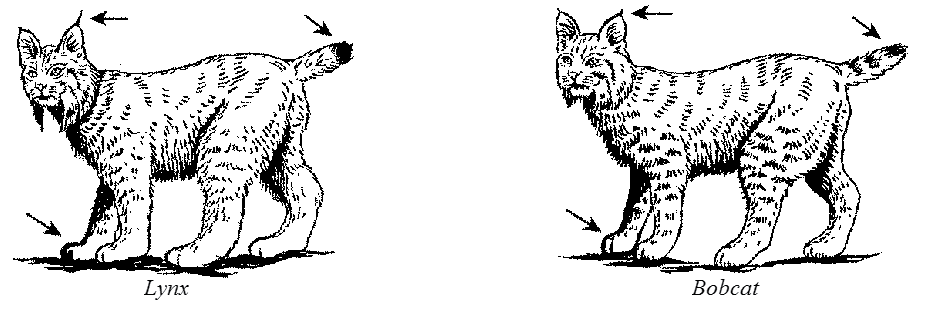
Canada lynx, a rare visitor to Wisconsin, are listed as a threatened species by the U.S. Fish and Wildlife Service. Please help us protect this unique animal through your careful observation. See illustrations below. If you observe a Canada lynx, report it immediately on the DNR's Wildlife Observation app or by contacting the DNR call center at 888-936-7463.
Lynx are distinguished from bobcat primarily by the tips of their tails, which are completely black. Only the upper half of the tail tip is black on the bobcat. Lynx also have larger ear tufts, are lighter in coloration, have large, densely furred feet and have less distinct tracks than bobcat.
Mink and Muskrat
Season Dates
Northern Zone: Oct. 24, 2026 – April 15, 2027
Central Zone: Oct. 31, 2026 – March 22, 2027
Southern Zone: Nov. 7, 2026 – March 15, 2027
Mississippi River Zone:* Nov. 9, 2026 – March 7, 2027
Note: During the closed season for muskrats, licensed trappers may retain for salvage any muskrats taken incidentally while trapping for beaver in the portions of the state open to beaver trapping. See rules listed under “trap size and placement restrictions” on the DNR's Body Grip Traps webpage.
*Permits are required and special regulations apply. See the DNR's Land Type-Specific Regulations webpage.
Zone Map
Check out the Map of Mink and Muskrat Management Zones. The northern zone is north of highway 64, while the southern zone is south of highways 60, 14, 12 19 and 94 (from left to right). The central zone comprises the area between the northern and southern zones, except for the area occupied by the Mississippi River Zone (west of the Chippewa River and Burlington Northern Santa Fe Railroad).
Bag Limits
No bag limit statewide.
Application And License Requirements
What you need to trap mink and muskrat:
- A current and valid trapping authorization is required unless exempt under landowner provisions. See the DNR's License and Permit's webpage for more information. Mink are not included in landowner provisions.