
Wisconsin Trapping Regulations, Fall 2026-Spring 2027
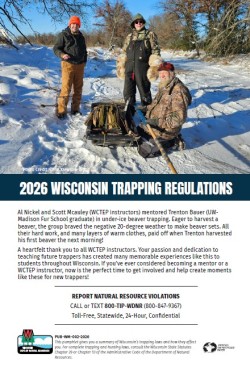
The Fall 2026-Spring 2027 Wisconsin Trapping Regulations are now available for trappers to look through. In addition to this web version of the regulations, a print copy is available at most license agent locations. Both versions contain the same information.
To use the online regulations, you must first choose a Section or click the "View All Regulations" button to see everything. You may then choose a Subsection to narrow your search and then press the View Regulation button to display the regulatory information you selected. If you'd like to see all info related to a section, select the first option ("-") to see everything under that section. You may also press Reset for a brand new search.
Please be aware that trappers are responsible for reading and following all the hunting regulations. Please read all sections in their entirety, as some of the information to trap a specific species may fall within multiple sections.
Possession Restrictions
You may not:
- Possess the green pelts of any bobcat or otter beginning longer than seven days after the month of harvest unless the pelt has a valid certification tag attached
- Possess any mink, muskrat, fisher or otter pelt that has been shot or speared
- Possess any raw fisher, mink, muskrat or otter pelt at any time without a current trapping or fur dealer’s license or other appropriate special license or permit issued by the DNR
- Ship fur unless the outside of the container is marked with the number and type of species being shipped and the name, address and trapping license number of the shipper
- Transfer to another, give, trade, sell or purchase a raw pelt or unskinned carcass of any bobcat or otter without a certification tag being attached and locked to the head portion of the pelt
- Purchase any raw fur without a fur dealer’s license. However, you may obtain written authorization from the DNR to purchase raw fur without the need to purchase a license if only for the purpose of making garments for yourself or a member of your family
License and Permits
License and Permit Information
Note: Reduced rates are available for first-time license buyers. Visit the DNR's Permits webpage for more information.
General Trapping Authorizations
| Resident | Nonresident | |
| Trapping License* | $20 | $150 |
| Youth Trapping License (Under 16)** | Free | Free |
| Mentored Trapping License*** | $10 | $10 |
*A certificate of successful completion of the Wisconsin trapper education course may be used by a resident in place of a trapping license for the trapping license year in which the certificate is issued.
**A youth trapper is required to work with a licensed supervisor trapper
*** Requires license and mentor trapper
Additional Applications To Trap Certain Species
The deadline to apply for an upcoming season is Aug. 1.
| Species | Patron License Holders | Trapping License Holders |
| Bobcat | $6 | $6 |
| Fisher | Included in license cost* | $3 |
*Conservation Patron license holders still need to register their application choices.
Combination Licenses
Trapping licenses for the 2026-27 license year expire on March 31, 2027.
| Resident | Nonresident | |
| Conservation Patron License* | $165 | $620 |
| Conservation Patron Junior License* | $75 | $77 |
| Conservation Patron Purple Heart License* | $10 | $161 |
*A Conservation Patron license includes a trapping license and a fisher application, among a variety of other hunting and fishing approvals. It does not include a bobcat application.
Acceptable Forms Of Proof
Any of the following are considered valid forms of proof:
- Conservation card
- Valid Wisconsin driver’s license
- A DNR-generated PDF file displayed on an electronic device or the physical hard copy license
Trappers must carry hard copies of DNR-issued bobcat permits while trapping.
Reprints And Duplicates
- Reprints of licenses can be obtained free of charge by visiting a DNR service center and through Go Wild. License agents also provide reprints for a $2 processing fee.
- Permit duplicates must be reprinted through the DNR by calling 608-228-0765.
You May Not:
- Transfer your license, permit, harvest authorization or tag or allow its use by anyone else except as provided in the Special Regulations: Bobcat and Fisher section (below)
- Carry any trapping license, permit, harvest authorization or tag issued to anyone else
Trapper Ed Requirements
- All trappers must obtain a trapping license with the exception of trappers younger than 16 years of age working with a supervising trapper. A minimum age of 10 years is recommended for successful completion of a trapper education program.
- All trappers must complete the Wisconsin trapper education course prior to purchasing a license unless trapping under youth-supervised or mentored trapping program rules (see below) or under one of the following statutory exemptions:
- Persons who purchased a Wisconsin trapping license on or before May 12, 1992
- Persons who are actively engaged in farming in Wisconsin as defined by State Statute 102.04(3) and who are current Wisconsin residents
Landowner Provisions
The owner or occupant of any land and any family members* who live with them do not need a license to:
- Trap coyote, beaver, fox, muskrat, raccoon, woodchuck, rabbit and squirrel on the land year-round.
- Live trap with cage or box traps for beaver, coyote, fox, woodchuck, rabbit, raccoon and squirrel on their land at any time in cities, villages or other areas where the discharge of firearms is unlawful. Live-trapped animals must either be humanely killed or be released on unenclosed private land with the landowner’s permission within 24 hours.
Note: Live-trapped animals cannot be released on DNR-owned and managed lands.
*Family members who do not live with the owner or occupant of the land but who are siblings and/or children of the owner and are under the age of 18 may also hunt or trap these species on that property without a license.
Youth-Supervised Trapping
Youth under age 16 may trap without a license under the supervision of a licensed trapper, even if the youth has not completed trapper education.
Note: Youth who are trapping under supervision may apply for, purchase and use bobcat and fisher trapping permits. Youths trapping without a license will need to add the otter harvest authorizations in Go Wild in order to pursue this species since they aren’t purchasing a license. All traps used must be tagged with supervisor’s information.
Alternatively, youths under age 16 who wish to trap alone must complete trapper education, purchase a trapping license and tag their traps with metal tags as described on the DNR's Methods webpage.
Mentored Trapping Program
Youth under age 16 do not need a license to trap with a mentor. See the Youth Supervised Trapping section (above).
Anyone age 16 years and older who wishes to trap in Wisconsin and who has not completed trapper education must possess a valid mentored trapping license and trap with a mentor, unless exempt from the trapping license requirement.
A mentee may only receive two mentored trapping licenses per lifetime. Each trapping license is valid for one trapping season.
A mentee may not trap a fisher or bobcat under a mentored trapping license. A mentee may apply for bobcat or fisher preference points while holding a mentored trapping license. However, if the mentee applies for the drawing for one of these species and is awarded a permit, the mentee must complete trapper education and purchase a regular trapping license before they may trap under the authority of the awarded permit. A mentee may assist the mentor in trapping a fisher. A mentee holding a mentored trapping license may still apply for and receive a bobcat harvest tag if hunting bobcat, in which case a small game hunting license must also be purchased.
If using the same traps, both the mentor and mentee must tag the traps with a metal tag stamped with the name/address or customer ID. This does not apply if the mentee is under age 16.
If the mentee alone tags the traps, then the mentee and mentor may operate the traps only when both mentor and mentee are present.
The mentor must be 18 years of age or older and be the parent/guardian of the mentee or authorized by the parent/guardian of the mentee if the mentee is under 18. The mentor must remain in visual and verbal contact with the mentee and must hold a current valid trapping license or be exempt from this requirement.
The mentor can take more than one person trapping provided the mentor can safely and adequately serve as mentor for all mentees.
Animals Causing Damage
During the closed season, a DNR permit may be required to remove nuisance animals. Visit the DNR's Nuisance, Urban and Damaging Wildlife webpage, DNR publication WM-007 Beaver Damage Control Guidelines or contact the DNR call center at 888-936-7463 for more information.
Special Regulations: Bobcat and Fisher
Permit Applications and Preference Points: Permit applications can be submitted at Go Wild or at DNR service centers or license agents. Trappers can submit their application choices for bobcat and fisher at the same time they pay the application fee for each species.
Applicants have the option of applying for a preference point only or may enter into the drawing for a permit(s). If an applicant makes the choice to be entered into the drawing and is selected for a permit, the applicant will lose all preference points, even if the permit is not used.
Applicants who fail to apply for either a preference point or a permit at least once during any three consecutive years will lose all previously accumulated preference points.
Note: Conservation Patron license holders who did not submit application choices for fisher with the purchase of a license must apply online or at a DNR service center.
Applicants who apply for a bobcat permit must choose a zone and period of preference.
Transfer of Bobcat or Fisher Permits: A person who has been awarded a bobcat permit or fisher harvest authorization may apply to transfer that permit or authorization to a youth under the age of 18 or a person holding a valid Class A, B, C or D disabled permit no later than 15 days before the open season. The person receiving the permit will retain their accumulated preference points. A youth or disabled permit holder may only be the recipient of each type of transferred permit once. Please visit the DNR's Awarded Permit Transfers webpage for more information and to download a permit transfer application (Form 9400-607).
Special Regulations: Assisting Trappers With Disabilities
A person that holds a current class A, B, C or D hunting permit may be accompanied by and receive assistance from a person who possesses a valid trapping authorization. This includes assisting with trap setting, trap checking, tagging and registration of these species if the disabled person has been issued the appropriate approval to do so. The accompanying person shall comply with all trapping rules and laws.
Game Management Units
When reporting a bobcat, fisher or otter harvest, trappers and hunters will be asked to determine the game management unit (GMU) of harvest.
To improve readability, the map was divided into two halves (northern and southern). Check out the respective map for specific boundaries and a description of each GMU.
Beaver
Season Dates
Zones A and B: Nov. 7, 2026 – April 30, 2027
Zone C: Nov. 7, 2026 – March 31, 2027
Zone D: Dec. 7, 2026 – March 15, 2027
Zone Map
View the map of the Beaver Management Zones. Zone A falls in the northwestern part of the state and is bound by highways 64 and 13. Zone B comprises the northeastern part of the state and is also bound by the same highways. Zone C occupies most of the remaining state, except for Zone D, which falls between the Chippewa River/Burlington Northern Santa Fe Railroad and the Western boarder of Wisconsin.
*Be aware that the Horicon National Wildlife Refuge and Horicon Marsh State Wildlife Area require special permits to trap in. There are also special regulations that apply. Find more on the Horicon Marsh Wildlife Area webpage.
Bag Limits
No bag limit statewide.
Application And License Requirements
What you need to trap beaver:
- A current and valid trapping authorization in required unless exempt under landowner provisions. See the Landowner Provisions section of the DNR's License and Permit webpage for more information.
Coyote
Season Dates
The following season dates are valid statewide:
Coyote: Oct. 17, 2026 – Feb. 15, 2027
Bag Limits
No bag limit statewide.
Mississippi River Zone
Federal Lands: On federal lands within the Mississippi River Zone, the coyote season opens when the muskrat and mink seasons open.
Application and License Requirements
What you need to trap a coyote:
- A current and valid trapping authorization in required unless exempt under landowner provisions. See the Landowner Provisions section of the DNR's License and Permit webpage for more information.