
Wisconsin Trapping Regulations, Fall 2026-Spring 2027
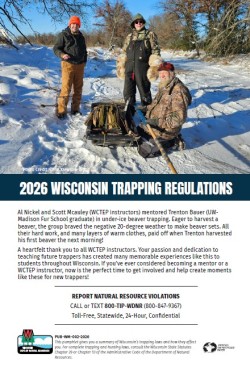
The Fall 2026-Spring 2027 Wisconsin Trapping Regulations are now available for trappers to look through. In addition to this web version of the regulations, a print copy is available at most license agent locations. Both versions contain the same information.
To use the online regulations, you must first choose a Section or click the "View All Regulations" button to see everything. You may then choose a Subsection to narrow your search and then press the View Regulation button to display the regulatory information you selected. If you'd like to see all info related to a section, select the first option ("-") to see everything under that section. You may also press Reset for a brand new search.
Please be aware that trappers are responsible for reading and following all the hunting regulations. Please read all sections in their entirety, as some of the information to trap a specific species may fall within multiple sections.
Land Type-Specific Regulations
Trapping Along Roadsides
Most roadsides are owned either by the state or by the local unit of government. However, in some cases, the adjoining landowner still maintains ownership of the underlying land. Trappers must have permission from the owner of the land underlying any public road, street or highway right-of-way area before trapping the location. The Wisconsin Department of Transportation has a policy that trapping is not allowed on DOT-owned roads. Some DOT retention ponds may be open to trapping. Contact DOT for details.
Trapping Navigable Waterways
Trapping on private land in Wisconsin, including on the beds of navigable waters, may constitute a trespass (enforced by the county sheriff’s department). Trappers need to obtain permission before trapping on any private land, even if entry is by public waterways and the trap is placed or staked in the water.
Trapping On DNR-Owned And -Managed Lands
No person may destroy, molest, deface, remove or attempt to remove any natural growth or natural or archaeological feature except that edible fruits, edible nuts, wild mushrooms, wild asparagus and watercress may be removed by hand without a permit only for the purpose of personal consumption by the collector.
Generally, it is not permissible to cut willow stems. However, you may cut willow stems with a diameter of 2 ½ inches or smaller from species that are not endangered or threatened if you intend to use them for personal, noncommercial use, such as for trap stakes.
Trapping On Managed Forest Law And Forest Crop Law Lands
With permission of the landowner/property manager, trapping is allowed on lands enrolled under the Forest Crop Law program and lands designated as “open” under the Managed Forest Law program.
Trapping In State Parks
Trapping is allowed in all Wisconsin State Park System properties except: Copper Culture, Cross Plains, Governor Nelson, Heritage Hill, Lakeshore and Lost Dauphin state parks, Hank Aaron State Trail, Fischer Creek State Recreation Area, Havenwoods State Forest and Lapham Peak and Pike Lake units of the Kettle Moraine State Forest. A state park sticker or pass is required for all vehicles in any state park. Trappers may enter a state park or state trail property up to one hour prior to sunrise and remain on the property until 11 p.m.
Trapping in state parks is only allowed for species when their season is open and only during either of the following time periods: Nov. 15 – Dec. 15, 2026 and April 1 – May 5, 2027.
You may not:
- Use traps that are not placed completely under water unless the traps are enclosed trigger trap
- Place or check traps past 11 p.m., remain on the property past 11 p.m. or enter the property prior to an hour before sunrise for the purpose of trapping
- Note: Trappers who are registered campers staying in a designated campsite are not required to leave the campgrounds but may not use other areas of the park after 11 p.m.
- Set, place or check traps located within 100 yards of designated trails or designated use areas, such as picnic areas, campgrounds and beaches, or in any area in the park closed to trapping indicated on that park’s trapping area map.
- Trap during the closed season for any species
For more information on regulations specific to state parks and maps of areas open to trapping within individual parks, visit the DNR's Hunting and Trapping In Wisconsin State Parks webpage.
Trapping On Federal Lands
- Horicon National Wildlife Refuge and Horicon Marsh State Wildlife Area: Trapping at these locations is authorized on a permit system only and special regulations apply. Permit details are available on the U.S. Fish and Wildlife Service's Horicon National Wildlife Refuge webpage.
- Upper Mississippi River National Wildlife and Fish Refuge: Special trapping permits are required. For more information, contact: Upper Mississippi River National Wildlife and Fish Refuge Headquarters, 51 E. 4th Street, Winona, MN 55987.
- Apostle Islands National Lakeshore: Access permits are required for the Apostle Islands National Lakeshore. For information, write Park Superintendent, 415 Washington Avenue, Bayfield, WI 54814.
- Trempealeau National Wildlife Refuge: Trapping is authorized on a permit system only and special regulations apply. For more information, call 608-539-2311 ext. 16, visit the FWS' Trempealeau National Wildlife Refuge webpage or write Trempealeau National Wildlife Refuge, W28488 Refuge Road, Trempealeau, WI 54661.
- Necedah National Wildlife Refuge: Trapping is authorized on a permit system only and special regulations apply. For more information, call 608-565-2551 or write Necedah National Wildlife Refuge, N11385 Headquarters Road, Necedah, WI 54660.
- St. Croix National Scenic Riverway: Trapping is restricted in the St. Croix National Scenic Riverway. For more information, visit the U.S. National Park Service's Trapping At St. Croix National Scenic Riverway webpage. The National Park Service has specific regulations on these sites to inform the public of special federal regulations already in place.
- Fort McCoy: Fort McCoy conducts its own trapping seasons, independent of the DNR’s seasons. Anyone interested in trapping on Fort McCoy must have the appropriate Fort McCoy permit/harvest authorization and applicable state of Wisconsin trapping approvals. To purchase Fort McCoy approvals, register game harvested on Fort McCoy or for season dates and regulation information, visit the Fort McCoy Natural Resources iSportsman System.
Marten Restoration Areas
Marten Restoration Areas Open To Forms Of Dryland Trapping
In the areas indicated in gray in the Pine River Marten Restoration Area and Clam Lake Marten Restoration Area, cable restraints, cage or box-type traps, weasel boxes with an opening 1 ⅜ inches or less and footholds with a pan tension device of 4 pounds or greater may be used on dryland for species that have an open season. No other traps on dryland are legal within the gray highlighted areas of the Pine River and Clam Lake marten restoration areas.
In the areas indicated in gray on the map of the Apostle Islands Marten Restoration Area, cable restraints and cage or box-type traps may be used on dryland for species that have an open season. No other traps on dryland are legal within the gray highlighted areas of the Apostle Islands marten restoration areas.
Please Contact The DNR About Incidental Take
The scientific use of these carcasses improves our understanding of these species, and the use and/or sale of salvaged pelts improves our trapper education program.
If incidental catch of a protected species occurs, please contact your local conservation warden or call 800-TIP-WDNR (800-847-9367) as soon as possible for instructions on how to release an animal or, if dead, how to transport it to the DNR. A protected species is any species for which the season is closed, for which there is no open season or for which a person has no possession authority.
Note: American marten are a rare and a state-endangered species. Please call 800-847-9367 to report their restraint and release or incidental take as soon as possible. If you catch a marten in a cage trap, please call 608-592-7025 so DNR staff can potentially obtain scientific information about that animal. If you intend to trap near a known marten population, please review the marten brochure. Visit the DNR's Trapper Education webpage and find “Avoid incidental marten” under “Supplemental Materials.”
Best Management Practices
Best Management Practices
Trappers and state wildlife agencies continue to develop best management practices (BMPs) for trapping in the United States. Trapping BMPs are documents that identify techniques and traps that address the welfare of trapped animals and allow for the efficient, selective, safe and practical capture of furbearers. BMPs are methods to improve trapping by developing recommendations using sound science. They are developed through actual field tests and careful data collection. The information is provided to state agencies and trappers for voluntary use in their trapper education and furbearer management programs.
Why Are BMPs Needed?
BMPs are needed to:
- Ensure the continued responsible management of wildlife resources.
- Continue the process of improving traps and trapping methods to maintain and improve animal welfare.
- Maintain public acceptance of trapping through a reduction in real and perceived problems associated with trapping.
- Sustain regulated trapping now and in the future and to maintain the integrity of furbearer management programs throughout the United States.
Regulated trapping will only prosper and continue if the trapping community and natural resource agencies work together to improve harvest systems and promote the humane treatment of animals. Thanks for your support!
For additional information on BMPs, please visit the Association of Fish & Wildlife Agencies' Furbearer Management webpage.
Trapper Education Course
Wisconsin Cooperative Trapper Education Program
Visit the DNR's Trapper Education webpage for information on the Cooperative Trapper Education Program of the Wisconsin Department of Natural Resources and Wisconsin Trappers Association.
Why Trapper Education?
We believe that trappers create a good image when they engage in responsible and ethical pursuit of our furbearing resource. Trapper education teaches new or inexperienced trappers ethical trapping procedures, the most humane trapping methods, the history of trapping in Wisconsin and North America and basic wildlife management principles. It is also important for trappers to learn and understand the importance of maintaining good relationships with landowners, other outdoor enthusiasts and managers of our natural resources. The Wisconsin trapper education course provides a solid beginning to trapping education, an education you will use every day on the trapline.
Trapper Education Coordinators
Trapper Education Coordinators
WCTEP Statewide Coordinator
Jim Binder
E8126 Church Rd.
New London, WI 54961
920-250-2515
wctep1@gmail.com
DNR Statewide Coordinator
Erinn Kiesow-Webb
473 Griffith Ave,
Wisconsin Rapids, WI 54494
608-228-0765
Erinn.KiesowWebb@wisconsin.gov
WCTEP Correspondence and Online Course Coordinator
Mike Widner 108 Mary St.
Boscobel, WI 53805
608-356-3621
trappereducation@yahoo.com
Please Note: Many trapper education instructors and coordinators are volunteers and their availability varies. Please be patient when contacting them or trying to enroll in trapper education courses.
Wisconsin Cooperative Trapper Education Districts
*Check out the map of the Trapper Ed Districts, as well as the descriptions of each district.
District 1
Jacob Hart
11552 Crosstown Rd
Grantsburg, WI 54840
715-663-0519
Jakehart84@gmail.com
District 2
Ed Dubuque
7602 CTY X
Chippewa Falls, WI 54729
715-559-6539
trappered39@gmail.com
District 3*
Casey Rustan
D3trappered@gmail.com
District 4
Shawn Bazile
N11950 CTY E
Tigerton, WI 54486
715-535-2794
fattrapper67@gmail.com
District 5
Junior Prudlick
P.O. Box 505
Strum, WI 54770
715-695-3675
prudlickdj@triwest.net
District 6
Al Nickel
2663 Green Grove Lane
Nekoosa, WI 54457
715-570-8718
afivecents@yahoo.com
District 7
Dennis Halbach
N9202 CTY W
Malone, WI 53049
920-375-0781
Gary Alexander
N5419 HWY 22
Montello, WI 53949
608-369-2010
District 8
Daniel Cichantck
2917 S 19th St
Manitowoc, WI 54220
920-901-9449
trapperdanc@yahoo.com
District 9
Dennis Knuth
217 Clark St
Reedsburg, WI 53959
608-524-2255
Demak1072@gmail.com
District 10
Larry Meyer
11921 E Pioneer Rd
Whitewater, WI 53190
262-903-0798
larrypmeyer@msn.com
District 11
Scott Schoenike
1621 Drexel Blvd.
South Milwaukee, WI 53172
414-704-1596
sschoenike@wi.rr.com