Fall Hunting Forecasts
Deer Fall Forecast
New for 2026
The antlerless-only holiday hunt will run from Dec. 24 to Jan. 1, 2027, in 48 counties this year. Of these 48 counties, 42 are also extending the archery and crossbow seasons to close Jan. 31, 2027. Some farmland zone counties have modified the number of antlerless harvest authorizations that will be issued with each license. Two permits issued with each license are most common, which is consistent with past years. However, 19 Citizen Deer Advisory Councils (CDACs) chose three permits, four CDACs chose four permits and one CDAC chose five permits in 2026. The remaining farmland zone CDACs chose one permit to be issued with each license. Some metro subunits also have modified permit availability. View a map showing the number of permits for each county.
The Gun Deer Hunt for Hunters with Disabilities will be held statewide on the same weekend as the Youth Deer Hunt (Oct. 10-11, 2026). During these two days, eligible hunters may hunt statewide on public land or a property they have permission for, without the need to have the land enrolled in the program. The other seven days of the hunt (Oct. 3-9, 2026) will still need to be done on a property that is sponsored and enrolled in the program.
Be aware that baiting and feeding regulations have changed in select counties. Visit the DNR’s Baiting and Feeding webpage for the most up-to-date info on baiting and feeding bans in your county.
Season Reminders
Deer Management Zones and Units
Wisconsin has four deer management zones: the Northern Forest, Central Forest, Central Farmland and Southern Farmland. These zones are divided into 92 DMUs, and some of the boundaries changed in 2025. DMUs follow county boundaries in all zones except the Northern Forest Zone. Fourteen counties are split by zone boundaries into separate Forest and Farmland DMUs. Antlerless deer permits are set at the DMU level. Check out the 2025 DMU map for the current boundaries.
Bonus Antlerless Harvest Authorization
Bonus antlerless permits go on sale Aug. 17 and can be purchased at a rate of one per person per day. Bonus harvest authorizations will be sold by zone, according to the following schedule:
- Monday, Aug. 17 at 10 a.m. – Northern Forest and Central Forest Zones
- Tuesday, Aug. 18 at 10 a.m. – Central Farmland Zone
- Wednesday, Aug. 19 at 10 a.m. – Southern Farmland Zone
- Thursday, Aug. 20 at 10 a.m. – All remaining tags may be purchased until sold out or the deer hunting season ends.
Citizen Deer Advisory Councils (CDACs)
CDACs were formed in 2014 to increase public involvement in deer season decision-making. Representatives from local hunting or conservation clubs, forestry, agriculture, tourism and local government interests make up each council and are led by Wisconsin Conservation Congress delegates. A team of three liaisons from the DNR’s wildlife, forestry and law enforcement programs attend CDAC meetings to present data from past seasons and offer professional perspectives. Council members directly participate in reviewing and recommending population objectives, antlerless harvest quotas and permit levels. Members also provide recommendations on various season structure options, including opting to implement the Dec. 24 to Jan. 1 antlerless-only holiday hunt and extending the archery and crossbow seasons through Jan. 31.
For information regarding Citizen Deer Advisory Councils, visit the DNR’s CDAC webpage.
2026 Season Dates
| Season | Dates |
| Archery and Crossbow | Sept. 12 to Jan. 3, 2027 |
| Extended Archery and Crossbow** | Jan. 4-31, 2027 |
| Youth Firearm | Oct. 10-11 |
| Gun Hunt for Hunters with Disabilities* | Oct. 3-11 |
| Nine-Day Gun Deer | Nov. 21-29 |
| Muzzleloader | Nov. 30 to Dec. 9 |
| Four-Day Antlerless Hunt | Dec. 10-13 |
| Antlerless-Only Holiday Hunt** | Dec. 24 to Jan. 1, 2027 |
*On sponsored properties only Oct. 3-9, 2026. Statewide Oct. 10-11, 2026
**In select DMUs only
Public Land Opportunities
Excellent public land deer hunting opportunities are available throughout the state. Lands open to public hunting come in all shapes, sizes, habitat types and deer densities. Familiarize yourself with property boundaries and key features prior to the season and consider connecting with adjacent private landowners to make any necessary mid-season contacts easier.
The DNR provides a public land online mapping tool to help hunters find land to hunt.
Go Wild Licensing System
Through Go Wild, hunters can purchase their deer hunting license, select their antlerless harvest authorization(s), submit CWD sampling information, check CWD testing results and print all their license and permit documents for free from the comfort of home. For those looking to make an in-person purchase, there are still more than 700 license agents available to hunters. To find a license agent, visit the DNR’s License Agent webpage.
As proof of license, hunters may present a paper copy of their license printed from Go Wild, their DNR-authenticated Wisconsin driver’s license, a DNR-issued Conservation Card or a DNR-approved PDF of the license displayed on a mobile device.
Deer Harvest Authorizations
Since September 2017, hunters are not required to validate or physically tag a harvested deer. However, hunters must carry proof of their harvest authorizations.
Forms of proof include an original paper harvest authorization, a reprint, a Go Wild Conservation Card, a DNR-authenticated Wisconsin driver’s license or a DNR-approved digital file displayed on an electronic device. Hunters can continue to use paper copies that they have printed themselves and should keep in mind that they will need to use their unique harvest authorization number to register deer. A hunter may only hold a single copy of any individual harvest authorization when afield.
To replace a paper harvest authorization, the easiest option is to log into your Go Wild account and reprint it from home for free.
GameReg - Electronic Harvest Registration
Successful deer hunters must register their deer either online or by phone. They have the additional option of registering electronically at a participating walk-in registration station. For a list of participating businesses offering walk-in registration, the DNR website offers a database of participating businesses.
To register a deer electronically, hunters should visit GameReg or call 1-844-426-3734 (1-844-GAME-REG). To start, the electronic registration system will prompt hunters to enter the unique deer harvest authorization number for the harvest authorization filled, as well as their date of birth. Then, harvest information, such as the DMU in which the deer was harvested, age (adult or fawn), sex (buck or doe) of the deer and weapon type used to harvest the animal, will be collected. Once hunters have provided this information, they will receive a unique 10-character confirmation number. All deer harvested during any deer season must be registered by 5 p.m. the day after harvest. For more information, visit the DNR’s Electronic Registration webpage.
Chronic Wasting Disease
Chronic wasting disease (CWD) is a contagious neurological disease of deer, elk, moose and reindeer (caribou) caused by a misshapen form of a protein called a prion. CWD can be spread through direct animal-to-animal contact or through the environment, which has been contaminated with bodily fluids or infected tissue from decomposed carcass parts. CWD prions can persist in the environment for an extended period of time, exposing deer to the disease and making containment a constant challenge.
The DNR’s Southwest Wisconsin CWD, Deer and Predator Study is one of the largest and most comprehensive studies on CWD in Wisconsin. Main takeaways from the results released in 2025 include that CWD substantially reduces adult deer survival rates and that, where CWD prevalence is high, deer populations are likely declining.
However, opportunities remain to slow the spread and growth of CWD. Continuing to harvest deer, using synthetic scents, refraining from baiting and feeding and proper deer carcass waste disposal are just a few of the many ways hunters can help.
Visit the DNR’s Reducing The Spread of CWD webpage for more information packet for more information.
CWD testing Across Wisconsin
In 2026, the DNR will continue prioritizing its sampling effort in select areas of the state around wild and farm-raised positive detections in central and northern Wisconsin. Sampling locations will also be available statewide for hunter- requested tests.
Exact sampling locations will be available on the DNR’s CWD Sampling webpage prior to the 2026 archery and crossbow seasons. Hunters can use an online form in Go Wild to enter data required for a CWD sample, but the sample still needs to be brought to a CWD sampling location.
CWD test results will be sent via email and are also available by visiting the DNR website or Go Wild. CWD surveillance efforts will be impacted by budgetary constraints this year, which could slightly increase the result turnaround time.
Volunteer Opportunities
Individuals and organizations can volunteer to sponsor a self-service kiosk or deer carcass waste dumpster through the DNR’s Adopt-a-Kiosk and Adopt-a-Dumpster programs. A cost-sharing option is offered by the DNR to offset the expense of sponsoring a dumpster. Find more information on how to get involved on the DNR’s CWD Volunteer Opportunities webpage.
The DNR is also partnering with individuals and organizations to provide convenient deer donation drop-off locations through the Deer Donation Partners Program. Partners will collect and transport donated deer to participating processors. Once processed, partners may return the ground venison to their local food pantries. More information on this new program is available on the DNR’s Deer Donation Program webpage.
Baiting And Feeding
The DNR is required to prohibit the baiting and feeding of deer on a county-by-county basis in accordance with state statute.
Please check the DNR’s Baiting and Feeding webpage for updates, as baiting and feeding bans may be enacted or extended during the 2026 deer season or beyond.
District Forecasts:
Northeast District
Steve Burns, DNR Wildlife Biologist
Steven.Burns@wisconsin.gov
Many deer hunters throughout the Northeast District are rightfully optimistic about the upcoming 2026 deer hunting season. For the third year in a row, the district experienced a mild winter, setting the stage for high winter survival and reproductive rates. Last year, six counties in our district had the highest buck harvest since 1980. However, only one county’s antlerless harvest ranked in the top 10 over that same period. This reflects an abundant huntable population but less willingness to harvest antlerless deer.
Across the Central Farmland Zone, 2025 harvest was above the five-year average and higher than any single year in the last five for antlered and antlerless deer. Agricultural crop planting is ahead of the 5-year average as of late May. Soybean planting has surged this year with approximately 500,000 more acres planted in 2026 than 2025. With a large deer herd on the landscape, 2026 deer harvest success will again be primarily impacted by fall crop harvest timing, weather conditions and hunter effort.
Habitat across the Northeast District is diverse, ranging from northern hardwood forest in Marinette and Oconto counties to flatter, agriculturally dominated areas of Winnebago, Fond du Lac and Calumet counties. The central part of the district provides a combination of fertile farmland, bottomland hardwood forest and upland forest, which provides ideal white-tailed deer habitat. Habitat in southern and eastern counties, including the more developed areas, is fragmented by development and land ownership. This can make hunting access difficult. However, these areas do hold high numbers of deer. Private landowners who do not hunt or those who have already harvested deer may choose to allow deer hunting on their property to increase local harvest. The diverse habitat found across the district means deer are not equally distributed on the landscape. Deer population density can vary from section to section, property to property. For this reason, scouting and preseason preparations are integral to hunting success.
Landowners interested in improving their property for deer and other wildlife are encouraged to check out the Deer Management Assistance Program. Again, this year, portions of Marinette and Oconto Counties are part of the numbered Northern Forest Zone deer management units, while the rest of the counties in the Northeast District remain in the Central Farmland Zone. Bonus antlerless authorizations will be available for purchase in Marinette and Oconto numbered forest units, while free farmland authorizations are available in Farmland units throughout the rest of the district. Bonus antlerless harvest authorizations are also available in farmland units that offer free farmland authorizations. Hunters who choose to pursue antlerless harvest authorizations in multiple counties can take advantage of bonus authorizations to expand their hunting opportunities.
The Calumet CDAC has opted against a December holiday hunt and extended archery season. The Waupaca CDAC has opted for the holiday hunt but not an extended archery season. All of the remaining CDACs for Farmland Units within the Northeast District have opted to hold the holiday hunt and extended archery season. As always, it is important to check regulations prior to the start of the hunting season. In many areas throughout the Northeast District, deer numbers are the highest they have ever been. Impacts to agricultural crops, forest regeneration and urban nuisance issues are on the rise. Impacts to future forest structure and habitat is compounded when damage from over-browsing occurs year after year. Most CDACs in the Northeast District, in response to public feedback, have established a harvest objective to either maintain or decrease the size of the deer herd.
West-Central District
Darren Ladwig, DNR Wildlife Biologist
Darren.Ladwig@wisconsin.gov
The landscape of west-central Wisconsin offers some of the most productive white-tailed deer range in the United States. Last winter was rather mild throughout the West-Central District, with only a few days of deep snow or below-zero temperatures. The March 15 blizzard that resulted in ~2 inches of snow was melted within a week, which was fortunate, as that time of year, wildlife are exceptionally vulnerable to winter mortality. This was the 12th consecutive “mild winter” according to the Winter Severity Index. Spring arrived with cooler temperatures and above average rainfall in early April. Temperatures eventually warmed up in May as well as being the 4th driest May on record. As of late June, crop conditions are trending ahead of 2025 for most major crops, with soil moisture still adequate. The annual acorn survey conducted at Sandhill Wildlife Area last fall indicated an excellent mast year for white oak, while the red oak group had virtually no acorn production. When scouting in mid-August, hunters should be looking in the canopies to ascertain the extent of mast crop in their specific location.
The western border of the district is mostly within the Driftless Area of Wisconsin, characterized by steep oak and hickory dominated ridges with flatter ridgetops and valleys that have agricultural crops. This area is known for excellent antler growth, with some of the highest numbers of Boone & Crockett and Pope & Young entries in the country every year. While most of the Driftless Area is private land, there are public lands scattered throughout that provide quality hunting opportunities.
The district also has extensive public land opportunities within the Central Forest Zone counties. Deer populations are not as high as in the western or eastern parts of the district, but hunters can still find quality hunting opportunities with proper scouting. Hunting pressure has been on a steady decline in the Central Forest Zone in the recent past. For those looking for a remote hunting experience with ample solitude and elbow room, this is the area for you.
Several significant modifications to Central Forest Zone boundaries have been implemented in recent seasons and are worth mentioning again. All of Adams County has now been placed in the Central Farmland Zone. In Wood County, the Forest Zone boundary has moved south to State Highway 54 and the Wisconsin River (same as Turkey Zone 1 boundary). In Juneau County, the Forest Zone boundary has moved north to State Highway 21. Lastly, in Monroe County, a section of the Forest Zone boundary has moved north to State Highway 21. Please review the updated Deer Management Unit map in the Fall 2026 Hunting Regulations.
Of special note in Jackson and surrounding counties, hunters are reminded that elk have been reintroduced and are established in the region. As elk numbers continue to increase, it is important for hunters to know the difference between white-tails and elk. If you are not sure, don’t shoot.
The eastern side of the district also has an abundance of deer. The mix of agriculture and woodlots provides good deer habitat, with great opportunities for hunters to fill antlerless permits and harvest a nice buck as well.
All counties in the West-Central District have had CWD-positive deer detected either within or close to their boundaries and are classified as “CWD affected.” Hunters should consult the deer regulations to comply with baiting and feeding regulations in the county where they are hunting. CWD testing is available throughout the district; hunters can find testing locations and more information about CWD at the DNR’s CWD webpage.
On behalf of the wildlife staff for the West-Central District, I hope you all have a safe and memorable hunting season this year!
Southern District
Jason Cotter, DNR Wildlife Biologist
Jason.Cotter@wisconsin.gov
The 2025 deer harvest fell slightly short of the 5-year average for most of the deer season in the Southern District but ended up surpassing it in the last 40 days, showcasing an increased hunter effort during the late season. Most counties had stellar buck harvests, with some counties, like Rock, Jefferson, Walworth and Waukesha, experiencing all-time high buck harvests.
Even with increased overall harvest, deer herd abundance is getting a step ahead of the recommended harvest goals every year. For most counties, this is due to relatively mild winters and early springs in recent years where these environmental conditions are providing an opportunity for the herd to stay above the curve.
The Southern District includes 18 counties that span from the eastern glacial kettles and moraines to the western driftless area’s ridges and coulees. Prime agricultural lands, wetlands, grasslands and woodlots intertwine throughout this vast landscape creating a high level of variation in habitat types.
There are ample opportunities for hunters with excellent opportunities, whether on private or public land. Even though private property comprises over 90% of this landscape, public lands tend to have the most variability in habitat types that deer thrive in. However, keep in mind that deer populations are very localized given the habitat mosaic across the area, and some hunters may not see this increase as readily as others.
Another important aspect for deer hunters to keep in mind is that CWD continues to slowly increase in prevalence and geographic area within the Southern District. In 2025, there were over 1,500 deer that tested positive for CWD in these 18 counties (an increase of roughly 100 in comparison to 2024).
County Deer Advisory Councils (CDACs) have recommended similar quotas and antlerless deer harvest authorizations, in addition to extra hunting seasons, in response to public feedback and the stable to increasing deer population trend. Please check the DNR's Deer Hunting webpage for more details and maps illustrating which counties are offering additional seasons; these additional seasons are a great way to enjoy family time afield during the holidays and to put extra meat in the freezer.
The 2026 deer season will be here before we know it and will be welcomed by deer hunters all over the nation. On behalf of the DNR, we’d like to wish everyone a safe and successful hunting season! We hope you take time this fall to get outdoors and enjoy the beauty and world-class hunting opportunities that Wisconsin has to offer.
Northern District
Derek Johnson, DNR Wildlife Biologist
DerekJ.Johnson@wisconsin.gov
Northern Wisconsin draws deer hunters to its depths like a magnet. The scale of the forests, wetlands and grasslands provides an escape from civilization and a step back into time. The southern portions of the state may have more deer on average, but the Northwoods still produces many deer and lots of opportunity to pursue them. Progress has changed the makeup of the landscape, but more acres of forests are managed with a wildlife focus than ever. Technology has changed how hunters pursue game, but the underlying motivations are still similar to those from decades past.
This past season was successful in many respects. The revised deer management units in the Northern Forest Zone led to more directed harvest to areas with higher deer populations and away from those experiencing lower productivity. The units are still new to many folks, so brush up on the unit boundaries and spread the word to your hunting friends to do the same. As always, reach out to your local wildlife biologist or conservation warden if you have questions about which unit you’re hunting in.
The deer herd going into the fall looks to be strong and healthy. A mild to moderate winter in most areas has over-winter survival and fawn production high. Early reports are pointing to high fawn-to-doe ratios in much of the north. There were some early ice storms and snowfall, especially in the snow belt of northern Ashland, Iron and Vilas counties. That led to some tough conditions but will have a delayed positive impact on deer in those areas. Lots of food and cover was brought down low for deer to utilize for years to come.
It may make it tougher on hunter access, so be sure to scout your hunting areas early to see if some clearing is needed. Timber markets are still tough in most of the Northwoods, but sustainable harvest is still churning. Look for recent cuts and nearby wooded edge corridors to find those deer before they get to open areas. With ample food sources, deer will rarely show themselves in the open during shooting hours.
I wish you and your hunting family a safe and exciting fall, filled with lots of time enjoying the Northwoods with family, friends and fellow hunters.
Bear Fall Forecast
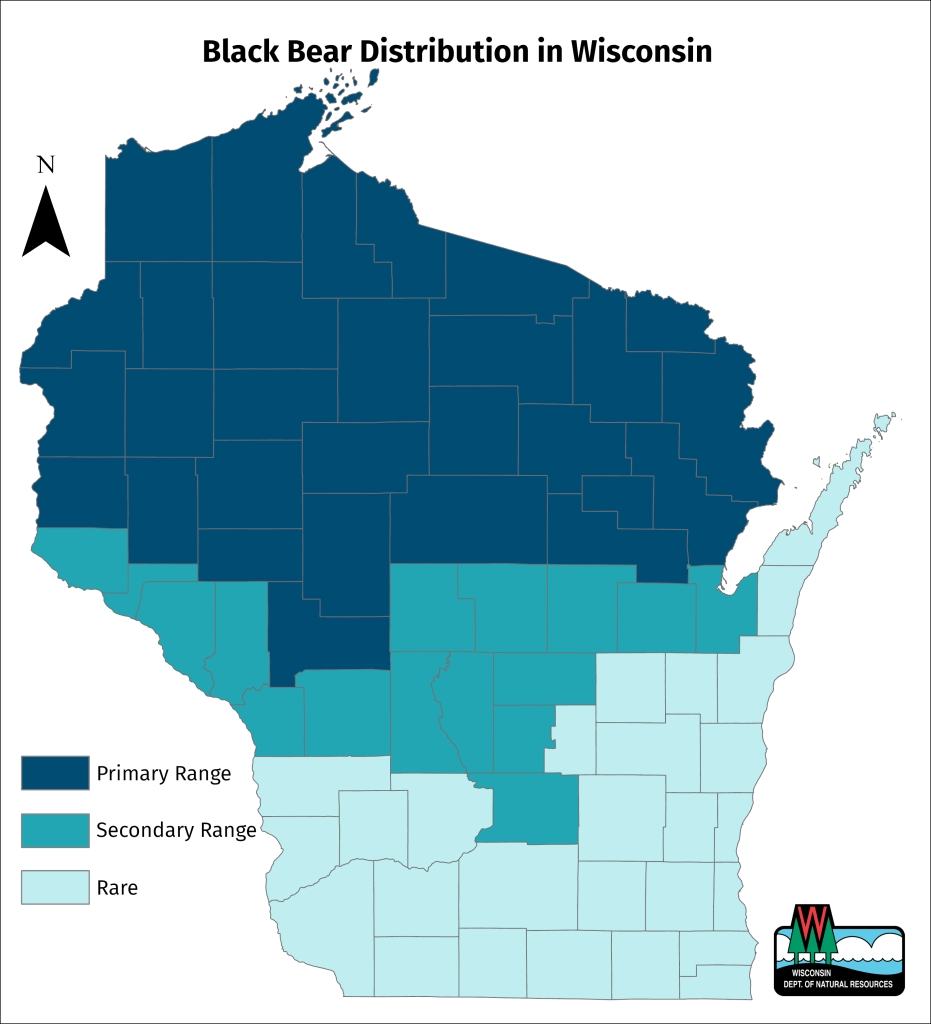
Wisconsin is home to one of the largest populations of black bears in the country, currently estimated to be around 24,000 strong and sharing the land with people across two-thirds of the state. Wisconsin’s bear population also continues to expand southward, with bear sightings becoming more frequent across southern Wisconsin. Careful and regulated public harvest of bears is the primary tool used to help keep bear numbers in balance with available habitat across the state. More focused strategies are used to address local issues, such as nuisance complaints and agricultural damage. This science-based management program has allowed Wisconsin’s bear population to thrive, provides quality bear hunting opportunities and helps address conflicts between humans and bears.
Bear hunting provides a unique and exciting outdoor experience with family and friends. Hunting also plays a critical role in black bear research. The samples hunters provide from each harvested bear provide critical data used to monitor and ensure the health of Wisconsin’s bear population into the future. Anyone wishing to hunt bear must apply for one of a limited number of bear licenses distributed each year through a lottery system.
Interest in bear hunting continues to increase both here in Wisconsin and across much of North America. This year, over 34,000 people applied for one of the 15,245 bear licenses available. Nearly 106,000 more people opted to purchase a preference point to improve their chances to draw a license in a future lottery. With over 140,000 people applying for a license or purchasing a preference point this year, demand for licenses remains strong, resulting in hunters in Zones A and B waiting over 10 years before receiving a license to hunt bear in those areas.
Bear Hunting Forecast
The 15,245 licenses awarded for the upcoming bear season represent the most bear licenses ever issued in Wisconsin since the modern license lottery system was established in 1986. Most of the increase in license issuance is in the southern portions of bear range (bear management zones C, E and F), where hunter success rates remain relatively low and bear populations are growing. This license increase is intended to modestly increase harvest and allow abundant hunting opportunity. The DNR will also continue to survey bear hunters and collect data on hunter experiences and satisfaction to monitor whether hunter crowding issues may develop. Fortunately, bear hunter surveys in recent years consistently indicate hunter crowding is an infrequent issue for most hunters. Across the state, about 80% of bear hunters report little to no issue with competition or interference from other bear hunters.
Bear populations and hunting opportunities remain abundant across the forested areas of northern Wisconsin as well. Top bear producing counties in recent years include Marinette, Sawyer, Rusk, Price, Washburn and Bayfield. Bear hunter surveys reveal a majority of hunters rate their overall bear hunting experience as ‘average quality’ or higher; this is especially true for hunters in Zones A and B, where three out of four hunters rate the season at average or above. Similarly, the majority of bear hunters across zones A, B, C and D report seeing a bear while actively hunting, whereas about one in three hunters report seeing a bear while actively hunting in zones E and F.
A significant driver of bear hunting success is how much natural food is available on the landscape in a given year. When natural food sources such as berries and acorns are abundant, bears key in on these food sources, and hunter baits tend to become less attractive. Similarly, hunters in areas with agricultural crops, like corn, often must compete with these broadly available food sources. These scenarios can result in a drop in hunter success rates. Natural food availability varies every year and depends upon numerous factors, including local weather conditions experienced during the spring and summer. Nevertheless, while hunting bears is far from easy, those who are diligent in their scouting and preparation efforts should have a quality chance at success this fall.
Setting Wisconsin's Bear Hunting Seasons
The state’s Black Bear Management Plan guides the development of each year’s bear harvest quotas. We consider scientific bear population data as well as regional data on bear nuisance complaints, agricultural damage, hunter satisfaction, hunter crowding, hunter success rates and bear health data. Using regional data helps us set population objectives by management zone, including whether to increase, maintain or decrease the bear population in each zone, and then determine harvest quotas to meet those population objectives. From there, we determine the number of licenses based on the quota and average hunter success rates. All bears taken must be registered with the DNR so important data can be collected.
Wisconsin state law allows bear hunters to use four hunting techniques to pursue bear depending upon location in the state and time of the season. These include stalking and hunting bear without the aid of bait or dogs, using bait as an attractant, hunting with the aid of dogs and the use of bait and dogs. On average, about one in three bear hunters successfully harvest a bear in Wisconsin. In Zones A and B, which cover much of the northern forest, success rates have traditionally been higher, with an average of two in three bear hunters harvesting a bear in recent years.
Hunters who wish to apply for the fall 2027 bear hunting season or for a preference point toward future seasons have until Dec. 10, 2026, to do so. Applications can be made at any authorized license agent, DNR service center or online through Go Wild. Hunters can review the latest bear license lottery results to assist in making their plans.
Black Bear Season Dates
| Zone | Dates |
| Zones A, B and D | Sept. 9-15
Sept. 16-Oct. 6
Oct. 7-13
|
| Zones C, E and F | Sept. 9-Oct. 13
|
Damage Program Offers Private Land Access For Bear Hunters
Bear license holders may hunt on private land enrolled in Wisconsin’s Wildlife Damage Program with landowner permission. Through the program, hunters get access to private hunting grounds, and producers get relief from lost agricultural crops due to bears.
For more information on the program requirements or to find private land open to public access, visit the DNR’s Damage Permit Hunting Access webpage. We update the page frequently as additional agriculture producers enroll in the program, so be sure to check back often.
2026 Black Bear Season Drawing Summary
| Zone | 2026 Harvest Target | 2026 Licenses Awarded | 2026 Population Objective | Number of Applications | Minimum Preference Points Needed |
| A | 1,100 | 1,675 | Maintain | 11,648 | 11 |
| B | 850 | 1,545 | Maintain | 5,071 | 11 |
| C | 875 | 4,465 | Maintain | 7,605 | 2 |
| D | 1,100 | 3,855 | Decrease | 6,847 | 2 |
| E | 185 | 2,805 | Maintain | 2,628 | 1 |
| F | 50 | 900 | Allow Local Control | 764 | 1 |
| Total | 4,160 | 15,245 | 34,563 |
2025 Black Bear Harvest Summary
Here's a reminder of how the 2025 black bear season went:
| Zones | 2025 Harvest Target | Licenses Awarded | Total Harvest |
| A | 1,075 | 1,680 | 1,161 |
| B | 900 | 1,610 | 841 |
| C | 750 | 3,750 | 661 |
| D | 1,100 | 3,570 | 906 |
| E | 200 | 2,000 | 128 |
| F | 50 | 500 | 27 |
| Total | 4,075 | 13,110 | 3,724 |
Migratory Bird Fall Forecast
Spring waterfowl surveys indicated stable population numbers and habitat conditions for migratory birds, meaning Wisconsin waterfowl hunters should be excited about the 2026 season.
Scaup Bag Limit Restriction
Based on the U.S. Fish and Wildlife Service (USFWS)’s season framework, there will continue to be a scaup bag limit of one scaup per day for 15 days and two scaup per day for 45 days.
Waterfowl Hunters Expo
For those interested in waterfowl, the DNR is once again partnering to host the Waterfowl Hunters Expo on Aug. 19 and 20, 2026, at the Sunnyview Expo Center in Oshkosh. The expo will feature hands-on exhibits for attendees to see the latest outdoor products, as well as presentations from industry experts, habitat managers and waterfowl scientists.
The event is family and dog-friendly, setting the stage for hunters to come together and experience everything waterfowl. More information is available on the Waterfowl Hunters Expo website.
2026 Migratory Bird Season Dates
| Season | Dates |
| Early Teal | Sept. 1-9 |
| Early Goose | Sept. 1-15 |
| Rail (Virginia, Sora) | Sept. 1-Nov. 9 |
| Snipe | Sept. 1-Nov. 9 |
| Common Gallinule | Sept. 1-Nov. 9 |
| Mourning Dove | Sept. 1-Nov. 29 |
| Woodcock | Sept. 19-Nov. 2 |
| Youth Waterfowl | Sept. 19-20 |
| Northern Duck Zone | Sept. 26-Nov. 24 |
| Southern Duck Zone | Oct. 3-11, Oct. 17-Dec. 6 |
| Open Water Duck Zone | Oct. 17-Dec. 15 |
| Coot | *Same as duck for each zone |
| Northern Goose Zone | Sept. 16-Dec. 16 |
| Southern Goose Zone | Sept. 16-Oct. 11, Oct. 17-Dec. 6, Dec. 19-Jan. 2, 2027 |
| Mississippi River Goose Zone | Oct. 3-11, Oct. 17-Jan. 5, 2027 |
Duck Forecast
We expect another great season for duck hunters in Wisconsin. The Northern Zone will continue to open one week earlier than the Southern Zone to provide better opportunity for our northern hunters during early migration efforts and before the winter freeze.
The Open Water Zone will continue to open two weeks later than the Southern Zone to allow for later hunting opportunities on Lake Michigan. Make sure to check the season dates before you head out into the field.
The 2025 continental duck population estimate was 34 million birds, similar to the 2024 population estimate and 4% lower than the long-term average. The DNR was able to conduct its spring breeding waterfowl survey in 2026, and Wisconsin’s breeding duck population estimate was 571,460 birds, a 1% increase from the 2025 estimate, still above the long-term average (1973-2026). The 2026 USFWS breeding population estimates are not available until the end of August.
Mallards are the most abundant duck in Wisconsin and make up 30% of the state’s total duck harvest. Their 2025 USFWS continental population estimates were similar compared to their 2024 numbers and are 17% below the long-term average. The Wisconsin 2026 mallard breeding population estimate is 162,894 birds, 5% higher compared to 2025 but still lower than the long-term average.
Wood duck populations are up 6% compared to last year, and populations remain above the long-term average. Together, mallards, wood ducks, blue-winged teal and green-winged teal make up about 70% of game waterfowl in Wisconsin this fall.
Woodcock Forecast
The woodcock population in Wisconsin remains stable. Though we have seen long-term declines at the national and regional levels, Wisconsin has seen an increase in the 10-year trend based on estimates produced by the USFWS.
About 16,000 woodcock hunters enter the field each fall in Wisconsin, harvesting roughly 40,000 birds.
Wisconsin remains a top-ranked state in the country for woodcock harvest. For the best chance of finding woodcock, check the DNR’s FFLIGHT Tool and head to the northern forests.
Goose Forecast
The U.S. boasts a goose population in the millions, and Wisconsin’s resident goose population continues to remain abundant. This fall, Wisconsin’s roughly 40,000 goose hunters can expect another strong season with excellent hunting opportunities.
The 2026 population estimate of 122,922 for Wisconsin-breeding Canada geese is slightly lower than 2025’s estimate but still remains higher than the long-term average.
The goose season will run for 92 days and will include two splits in the Southern zone, allowing for an open season over the Christmas and New Year’s holidays. The Mississippi River Zone will revert back to its historic dates, which open concurrent with the duck season, split with the duck season and then continue through December into early January.
The Southern Zone will have an increase to the bag limit during the Holiday Hunt portion of the season. The bag limit will be three geese per day for the first portion of the season and five geese per day during the portion of the season that is open from Dec. 19 to Jan. 2, 2027. This increase in bag limit will provide increased opportunity during a time of the year when additional harvest focuses primarily on Wisconsin’s resident Canada geese.
Mourning Dove Forecast
Estimates from the USFWS indicate that hunters harvested over 16 million mourning doves nationally during the 2024-25 seasons. In Wisconsin, mourning dove hunting is a relatively new opportunity for hunters.
For new and seasoned dove hunters alike, state-planted dove fields can be a great option for finding birds and having a successful hunt. Across Wisconsin, field staff have been hard at work, planting fields of food crops for mourning doves. Find fields with FFLIGHT.
Upland Bird Fall Forecast
With the fall seasons nearly here, upland game bird hunters can expect plenty of opportunity to hunt birds across the state.
So far, the 2026 nesting and brood-rearing season has been above average, coupled with a mild winter. The DNR expects good numbers of turkeys, pheasants and ruffed grouse throughout habitats suitable for each of these species.
2026 Season Dates
| Season | Zone | Dates |
| Fall Turkey | Statewide | Sept. 12-Jan. 3, 2027 |
| Pheasant | Statewide | Oct. 17 (9 a.m.)-Jan 3, 2027 |
| Ruffed Grouse | Zone A | Sept. 12-Jan 3, 2027 |
| Ruffed Grouse | Zone B | Oct. 17-Dec. 7 |
| Crow | Statewide | Nov. 21-March 24, 2027 |
| Hungarian Partridge | Statewide (closed in Clark, Marathon and Taylor Counties) | Oct. 17 (9 a.m.)-Jan. 3,2027 |
| Bobwhite Quail | Statewide | Oct. 17 (9 a.m.)-Dec. 9 |
Turkey Forecast
The DNR issued 85,976 fall turkey harvest authorizations in 2025, and hunters registered 3,964 harvested birds. This harvest was a 8.7% decrease from 2024.
The success rate of hunters in fall 2025 was 7.6%, up from 5.4% success rate in 2024. Turkey Management Zones 1 and 3 saw a moderate increase in harvest levels from 2024, while Turkey Management Zone 2 saw a slight decrease. The full harvest report and a zone map are available on the DNR website.
Fall turkey hunters receive one harvest authorization with the purchase of their fall turkey license or Conservation Patron license. Bonus turkey harvest authorizations go on sale Aug. 15.
Ruffed Grouse Forecast
Due to their strong reliance on specific habitat, the loss of early successional forests have challenged grouse populations nationwide. We are fortunate to still have a healthy and abundant grouse population in Wisconsin, mostly in the northern third of the state.
2026 drumming surveys showed an 11% statewide decline in abundance, from 2025. The largest year-to-year declines were in the driftless and central forest areas of the state. This decline was anticipated as the grouse population follows a 10-year cycle, with low points typically occurring in years that end in 4, 5 or 6. The DNR didn't see these declines in recent years due to ideal, dry, nesting and brooding conditions in 2023 and 2024.
More information on ruffed grouse biology, history and habitat management can be found in the 2020-2030 Ruffed Grouse Management Plan.
Pheasant Forecast
The spring ring-necked pheasant crowing survey was completed in 2026. The 2026 pheasant crowing survey indicated pheasant numbers decreased slightly from 2025 but is still higher than the 5-year average of 0.56 pheasants per stop. Wisconsin's northwest counties saw the highest numbers of pheasants detected.
The State Game Farm has been working tirelessly amid budgetary concerns to provide stocking levels that provide adequate opportunities for pheasant hunters. Amid budget concerns, however, the stocking levels will be reduced by 10,000 birds for a total of 65,000 pheasants in 2026.
Enrollment in the U.S. Department of Agriculture’s Conservation Reserve Program (CRP) has declined significantly in Wisconsin. CRP pays landowners to retire their cropland for 10-15 years and plant permanent cover like grass or trees. A long-term decline in stable grassland cover across the state has contributed to a decline in ring-necked pheasant populations.
Daily pheasant shooting hours close at noon at the following properties:
- Allenton Wildlife Area (W.A.) | Washington County
- Brooklyn W.A. | Dane and Green
- C.D. “Buzz” Besadny Fish and W.A. | Kewaunee
- Dunnville W.A. | Dunn
- Eldorado Marsh W.A. | Fond Du Lac
- Goose Lake W.A. | Dane
- Grand River W.A. | Green Lake and Marquette
- Holland W.A. | Brown
- Horicon W.A. | Dodge
- Jackson Marsh W.A. | Washington
- Killsnake W.A. | Calumet and Manitowoc
- Mazomanie Unit of the Lower Wisconsin State Riverway | Dane
- Mud Lake W.A. | Dodge
- Mud Lake W.A. | Columbia
- New Munster W.A. | Kenosha
- Nichols Creek W.A. | Sheboygan
- Pine Island W.A. | Columbia and Sauk
- Theresa W.A. | Dodge and Washington
- Tichigan W.A. | Racine
- Vernon W.A. | Waukesha
- White River W.A. | Green Lake and Marquette
Sharp-tailed Grouse Forecast
The sharp-tailed grouse hunting season will be closed for 2026. Permits and applications will not be available or accepted this year.
The Sharp-tailed Grouse Advisory Committee uses a variety of population metrics to make a recommendation about a potential hunting season. They use several metrics, including the spring lek surveys, nesting success, winter survivability and habitat data.
Each of the four previous years have indicated an increase in the sharp-tailed grouse population; however, the committee evaluated the 2026 data and recommended to not hold a hunting season.
It’s important to note that populations of grouse species do typically have natural variability. The 22% decline in lek survey indices seen this year is within the range of natural variability we’d expect, but the committee decided to recommend forgoing a season this year. Although fall permits will not be issued this year, sharp-tailed grouse will retain their status as a game species, per state law.
As a reminder, a limited hunting season was held in 2025 with 12 permits awarded for state hunters in Zone 10 (the Crex Meadows Wildlife Area). The hunt resulted in five sharp-tailed grouse harvested from this zone.
Sharp-tailed grouse populations have grown in recent years, thanks, in large part, to significant habitat restoration efforts that have occurred in core areas of northwest Wisconsin. DNR managers and conservation partners expect the dip in the 2026 population estimate to be short-lived and continue to focus on long-term recovery and habitat management efforts that will increase population persistence across their primary range.
For more information on sharp-tailed grouse, please visit the DNR's Sharp-tailed Grouse Management webpage.
Furbearer Fall Forecast
Wisconsin is home to 20 furbearer species, many of which have been historically hunted or trapped for their fur. Eighteen of these species maintain breeding populations in the state, with the exception of the nomadic lynx or rare spotted skunk. Today, many of these species maintain populations abundant enough in Wisconsin for sustainable harvest by hunting and trapping.
Some species, like raccoons, coyotes, foxes and bobcats, can be both hunted and trapped, while others, like fisher, mink, muskrat, beaver and river otter, may only be trapped. The 2026 Trapping Regulations contain a full list of which species can be hunted or trapped.
Those hoping to trap fisher or hunt/trap bobcats must receive a permit through an annual application process. The deadline to apply is Aug. 1. Fisher and bobcat drawing results will be available in mid-August.
As a reminder, trapping seasons may close before the listed closing date if the harvest quota for a specific species is reached in a particular zone. Any closures will be announced on the DNR’s Trapping webpage, so please check the webpage periodically. Call the DNR trapping hotline at 855- 299-9653 if you still have questions.
New in 2026, certain types of technology can now be used to fulfill trap checking requirements. The new regulations address the increased interest in using technology while still ensuring animal welfare. The DNR will continue to review and adjust the use of technology as needed. See the 2026 Trapping Regulations for more details.
2026 Season Dates
- Coyote Hunting | Year-round
- Coyote Trapping | Oct. 17 to Feb. 15, 2027
- Fox (Red & Gray) | Oct. 17 to Feb. 15, 2027
- Bobcat Period 1 | Oct. 17 to Dec. 25, 2026
- Bobcat Period 2 | Dec. 26 to Jan. 31, 2027
- Raccoon Resident | Oct. 17 to Feb. 15, 2027
- Raccoon Non-Resident | Oct. 31 to Feb. 15, 2027
- Fisher | Oct. 17 to Jan. 3, 2027
- Otter North Zone | Nov. 7 to April 30, 2027
- Otter South Zone | Nov. 7 to March 31, 2027
- Beaver Zones A & B | Nov. 7 to April 30, 2027
- Beaver Zone C | Nov. 7 to March 31, 2027
- Beaver Zone D | Dec. 7 to March 15, 2027
- Mink/Muskrat North Zone | Oct. 24 to April 15, 2027
- Mink/Muskrat Central Zone | Oct. 31 to March 22, 2027
- Mink/Muskrat South Zone | Nov. 7 to March 15, 2027
- Mink/Muskrat Miss. River | Nov. 9 to March 7, 2027
Fisher Forecast
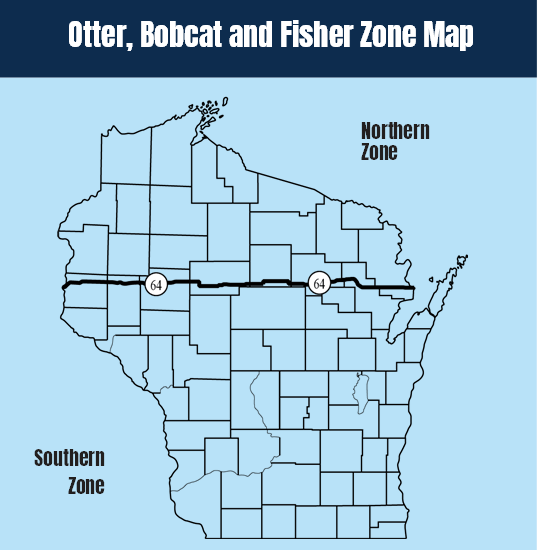
Wisconsin manages fisher using a limited draw and harvest quota system. Fisher trapping is divided into a northern and a southern zone, with separate permit and quota levels for each zone. The map below shows the boundary between the two zones. There is no longer a physical pelt tag mailed to applicants who are successful in the annual drawing for fisher.
Fisher were reintroduced to Wisconsin in the 1950s. By the 1980s, their population had rebounded enough to have a limited harvest. The fisher population continues to fluctuate but remains stable.
Historically, most of the fisher harvest occurred in the northernmost counties of Wisconsin, reflective of their distribution. However, the harvest distribution has shifted slightly southward over the past couple decades.
This southward population shift isn’t unique to Wisconsin. Surrounding states have also reported declining population numbers in some of their northern regions, while simultaneously seeing population increases in their central forests and agricultural land. Some states have reported an even further southward expansion of fisher populations.
Otter Forecast
River otters can be found on all Wisconsin waterways. Their presence is an indication of a healthy aquatic ecosystem, and seeing them in our urban waterways is a good sign. Otters may travel many miles by water and are occasionally seen traveling great distances over dry land.
In Wisconsin, otters are monitored through multiple data sources, including harvest distribution and surveys. The most recent harvest data, as well as information from the DNR’s river otter bridge survey, indicate a robust river otter population throughout the state.
Winter is the best time to look for otter signs. Their distinctive dot-dot-dash tracking pattern is easily identifiable in the snow. Local populations will vary across the state, but the otter population looks healthy overall.
Contact your local DNR wildlife biologist if you are experiencing nuisance issues with river otters.
Bobcat Forecast
*Special Note: This year, the DNR will collect a section of the lower jaw from all bobcat harvested during time period 2. Prior to certification, the lower jaw must be removed and placed in a plastic bag with the jaw tag. The remainder of the carcass can be used for personal use or properly discarded.
Bobcat are widespread and maintain a healthy breeding population throughout the state of Wisconsin. However, due to their secretive nature, bobcat are difficult to monitor. The DNR has concluded work on a bobcat collaring project to monitor these cats in the state. Information from this study, along with other population data, helps improve the state’s bobcat population management strategy by providing a better understanding of the population structure and distribution in the southern zone. It also allowed for another hunting and trapping opportunity for those in the southern zone.
Interest in harvesting bobcats has increased over the last five years. Bobcat, like fisher, are managed using a limited draw and harvest quota system. A record number of hunters and trappers, 35,399 in total, applied for a bobcat permit or preference points during the 2025 application period.