Recent and potential nonferrous metallic mining projects in Wisconsin
Click on the tabs below for short descriptions of known nonferrous metallic mineral deposits in Wisconsin that have had mining interest. In addition, you can read information about the closed Flambeau Mine and its reclamation.
Bend Deposit
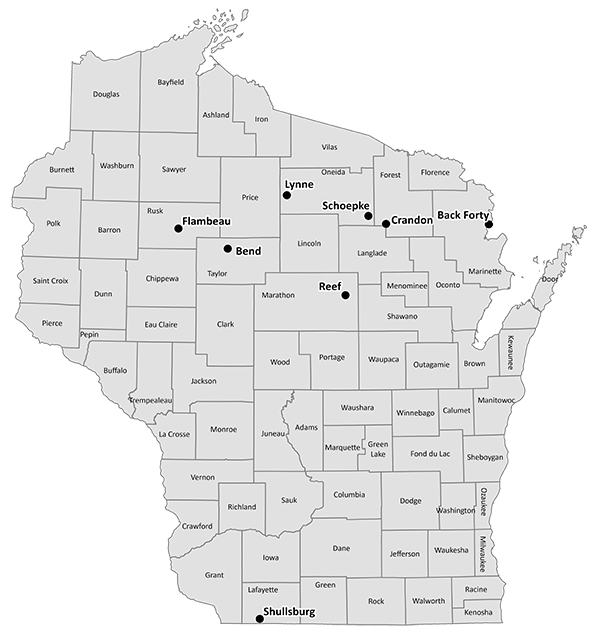
Location: Chequamegon-Nicolet National Forest, Taylor County
The Bend Copper-Gold Deposit is located approximately 19 miles north-northwest of the city of Medford in Taylor County, within the Chequamegon-Nicolet National Forest. The deposit was originally discovered in 1986 and drilled in the early 1990s by the Jump River Joint Venture. The deposit is mostly copper-bearing sulfides with significant gold and minor amounts of silver in two overlapping zones, totaling an estimated 4.23 million tons of ore.
The Aquila Resources company conducted exploration drilling operations in 2012. In February 2022, a Certificate of Completion was granted along with authorization for the termination of the bond. Green Light Wisconsin (GLW), a subsidiary of Green Light Metals, acquired Aquila Resources including their Wisconsin assets in July 2021. GLW obtained an exploratory drilling license in February 2022 and subsequent license renewals in 2022, 2023, 2024 and 2025.
Bend Soo Line 40 Exploration Drilling 2025
GLW submitted a complete Notice of Intent (NOI) for exploration drilling at the Bend Deposit to the DNR in April 2023. Drilling was proposed on parcels with a surface estate owned by the U.S. Forest Service and a private mineral estate owned by Soo Line Railroad Company referred to as the "Soo Line 40" project. In May 2023, DNR determined that the exploration proposal met all of the requirements under state law and issued a conditional approval for metallic mineral exploration. The U.S. Forest Service issued an approval to the exploration plans in February 2025.
Site activities commenced on June 16, 2025. Six drillholes on three drill pads were completed in 12 weeks. A total of 6,673 linear feet of borehole was drilled to collect rock samples and geologic data. Site restoration in accordance with the reclamation plan is ongoing.
Bend Soo Line 40 Exploration Drilling 2026
In December 2025, GLW submitted a second NOI for exploration drilling on the Soo Line 40 parcel. The Bend Soo Line 2026 project proposed up to 20 drillholes on up to 15 drill sites for a total of up to 23,000 feet of borehole. In January 2026, DNR issued a conditional approval to the exploration plans and in February 2026, GLW received approval from the U.S. Forest Service. Drilling started on February 19, 2026, and will continue in accordance with the exploration plan until complete.
Bend Federal Mineral Exploration Drilling Proposal
On March 25, 2026, DNR received a third NOI for exploration drilling at the Bend Site. This project is located on national forestland surrounding the Soo Line 40 mineral parcel with a federal surface estate managed by the U.S. Forest Service and a federal mineral estate managed by the Bureau of Land Management. Due to the federal mineral rights, this project requires a more rigorous federal review and must obtain a federal prospecting permit. GLW intends to drill up to 25 drillholes on 28 potential drill sites for a maximum of 30,000 feet of borehole. The total land disturbance will be less than 8 acres. Both the NOI and the federal prospecting permit application are under review.
Current Projects
- Green Light Wisconsin 2026 Soo Line Abandonment Reports
- Green Light Wisconsin Exploration License Renewal 2026
- Green Light Wisconsin Exploration License Renewal Application 2026
- DNR Request for NOI Additional Information
- Green Light Wisconsin Notice of Intent to Drill Bend Federal Minerals 2026
- Green Light Wisconsin Plan Maps (Attachment 000)
- Green Light Wisconsin Wetland Delineation Report (Attachment 001)
- Green Light Wisconsin Intake Exemption Checklist (Attachment 002)
- Green Light Wisconsin Drill Abandon Products 2022 (Attachment 003)
- Green Light Wisconsin Tooling Specs (Attachment 004)
- Green Light Wisconsin Sump Schematic (Attachment 006)
- Green Light Wisconsin USFS Forest Plan Mitigation Standards (Exhibit A)
- Green Light Wisconsin Drilling Notice Feb 9, 2026
- Green Light Wisconsin Bond Feb 9, 2026
- USFS Letter of Concurrence Feb 9, 2026
- Green Light Wisconsin NOI Conditional Approval Jan 29, 2026
- Green Light Wisconsin Notice of Intent to Drill Bend Soo Line 2026
- Green Light Wisconsin Construction Site Storm Water Permit Coverage 2025
- Green Light Wisconsin Dewatering Operations Permit Coverage 2023
Prior Projects (Archive)
- September 2025 Bend metallic mineral exploration drilling FAQs
- Green Light Wisconsin Drillhole Abandonment Reports 2025
- DNR Notice of Noncompliance Letter Aug 8, 2025
- Green Light Wisconsin Drilling Notice June 11, 2025
- US Forest Service Notice to Proceed 2025
- Green Light Wisconsin NOI Conditional Approval May 4, 2023
- Green Light Wisconsin Final NOI to Drill - Bend Soo Line 2025
Crandon Deposit
Location: Forest County
Exxon discovered the Crandon deposit, located on private property approximately five miles south of the city of Crandon, in 1976. Companies made two unsuccessful attempts at permitting, first in the 1980s and later between 1994 and 2003. The Chippewa and Potawatomi tribes purchased the site in 2003. There is no current mining activity.
The ore deposit is 4,900 feet long, 2,200 feet deep and 100 feet wide. It has an estimated 55 million tons of ore containing zinc, copper, lead, gold and silver. Had the deposit been mined, it would have been an underground mine with approximately 550 acres of surface processing and disposal areas.
Lynne Deposit
Location: Oneida County
The Lynne Deposit is located in the Town of Lynne within the Oneida County Forest. It was discovered in 1990 by Noranda Exploration and is primarily a zinc sulfide ore with significant lead and silver and minor amounts of gold and copper. The deposit is estimated to be approximately 5.6 million tons and recoverable by open pit mining. An interested mining company would need to work with Oneida County's Forestry Department and the Oneida County Mining Impact Committee to obtain exploration and development leases.
Reef Deposit
Location: Marathon County
The Reef Deposit is a potential high-grade gold deposit located in the Town of Easton in Marathon County. The deposit was drilled and described by Noranda Exploration into 1980s and was estimated to contain up to 454,000 tons of high-grade gold reserves in scattered, shallow weathered sulfides and quartz breccias.
Aquila Resources acquired options on the mineral and surface rights and conducted exploration drilling operations in 2 phases during 2011 and 2012. Green Light Wisconsin (GLW), a subsidiary of Green Light Metals, acquired Aquila Resources including their Wisconsin assets in 2021.
In 2022, the DNR issued GLW an exploration license for drilling statewide. GLW then submitted a Notice of Intent for exploration drilling at the Reef Deposit. The submittal was incomplete and has since been withdrawn.
GLW has kept their exploration license current through subsequent renewals. A copy of the current license is located under the Bend tab.
Michigan Back Forty Deposit
Location: Menominee County, Michigan
The Back Forty Deposit is a zinc and gold deposit located in Menominee County in the south-central part of Michigan's Upper Peninsula. The deposit is approximately 21 miles north of Menominee, Michigan, and Marinette, Wisconsin, and is located adjacent to the Menominee River, which is a shared resource water between Michigan and Wisconsin. The known Back Forty Deposit is wholly contained within Michigan's jurisdiction therefore the State of Michigan has sole permitting and oversight authority for a proposed mine. Due to the proximity of the site to the Wisconsin border and the Menominee River, the DNR has been in coordination with the State of Michigan's Department of Environment, Great Lakes, and Energy (EGLE) from the initial scoping of the project through present day.
In 2016, EGLE issued Aquila Resources air and mining permits for the proposed Back Forty Mine. In 2017, the State of Michigan issued a wastewater permit for the proposed Back Forty Mine discharge for a term of five years. The permit authorized a discharge of treated wastewater to the Menominee River, an interstate water. As part of the review process, Michigan consulted DNR who confirmed that the discharge would meet Wisconsin water quality standards.
In 2021, the State of Michigan requested DNR review for reissuance of the NPDES permit. The DNR evaluated the proposed discharge limitations with respect to Wisconsin water quality standards and made recommendations based on Wisconsin’s methodology for metals water quality standards and effluent limits. The DNR recommendations account for slight statistical differences between Wisconsin and Michigan’s water quality standards for metals as well as how metals water quality-based effluent limits are calculated. In 2022, DNR sent a letter to Michigan describing its evaluation of the draft permit and recommending that Wisconsin's comments on the metals permit limits for copper, nickel, lead and zinc be considered to ensure protection of Wisconsin water quality standards.
Specific questions or concerns regarding the proposed Back Forty Mine should be directed by email to Melanie Humphrey, EGLE.
The original mine permit documents and amendment are available at EGLE Mining.
Schoepke Site
Location: Oneida County
The Schoepke Site sits atop a sulfide mineral occurrence containing zinc, copper, lead, silver, and gold. It is located in the Town of Schoepke approximately 15 miles southeast of Rhinelander in Oneida County. It was previously explored in the late 1970s by Noranda, Inc.
In 2020, Badger Minerals, LLC, a subsidiary of Can-American Minerals, Inc. of Thunder Bay, Ontario, Canada, was issued a metallic mineral exploration license and completed a drilling campaign consisting of five drill pads containing six drillholes totaling 2,975 linear feet of drill core for analysis. Badger Minerals completed the permanent abandonment and restoration of all 5 drill sites and was issued a Certificate of Completion in 2023 followed by the release of financial assurance in 2024.