
Wisconsin Urban Forestry Council Annual Awards
Award Categories
The Wisconsin Urban Forestry Council presents annual awards to outstanding individuals, organizations, communities and tribes that further urban forestry in Wisconsin. The awards are announced each year at the annual Wisconsin Urban Forestry Conference and presented to winners in their community.
There are six categories of awards:
- Species Diversity recognizes individuals and organizations who have made an outstanding contribution to the promotion of species diversity through projects, outreach and other activities.
- Next Gen recognizes an organization or individual working to inspire and educate the next generation of citizens engaged with their urban forests through projects, activities and a variety of additional contributions. These inspiring adults will support the future growth and development of the field by encouraging these youth to become the next generation of urban forestry professionals and its supporters. Eligible programs engage youth through age 18.
- Project Partnership recognizes outstanding projects that utilize partnerships as a means of providing services or benefits to the urban forest.
- Lifetime Achievement recognizes outstanding contributions to urban forestry in Wisconsin demonstrated throughout a lifetime career.
- Innovations in Urban Forestry recognizes a community, individual, association or organization exhibiting outstanding innovations in the development or enhancement of an urban forestry project or program. This award recognizes the creativity, commitment and success of urban forestry efforts.
- Leadership recognizes an individual or elected official at the county or local level of government who has made an outstanding recent contribution to urban forestry in Wisconsin. This could be a mayor, alderman, county executive or citizen who has gone above and beyond in their support. Wisconsin State Legislators who have made outstanding contributions to urban forestry will also be considered after they have completed their terms of office.
Nomination Process
Nominations for the 2027 awards must be submitted by Oct. 31, 2026.
Complete the online nomination form.
For additional information, please contact a Wisconsin Urban Forestry Council member or regional urban forestry coordinator.
2026 awards
The Wisconsin Urban Forestry Council presents annual awards to outstanding individuals, organizations, communities and tribes that further urban forestry in Wisconsin. The awards are announced each year at the annual Wisconsin Urban Forestry Conference and presented to winners in their local communities.
Leadership
Award winner: Tom Jerow
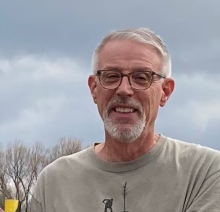
Tom Jerow has served as the Rhinelander City Forester for several years. Among his many accomplishments, highlights include establishing and chairing an Urban Forestry Tree Board, securing over $300,000 in urban forestry grants and donations, establishing a cost sharing program for private property plantings and leading numerous education and outreach events. These accomplishments would be impressive for any full-time employee, but Tom has done all of this as an unpaid volunteer.
Leadership
Award winner: Jeremy Kane

Jeremy Kane has taken the Urban Tree Alliance from a small non-profit to a recognized leader in non-profit urban forestry efforts over the last decade. Through projects like the Madison Tree Canopy project, Community Housing canopy partnerships and most recently, the Neighborhood Forests project where he has teamed up with community groups such as EcoLatinos to plant trees in low-canopy neighborhoods with over 1000 trees planted and growing! He has presented innumerable tree workshops for schools and community organizations and actively shares his perspective as a member of Dane County’s Tree Canopy Collaborative.
Next Gen
Award winner: David Miller
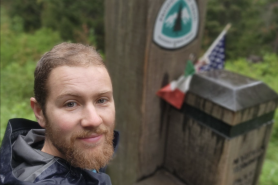
David Miller, botany teacher and high school Rotary Club advisor, spearheaded a school district reforestation initiative in Sheboygan after losing over 300 ash trees to EAB. He actively engaged high school students to complete a comprehensive tree inventory across all school campuses, identify optimal planting sites, collaborate with other organizations and lead volunteer events. To date, these efforts have resulted in planting and support for approximately 300 trees on six campuses with a focus on diversity and sustainability. One noteworthy outcome has been to offer students a direct personal role in combating climate change and global warming through community urban reforestation.
Project Partnership
Award winner: Sweet Water (Southeastern Wisconsin Watersheds Trust Inc.), Mequon Nature Preserve, Milwaukee Metropolitan Sewerage District and Molson Coors
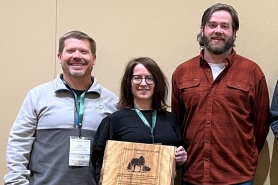
This project enabled more than 180 corporate volunteers to plant over 1,000 native trees in just two hours. This single-day effort will capture an estimated 600,000 gallons of stormwater annually, reduce localized flooding and improve downstream water quality. The event also served as an outdoor classroom by educating participants about sustainable planting, soil health, and the interconnectedness of corporate responsibility and watershed health. Through this initiative, and numerous other projects, Sweet Water continues to demonstrate how science, partnership and shared stewardship can produce tangible, lasting results for both people and the environment.
Innovations in Urban Forestry
Award winner: Lake Michigan Bird Observatory
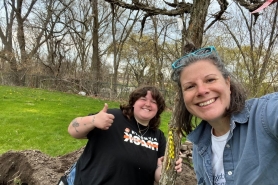
The Lake Michigan Bird Observatory has partnered with several municipalities on a unique biochar project. Thanks to the work lead by Joanna Demas and Mabel Kirst, over 4,000 pounds of biochar has been produced. Biochar is a type of charcoal that acts like a sponge to hold water and can be enriched with nutrients. When used as a soil amendment, it slowly releases water and nutrients that can be taken up by the tree and potentially improve its health. Nearly 300 treatment trees have been planted with biochar and over 100 control trees have been planted without biochar. Ongoing monitoring will determine the effect biochar has on these trees and will provide valuable information that could be used to improve the canopy throughout the state.
Past Recipients
Award recipients from previous years