Wisconsin Hunting Regulations, Fall 2026-Spring 2027
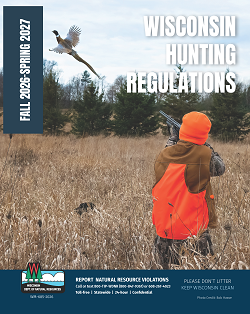
The Fall 2026-Spring 2027 Wisconsin Hunting Regulations are now available for hunters to look through. In addition to this web version of the regulations, a print copy is available at most license agent locations. Both versions contain the same information.
To use the online regulations, you must first choose a Section or click the "View All Regulations" button to see everything. You may then choose a Subsection to narrow your search and then press the View Regulation button to display the regulatory information you selected. If you'd like to see all info related to a section, select the first option ("-") to see everything under that section. You may also press Reset for a brand new search.
Please be aware that hunters are responsible for reading and following all the hunting regulations. Regulations that apply to all species are found within the "General Hunting" and "Licensing Requirements" sections, meanwhile species-specific regulations are found in the respective species sections.
Health Advisories (Lead, PFAS And CWD)
Chronic Wasting Disease
Hunters Help Monitor CWD and Reduce Risk of Spread
Chronic wasting disease (CWD) is a contagious neurological disease which has been found in wild deer and captive deer/elk in Wisconsin. It is caused by a misfolded protein (prion) and is always fatal. It can be spread through direct animal to animal contact, or even through the environment contaminated with bodily fluids or infected tissue from decomposed carcass parts.
Hunters can help monitor CWD and reduce risk of spread by:
- Continuing to hunt, especially in areas where CWD has been detected.
- Properly disposing of their deer carcass waste.
- Following baiting and feeding rules and choosing not to bait deer where it is allowed.
- Having their deer tested for CWD in priority sampling areas.
To learn more, visit the DNR's CWD webpage.
Venison: What Hunters Should Know
Cooking does not deactivate CWD prions. CWD prions can be found in the muscle tissue in late-stage deer with the disease.
There have been no reported cases of CWD in people. As a precaution, the Wisconsin Department of Health Services recommends that venison from deer harvested in CWD affected areas not be consumed or distributed to others until test results show that CWD was not detected in the harvested animal.
For additional recommendations on the safe handling of venison, visit the DNR's Carcass Movement, Processing and Disposal webpage.
Use GoWild to Submit Your CWD Sampling Data Online
Save time by using the online CWD form. Find a link to the form in your registration confirmation email or in your Go Wild harvest history when submitting your sample at a CWD sampling location. Submitting your deer for CWD sampling does not fulfill the registration requirements. Register first, then submit for sampling.
Looking For Carcass Disposal or CWD Sampling Locations?
Visit the DNR's Sampling for CWD webpage to find a map of these resources. Some locations will have both sampling and disposal available.
Check Your Deer's CWD Test Results
Check your deer’s CWD test results online! Log into your Go Wild account and navigate to your harvest history, or visit the DNR's CWD Test Results webpage.
Consumption Advisory for Deer Harvested Within a 5-Mile Radius of the Town of Stella in Oneida County
The Wisconsin Department of Health Services has issued a PFAS-based consumption advisory for deer harvested in this area: do not consume more than one meal per month of muscle tissue (venison) and do not eat liver.
PFAS are a group of human-made chemicals used for decades in numerous products. These contaminants have made their way into the environment in a variety of ways. These chemicals are known to accumulate in the human body, posing several risks to human health including certain cancers, liver damage and decreased fertility.
Potential Lead in Venison
Lead is toxic to humans, even in very low amounts. Children under 6 years old and pregnant women face the highest risk of health problems if exposed. The Wisconsin Department of Health Services recommends using caution when consuming venison harvested with lead ammunition. For more information, visit the DNR's Safely Eating Venison webpage.