
Aquatic Plant Management (APM) Permit Application Forms
Note: We thank you for your patience as we review your permits. Your permit will be viewable in the ePermitting system once it has gone through the intake process, which reviews your application for completeness and correctness.
Please be advised: any large batches of permit submittals in a single day or week may delay the permit review process.
For more information and helpful tips, please review the APM ePermitting Guidebook.
Most aquatic plant management control activities require a permit issued by the Wisconsin Department of Natural Resources (DNR). The DNR reviews permits in order to protect diverse and stable communities of native aquatic plants and prevent the spread of invasive aquatic plants.
When Do You Need A Permit?
Generally, permits are needed for aquatic plant control when:
- chemicals are used;
- wild rice is involved or plants are located in a designated sensitive area;
- plants are removed mechanically; or
- plants are removed manually from an area greater than 30 feet in width along a riparian owner's shore;
- biological controls are used.
Permit Questionnaire
Answer these questions to determine whether you need a permit and what permit you need.
Question 1:
What type of treatment are you proposing to use to manage Aquatic or Riparian Plants, Mosquitoes or Fish?
If your answer is Use Herbicides or other Chemicals: go to Question 2
If your answer is Non-Mechanical Harvesting: go to Question 4
You will need to apply for a Mechanical Permit.
If your answer is Mechanical Harvesting: go to Question 6
If your answer is Use of chemicals for fish removal: go to Question 7
Question 2:
Are you proposing a treatment in a private pond? A pond is considered a private pond if it meets ALL THREE of the following, as described in NR 107.11(3).
- A body of water located entirely on the land of an applicant.
- A body of water with no surface water discharge or a discharge that can be controlled to prevent chemical loss.
- A body of water without access by the public.
You've answered All three conditions are met.
If your answer is "All three conditions are met":
Apply using the online permit system *(Please note: MyWisconsin ID and password needed to apply). If you do not have a MyWisconsin ID, you must register for one before proceeding. The permit fee for private ponds is $20 and does not require the acreage fee portion. Be sure to include:
- Map(s) of proposed treatment areas
If your answer is "One or more of the conditions are not met": go to Question 3.
Question 3:
Are you proposing to treat 10 acres or more, or 10% or more of the waterbody?
You've answered Yes.
If your answer is "Yes":
Apply using the online permit system *(Please note: MyWisconsin ID and password needed to apply). If you do not have a MyWisconsin ID, you must register for one before proceeding. Be sure to include:
- Map(s) of proposed treatment areas
- List of Riparian Owners
- Public Notice (See NR107.03(3)(f))
- Large Scale Worksheet (Form 3200-004A) or copy of one submitted and approved within the past five years as long as everything is current.
You've answered No.
If your answer is "No":
Apply using the online permit system *(Please note: MyWisconsin ID and password needed to apply). If you do not have a MyWisconsin ID, you must register for one before proceeding. Be sure to include:
- Map(s) of proposed treatment areas
- List of Riparian Owners
Question 4:
Are you removing an Invasive Species?
You've answered Yes.
If your answer is "Yes":
Contact your local aquatic plant management coordinator for further guidance
You've answered No.
If your answer is "No": go to Question 8
Question 5:
Are you proposing to harvest within a 30-foot corridor that contains your dock or boathouse?
You've answered Yes.
If your answer is "Yes": go to Question 9
No permit is needed. Contact your local aquatic plant management coordinator if you need further guidance.
You've answered No.
If your answer is "No":
Apply using the online permit system *(Please note: MyWisconsin ID and password needed to apply). If you do not have a MyWisconsin ID, you must register for one before proceeding. The permit fee is $30/acre with a $300 cap. Be sure to include:
- Map(s) of proposed treatment areas
- List of Riparian Owners
Question 6:
Are you proposing to harvest aquatic plants on a waterbody less than 10 acres with single ownership?
You've answered Yes.
If your answer is "Yes":
No permit is required. Refer to the DNR Pond Guide or contact your local aquatic plant management coordinator for further guidance.
You've answered No.
If your answer is "No":
Apply using the online permit system *(Please note: MyWisconsin ID and password needed to apply). If you do not have a MyWisconsin ID, you must register for one before proceeding. Be sure to include:
- Map(s) of proposed treatment areas
- List of Riparian Owners
Question 7:
Are you proposing to use a material such as Rotenone for fish removal from a waterbody?
If your answer is "Yes": go to Question 2
If your answer is "No": go to Question 2
Question 8:
Is wild rice in the area you are working on?
You've answered Yes.
If your answer is "Yes":
Please reach out to your regional APM Coordinator for more information on permitting, the procedures of NR 19.09 should be followed.
You've answered No.
If your answer is "No": go to Question 5
Question 9:
Is the site within designated sensitive area, or known to contain threatened or endangered resources or floating bogs?
You've answered Yes.
If your answer is "Yes":
Please reach out to your regional APM Coordinator for more information.
You've answered No.
If your answer is "No"
No permit is needed.
If you are unsure whether a permit is needed or not, please contact your local aquatic plant management coordinator.
Permit Waivers
If you own property along a waterbody or have a wetland within your property, there are a few situations when a permit is not needed for aquatic plant control.
- Your own land with a waterbody less than 10 acres in size entirely on your property and you are only doing mechanical or manual control.
- You are doing manual removal around your dock. Please see below for more information on when this applies.
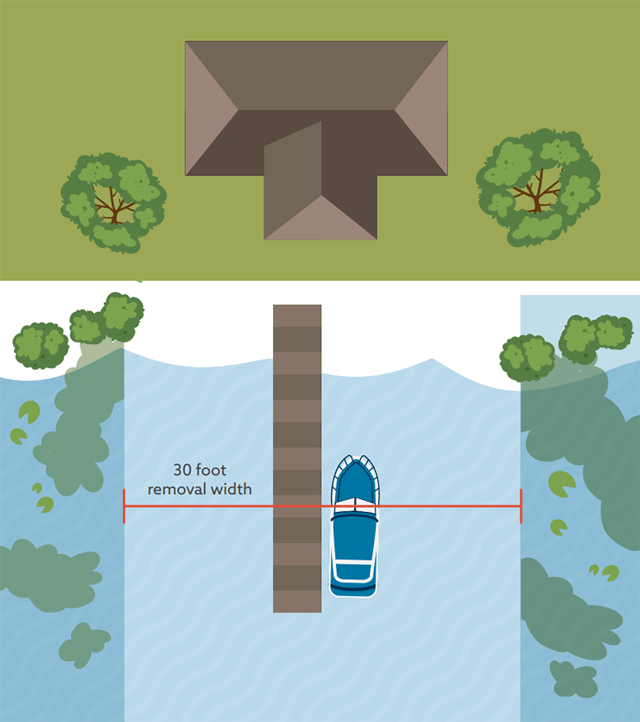
No permit is needed when homeowner manually removes one 30-foot swath of aquatic plants around their pier for boats and swimming. The Riparian Owners Exemption: No Permit Needed is also available as a printable resource.
Manual Removal Of Plants Around A Dock - An Aquatic Plant Management Permit Is Needed If:
- If you want to manually remove aquatic plants along underdeveloped shoreline.
- If you want to manually remove more than a single 30-foot swath of aquatic plants.
- If you want to manually remove two separate segments of aquatic plants.
- If wild rice is present in the area.
- If you are unsure if your shoreline has wild rice, use the Surface Water Data Viewer to find out.
- If your shoreline is part of a Sensitive Area.
- If you are unsure if your shoreline is within a Sensitive Area, use the Surface Water Data Viewer to find out.
- If your shoreline is known to have threatened or endangered species or floating bogs.
- If you are unsure if there are threatened or endangered species or floating bogs, contact your local aquatic plant management coordinator.
- If you already use other permitted methods to control the plants along your shoreline.
- Methods may include:
- Diver-assisted suction harvesting
- Mechanical harvesting
- Chemical control
- Benthic barriers
- Any other equipment attached to a dock for plant removal
- Methods may include:
This information is also available as a printable resource: Riparian Owners Exemption: Permit Needed.
Applying For Permits and Submitting Records
All permits must be submitted through the Water Permit Applications portal. We have a detailed guidebook to walk you through the entire permit and reporting process. Each permit and reporting category has detailed instructions to follow line by line. Use the table of contents to find what section to look at.
Treatment Records
Chemical Control
You may submit chemical records to the APM program two ways:
- The APM Treatment Record APP. This is a new tool that can be used in the field or in the office. It allows users to send the record to the DNR, to themselves and to the permittee all at once from a phone, tablet or desktop.
- Use this link to access: https://apps.dnr.wi.gov/apm/.
- Use this guide if you have questions: APM TR App Guidebook.
- Or, use the Water Permit Applications page to submit Aquatic Plant Management Herbicide Treatment Records (Form 3200-111).
Submit the treatment record form:- Immediately if any unusual circumstances occured during treatment.
- As soon as possible, but no later than 30 days after treatment.
- By Oct. 1 of the permit year, if no treatment occured.
Beginning in 2026, you may not submit paper treatment records to the DNR. Starting in 2027 you will not be able to submit emailed treatment records to the DNR.
Mechanical Control
Mechanical, manual and diver-assisted suction harvesting (DASH) control reports are due once a year summarizing the activities conducted under the permit that year. You may submit this record on the Water Permit Applications page. There is no alternative method of submittal available at this time.
- The APM Treatment Record APP. This is a new tool that can be used in the field or in the office. It allows users to send the record to the DNR, to themselves and to the permittee all at once from a phone, tablet or desktop.
Private Ponds
Private ponds are waters on the land of one owner, with no discharge or a discharge which can be controlled, and no public access. If your waterbody does not meet all three criteria, then you will need to either apply for a wetland or lake permit. In most situations, wetlands do not meet the criteria to be considered private ponds. Please review the Frequently Asked Questions tab for more information.
Private pond permits are $20 and are non-refundable. They are reviewed and issued within 15 business days. During peak permit season (January-March), permit review times may be delayed due to the high volume of permits submitted on any given day. Thank you for your patience.
Pond Permits Are Delayed Most Often For:
- Missing the pond owner’s personal information; it should not be the company conducting control. The company conducting the services has their own section on the permit form.
- Vague permit maps. The DNR has good and bad examples available here: Aquatic Plant Management (APM) Permit Site Map Examples.
- Permits incorrectly submitted as private ponds; if multiple people live around the pond, it is not private.
Lakes
If your water is not a private pond or a wetland, you will need either a chemical or mechanical non-private APM permit. If you are conducting both chemical and mechanical management, you need two separate permits.
Chemical Control Permits
Chemical permits are issued annually. The fee structure is outlined in Table 1.
Table 1. Chemical Control Fees
Non-Refundable Base Application Fee $20 Acreage Fee $25 per acre Acreage Cap 50 acres Acreage fees for chemical control may be refunded if no control happens that year. The DNR will not issue a refund if control happens on any portion of the waterbody.
Large-Scale Chemical Control
If you are controlling more than 10 acres OR 10% of water less than 10 feet in depth, you need to publicly notice your permit application prior to submitting your permit to the DNR. This cannot be done after a permit is sent to the DNR. The ePermitting guidebook has examples of acceptable public notice on page 93.
In addition, permit applications for lakes should include the theoretical whole waterbody concentration calculation. Your certified chemical applicator should be able to calculate this number, and there is also a detailed guide to assist.
Mechanical Control Permits
Permits for mechanical harvesting, Diver Assisted Suction Harvesting (DASH) and manual removal may be issued annually without a plan or for 3-5 years with a department-approved management plan.
Mechanical Control Fees
Non-Refundable Acreage Fee $30 per acre Acreage Cap 10 acres The mechanical permit fee is non-refundable in all situations.
Things To Know Before Filling Out Your Permit
Permits are usually issued within 15 business days. This timeline can be delayed if the DNR doesn’t receive a complete application right away. Lake permits are delayed most often for these reasons:
- Public notice was not done or done improperly for large-scale chemical control. Public notice must be done before a permit is submitted to the DNR.
- The permit information does not include an accurate map of the control areas. The DNR has good and bad examples available: Aquatic Plant Management (APM) Permit Site Map Examples.
- The permit information does not include sufficient information on the plant community.
- The permit information includes too many herbicides or not enough information on the planned herbicide application rate.
There are also more considerations if wild rice may be impacted by the permit within the Ceded Territory.
Follow this checklist to ensure your permit is reviewed faster.
Wetlands
An APM permit is always required for chemical control in wetlands that meet the wet sock test. Wetlands are areas where water is located, near or above the land surface long enough to be capable of supporting aquatic or hydrophytic vegetation. Soils will be indicative of wet conditions as well.
Wet sock rule is used to determine if the soil is saturated with water even when there is no visible standing water. Instead of requiring a battery of physical tests on the soil to determine this, the sock rule was devised for a quick and dirty (no pun intended) field test. If you walk on a site with socks on your feet and they get wet, you should assume the soil is saturated and ponded water may be present; therefore, the site contains waters of the state and requires an NR107 permit before pesticides can be applied.
If the area you are controlling is in an ephemeral wetland and you will not be controlling during saturation times, a permit is not required. If you are unsure whether the area will be wet or not when you control, we recommend you get a permit in advance so that your work is not delayed. If you are doing mechanical removal of cattails, phragmites, buckthorn or other vegetation in a wetland, and the area is over 10 acres or not on private land, a permit is needed. If the area is less than 10 acres and on private land, no permit is needed for mechanical removal.
If you have questions about your area, check in with your regional APM Coordinator before you conduct any management.
Table 1: Chemical Control Permit Fees For Wetlands
Non-Refundable Base Application Fee $20 Acreage Fee $25 per acre Acreage Cap 50 acres Acreage fees for chemical control may be refunded if no control happens that year. The DNR will not issue a refund if control happens on any portion of the wetland.
If you need a mechanical harvesting permit for wetland work, you should submit that under the lake mechanical harvesting permit form. The wetland form is only for chemical control.
Things To Know Before Filling Out Your Permit
Permits are usually issued within 15 business days. This timeline can be delayed if the DNR doesn’t receive a complete application right away. Wetland permits are delayed most often for these reasons:
- Public notice was not done or done improperly for large-scale chemical control. Public notice must be done when you are applying chemicals to more than 10 acres of wetland. This is not the areas over where the work occurs, just where herbicide is applied.
The permit information does not include an accurate map of the control areas. The DNR has good and bad examples available here: Aquatic Plant Management (APM) Permit Site Map Examples.
FAQ
Still have questions about when you need APM permits or how to submit permits? Visit our Frequently Asked Questions Page to learn more.