
Wisconsin Hunting Regulations, Fall 2026-Spring 2027
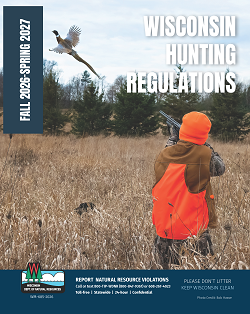
The Fall 2026-Spring 2027 Wisconsin Hunting Regulations are now available for hunters to look through. In addition to this web version of the regulations, a print copy is available at most license agent locations. Both versions contain the same information.
To use the online regulations, you must first choose a Section or click the "View All Regulations" button to see everything. You may then choose a Subsection to narrow your search and then press the View Regulation button to display the regulatory information you selected. If you'd like to see all info related to a section, select the first option ("-") to see everything under that section. You may also press Reset for a brand new search.
Please be aware that hunters are responsible for reading and following all the hunting regulations. Regulations that apply to all species are found within the "General Hunting" and "Licensing Requirements" sections, meanwhile species-specific regulations are found in the respective species sections.
General Hunting Definitions
Accompany
Within visual and voice contact without the aid of any mechanical or electronic amplifying device other than a hearing aid.
Afield
An area where hunting can legally occur, such as fields, forests or similar areas.
Aggregate Daily Bag Limit
The maximum number of migratory game birds permitted to be taken by one person in any one day, when the person hunts in more than one zone or state and/or more than one species for which a combined daily bag limit is prescribed. The aggregate daily bag limit is equal to the largest daily bag limit prescribed for any one species or for any one zone or state in which the taking occurs.
Buck Deer
A deer with at least one antler that is three inches or longer in length.
Daily Bag Limit
The total number of a particular game species that a person may harvest in one day, regardless of how long or often that person hunted that day.
Firearm
Any weapon that uses gun powder, including black powder or black powder substitutes for muzzleloaders.
Highway
The entire width between the boundary lines of every public road, but does not include private roads and driveways.
Migratory Game Birds
Any bird which is migratory and for which an open season has been prescribed.
Point Of Kill
The location at which a light is used to illuminate, identify and kill an animal. It does not include shining a light for the purpose of searching for wild animals whose specific location the hunter does not yet know.
Possession Limit
The maximum number of a game species that a person may possess at-large, including all game stored or controlled by a person, regardless of the proximity to the location of storage.
Public-Access Land
Lands open to hunting that are owned, under easement to, or leased by federal, state, county or municipal government. Managed Forest Law lands, Forest Crop Law lands, public utilities lands and lands acquired with state stewardship funds that are open to hunting are also considered public-access lands.
Public Road
Roads shown on the current official highway map available from the Department of Transportation for public use. This does not include private roads or driveways.
Roadway
The portion of the highway which is improved or ordinarily used for vehicle travel, excluding the berm or shoulder.
Take
To legally kill or harvest under the authority of a license and appropriate harvest authorization.
Unprotected Species
Mammals and birds that can be hunted year-round without bag limits or shooting hours restrictions, including starling, English (house) sparrow, chukar partridge, coturnix quail, feral pigeon, opossum, skunk, weasel, woodchuck, porcupine and all other wild mammals not specifically mentioned in the hunting and trapping regulation pamphlets and not listed as an endangered, threatened or protected species. See the Protected Species webpage for more information. The DNR does not regulate the take of non-wild animals (e.g. feral pigeons and hogs).
Vehicle
Any device, motorized or not, in, upon or by which any person or property is or may be transported or towed upon a highway or other roadway. For example, cars, trucks, tractors, ATVs, UTVs, trailers, bikes and similar devices.
Waterfowl
Ducks, geese, brant, mergansers, coots and gallinules.