
Wisconsin Hunting Regulations, Fall 2026-Spring 2027
The Fall 2026-Spring 2027 Wisconsin Hunting Regulations are now available for hunters to look through. In addition to this web version of the regulations, a print copy is available at most license agent locations. Both versions contain the same information.
To use the online regulations, you must first choose a Section or click the "View All Regulations" button to see everything. You may then choose a Subsection to narrow your search and then press the View Regulation button to display the regulatory information you selected. If you'd like to see all info related to a section, select the first option ("-") to see everything under that section. You may also press Reset for a brand new search.
Please be aware that hunters are responsible for reading and following all the hunting regulations. Regulations that apply to all species are found within the "General Hunting" and "Licensing Requirements" sections, meanwhile species-specific regulations are found in the respective species sections.
Bear Season Dates and Bag Limits
| Zone | Dates |
| Zones A, B and D | Sept. 9-15 With aid of bait With all other legal methods not using dogs |
| Zones A, B and D | Sept. 16-Oct. 6 With aid of dogs With aid of bait With all other legal methods |
| Zones A, B and D | Oct. 7-13 With aid of dogs only, no other methods |
| Zones C, E and F | Sept. 9-Oct. 13 With aid of bait With all other legal methods not using dogs |
Licensing Requirements
What You Need To Hunt Bear:
- A Class A bear license (See the Forms of Proof webpage for more information).
- A paper carcass tag.
- No license is required for a person to bait bear for hunting or training purposes, to train a dog to track or trail bear or to assist a licensed bear hunter in hunting bear by tracking or trailing bear.
Management Zones and Units
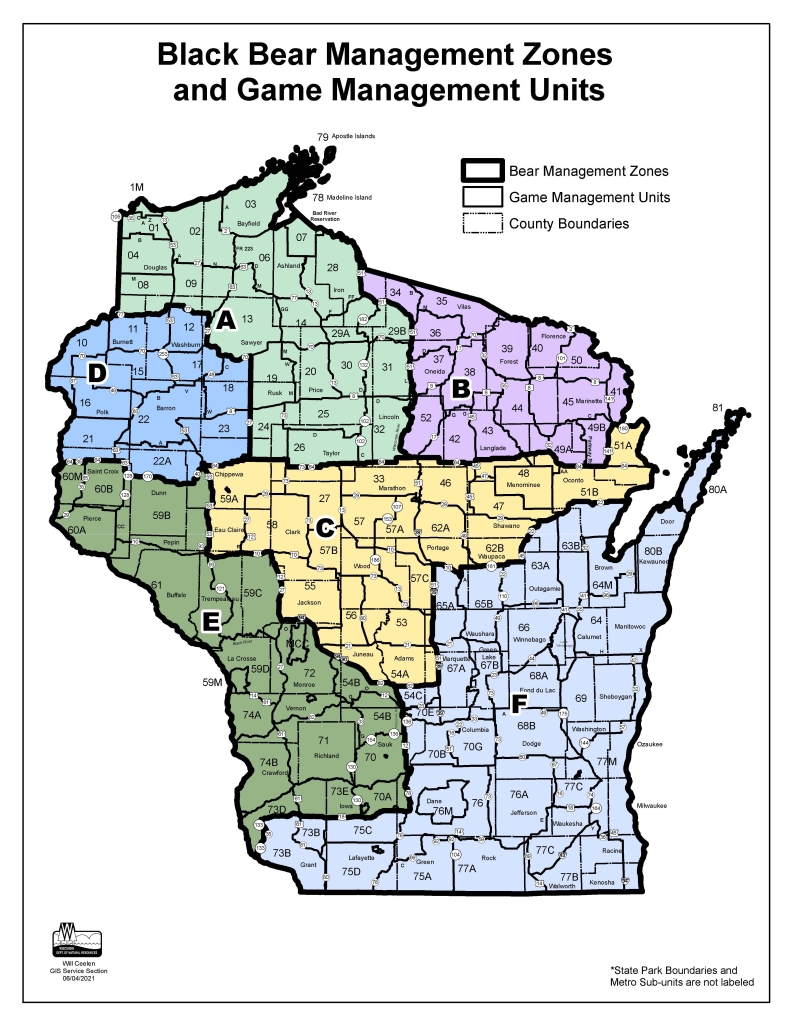
Hunters will need the zone and game management unit (GMU) when registering a harvested bear.
A downloadable version of the bear management units is also available.
Registration and Tooth Submission
Mandatory Bear Registration And Tooth Submission
There are two required steps all successful bear hunters must complete.
First, successful hunters must electronically register bears they harvest in the county of kill or in an adjoining county, by 5 p.m. the day after recovery. Register a bear in one of three ways:
- Go to gamereg.wi.gov (fastest and easiest method).
- Call 844-426-3734 (844-GAME-REG).
- Visit an in-person station. Go to the Bear Registration webpage to find a list.
Once registration is complete, the GameReg system will issue a confirmation number for the hunter’s records. Once the bear is registered, keep the carcass tag with the meat until all meat has been consumed.
Second, successful hunters are required to provide two upper pre-molar teeth by the Oct. 15 deadline.
Instructions for collection of the teeth will be mailed to hunters who draw Class A licenses. To find instructions online, visit the Bear Registration webpage.
After samples are analyzed, bear age results will be available in Go Wild.
If a hunter does not have DNR-provided materials, the hunter should write their name, customer ID number and registration confirmation number on a piece of paper and affix the teeth to it with tape. Enclose this in an envelope and mail to:
Bear Tooth
107 Sutliff Ave
Rhinelander, WI 54501
Validation and Tagging
Validation And Tagging
- The hunter is required to possess a paper carcass tag while bear hunting. Electronic copies of carcass tags are not accepted.
- Immediately upon killing a bear, validate the paper carcass tag by removing the bottom portion (the “validation stub”).
- If you leave it, tag it! You may not leave the bear carcass unless the validated carcass tag is attached to it. In other words, attach the tag with string or other fastener as soon as you plan to leave the carcass.
- Carcass tags must be kept intact and legible; consider protecting the tag inside a zip-top plastic bag.
- It is illegal to:
- Possess or transport a bear carcass unless also in possession of the validated carcass tag.
- Possess while afield a validated bear carcass tag unless that person is also in possession of the legally killed bear corresponding to it.
- Possess while hunting or afield more than one copy of a unique carcass tag.
- Possess, borrow or loan another’s license, permit or tag.
- If a backup shooter kills a bear that was shot, but not killed, by the Class A bear license holder, it is still the Class A bear license holder’s responsibility to validate that carcass tag.