
Contact: Erin Larson, DNR Deer Herd Health Specialist
Erin.Larson@wisconsin.gov or 608-516-2783
DNR Shares Deer Herd Health Reminders And Updates
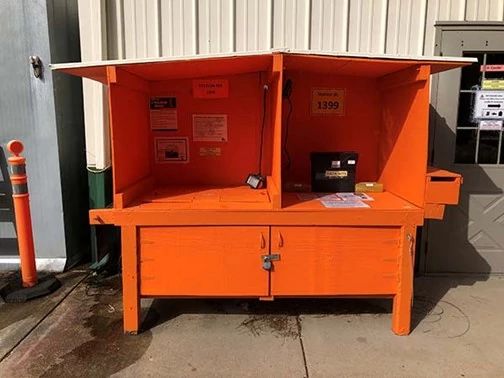 The DNR offers convenient testing options statewide for hunters to test their deer for CWD.
Photo credit: Wisconsin DNR
The DNR offers convenient testing options statewide for hunters to test their deer for CWD.
Photo credit: Wisconsin DNR
MADISON, Wis. – The Wisconsin Department of Natural Resources (DNR) reminds hunters that they play an important role in the continued efforts for Chronic Wasting Disease (CWD) surveillance in Wisconsin. One of the most effective tools for monitoring CWD is testing your harvested deer.
The DNR is especially interested in receiving more samples from the 2026 Fall Priority Areas near recent CWD detection locations. Additional samples in these areas will help the DNR better understand disease levels and distribution.
How To Test Your Deer
Any hunter in the state may choose from the following testing options:
- Self-service kiosks, open 24/7: Kiosks contain supplies for hunters to drop off a deer head with 5 inches of neck attached.
- A helpful video tutorial is available to show you how to submit your sample information using the online form.
- In-person with cooperating partners: Meat processors and other businesses can collect the deer head for sampling or remove the lymph nodes at the time of drop-off. This is a convenient option for hunters who intend to do a European or skull mount.
- If a taxidermist is not a cooperator, ask to get the caped-out head back to submit at a kiosk for a shoulder mount.
- At-home lymph node extraction: Hunters may pick up a kit from a kiosk ahead of time, extract the retropharyngeal lymph nodes using the provided instructions and return the lymph nodes to the DNR or a kiosk for testing.
- Follow the printable step-by-step instructions to extract lymph nodes and prepare them for testing.
- By appointment with local DNR staff: Hunters can contact their local wildlife management staff to schedule an in-person appointment. Please note, the availability for these appointments is limited.
CWD results will typically be available within 2 weeks. Hunters can find the nearest sampling location using the DNR’s CWD Sample and Disposal Locations map.
Replacement Harvest Authorizations
A reminder, if a hunter receives a CWD-positive test result, a replacement authorization will be issued to their Go Wild account within 2-4 days from notification. A positive result from an antlered harvest authorization will result in a replacement antlered harvest authorization for the hunter (valid statewide). If the positive result was received for an antlerless harvest registration, an either-sex replacement harvest authorization will be issued for the same DMU and land type.
Replacement authorizations aren’t weapon-specific and are valid for the remainder of the current hunting season and next year's hunting seasons (starting in September 2027).
Carcass Disposal Reminders
Proper disposal of deer carcasses can reduce the chance of CWD being introduced to a new area. Several disposal resources are available for hunters, including deer carcass waste disposal dumpsters, landfills or transfer stations. These options can be found on the DNR's CWD Sample and Disposal Locations map, and the DNR encourages hunters to check the map again throughout the season.
Contact your local solid waste provider or municipality to check carcass waste acceptance policies before disposal.
Due to rising operational costs and decreasing revenue, the DNR is facing a budget deficit that will limit CWD efforts, particularly deer carcass waste dumpsters for the 2026 hunting season. The dumpsters will still be available statewide, but with fewer locations than prior years. Hunters are encouraged to consider alternative disposal options including disposing of carcass waste via municipality curbside waste pickup (if allowed by the local solid waste provider), using a landowner or transfer station or returning the carcass to the location of harvest and burying if feasible.
Baiting And Feeding
Hunters should also be aware of current baiting and feeding bans by visiting the DNR’s Baiting and Feeding webpage.
The DNR’s Chronic Wasting Disease webpage provides more information about baiting and feeding bans, testing options and disposal options.
Consuming Venison
The Wisconsin Department of Health Services (DHS), the Centers for Disease Control and Prevention and the World Health Organization all recommend against consuming meat from deer that test positive for CWD. Infected deer typically appear healthy for many months after contracting the disease, so DHS encourages testing for the disease regardless of the physical condition of the harvested deer, especially in areas prevalent with CWD. To date, there have been no reported cases of CWD infection in humans.
EHD Update
The DNR continues to track the epizootic hemorrhagic disease (EHD) outbreak in southeastern Wisconsin.
Updated numbers of suspected EHD reports received and a preliminary map of reports are available on the DNR's EHD webpage. The county totals are a sum of all reports received by the department. Posted figures are not an estimate of the total number of deer affected, nor are all of the reports received confirmed cases of EHD.
As things stand, the 2026 deer season will occur as outlined in the current regulations and without any reductions to harvest opportunities.
Given the history of deer harvest and current population size, the affected areas are still able to support an antlerless harvest this fall. Localized areas may experience high mortality from EHD, but the impacts from the disease are short-lived and populations rebound quickly.