
Contact: DNR Office of Communications
DNRPress@wisconsin.gov
Piping Plovers Observed Nesting On Wisconsin Point For The First Time In 49 Years
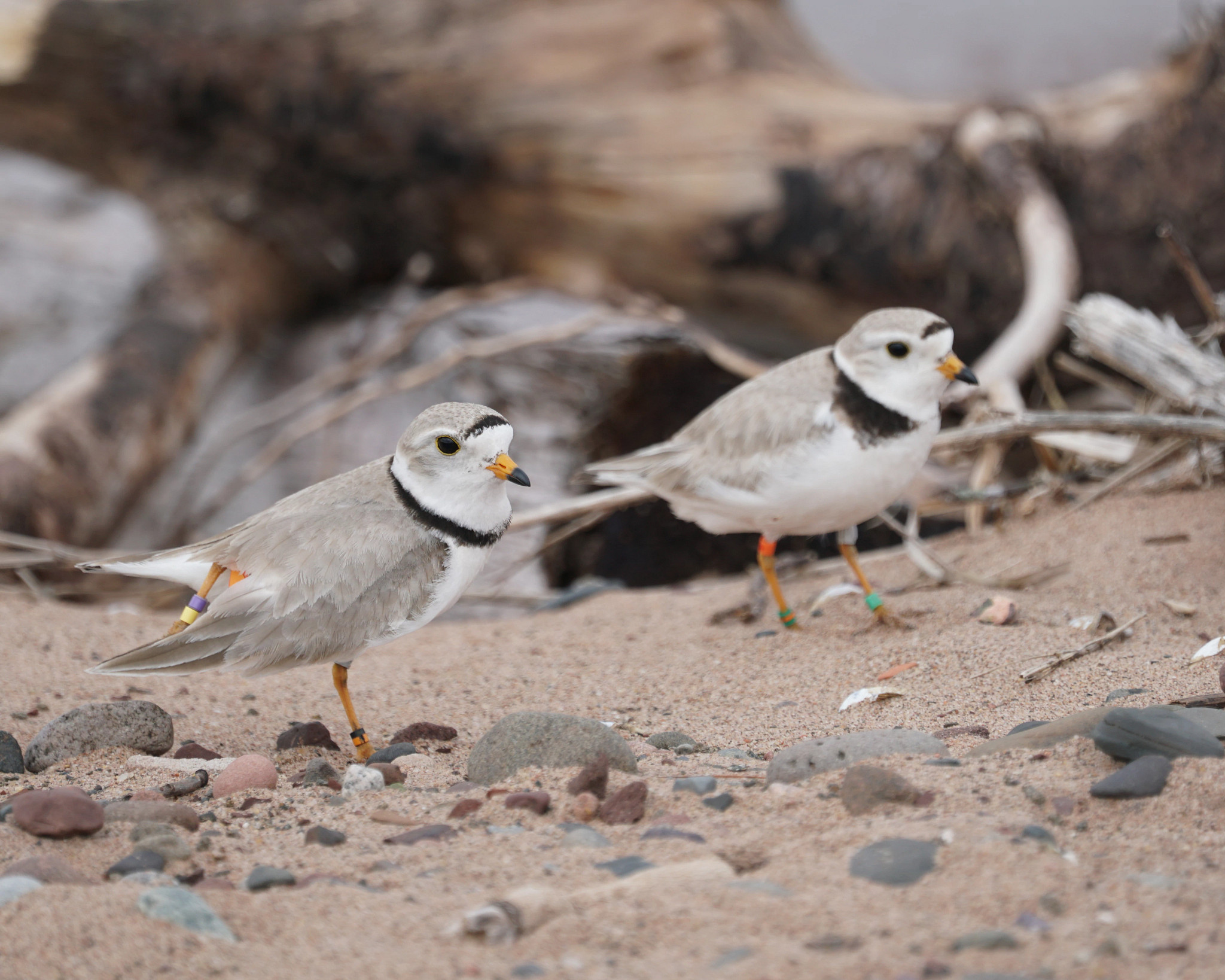 A nesting pair of piping plovers on Wisconsin Point. Birds are marked with colored plastic bands to identify and track individuals.
Photo credit: Mikayla Erickson
A nesting pair of piping plovers on Wisconsin Point. Birds are marked with colored plastic bands to identify and track individuals.
Photo credit: Mikayla Erickson
MADISON, Wis. – The Wisconsin Department of Natural Resources (DNR) announces that a pair of piping plovers (Charadrius melodus), migratory shorebirds that are endangered in the Great Lakes region, was observed nesting this summer on Wisconsin Point in Superior for the first time in 49 years. The St. Louis River estuary historically supported breeding populations of piping plovers, but nesting had not been documented in the estuary since 1977.
The pair nested on an isolated stretch of sand and cobble that was built as part of a collaborative habitat recovery project for the species. The U.S. Army Corps of Engineers, U.S. Fish and Wildlife Service, Wisconsin DNR, St. Louis River Alliance (SLRA) and U.S. EPA, with funding from the Great Lakes Restoration Initiative, invested $4.5 million into the creation and maintenance of this site as part of the St. Louis River Area of Concern (AOC). AOCs are sites on the Great Lakes with significant environmental damage that were designated by the U.S. and Canada in 1987 as needing special attention to restore.
This site was created with over 87,000 cubic yards of clean material dredged from the navigational channel in the Duluth-Superior Harbor in 2019. The dredged material was placed along a small sand spit within the existing state-owned Wisconsin Point Bird Sanctuary to create 14 acres of new nesting and foraging habitat and enhance critical features that are needed for piping plovers to nest. The protected DNR property is closed to the public from April 1 – Aug. 24 to ensure that nesting birds, their eggs and young are not disturbed during the active breeding season. The site closure is monitored and enforced by the DNR and will continue to help protect piping plovers and other migratory birds.
"The news of a piping plover pair nesting here is a very significant milestone for this site," said Matt Steiger, DNR St. Louis River AOC coordinator. "The habitat project that made this possible is an excellent example of how we can collaborate in a working harbor to restore endangered species habitat."
Community involvement has also been key to bringing back piping plovers. The SLRA has been working with federal, state and local partners for 14 years to conduct seasonal monitoring and habitat maintenance at the Wisconsin Point Bird Sanctuary and other sites in the estuary, as well as community outreach and education on how people can help piping plovers. SLRA coordinates volunteers for workdays that supplement DNR site management and help keep the site ideal for plover nesting by removing unwanted vegetation, managing woody debris and monitoring for piping plover activity, which dictates when a predator exclosure is deployed over the nest.
The Great Lakes population of piping plovers included 99 breeding pairs and at least 160 wild chicks fledged, both record numbers since the species was listed as endangered in 1986. This species has highly specialized habitat needs including large expanses of sand dunes and beaches. There are few sites like this in the state, especially with limited disturbance from humans. Wisconsin Point joins the Apostle Islands and two sites in lower Green Bay as the only four sites with nesting piping plovers in the state, this year collectively hosting 12 breeding pairs that fledged 14 young in the wild and four in captivity.