Driveway Access
If there’s a wildfire in the area, firefighters may need to reach your home. If firefighters cannot safely drive a fire truck to your house, they will have to come up with another plan.
Perhaps they will park on the street and run hoselines down your driveway to your house, or maybe they will send in a smaller truck to assess the situation.
They will try to come up with a way to get to your home but it will likely take longer. As you can imagine, the faster a fire is extinguished the lower the risk of damage.
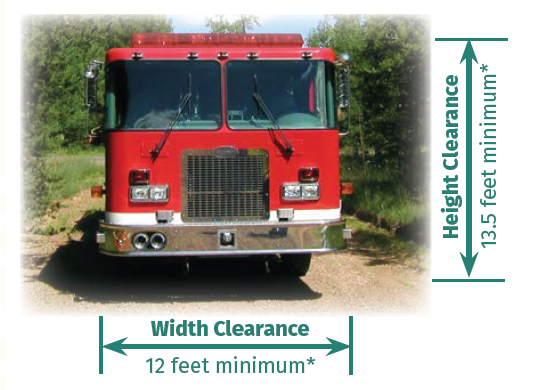
The National Fire Protection Association (NFPA) recommends a driveway clear of vegetation to a minimum width of 12 feet and a minimum height of 13.5 feet.
Doing Your Part
As the homeowner, you are the first line of defense when it comes to helping your home survive a wildfire. When you do your part to ensure adequate driveway access, it means that:
- You have a safe route to leave your property when evacuation is necessary.
- Firefighters can locate your home and reach it quickly.
- Firefighters have a safe place to work around your home and can exit quickly when they need to.
Is your home:
- Easy to find?
- Can your address sign be clearly seen from the road in either direction?
- If there are multiple address signs at the road, is there a secondary sign that will direct firefighters to your home?
- Can your home be seen from the road so firefighters can tell if it’s safe to enter?
- Are street signs with clearly visible road names located at the intersections leading to your home?
- Easy to access?
- Does your driveway have adequate height and width clearance to allow emergency vehicle access, even around the curves?
- Does your driveway have a firmly packed surface which is able to support the weight of emergency vehicles even in the spring when the ground is soft?
- Is your driveway free of gates, fence posts and other obstructions that could restrict access?
- Is there room for an emergency vehicle to turn around once it reaches your home?