
Wisconsin's state fish: the muskellunge
Fishing Wisconsin

New Regulations For The Inland Musky Season in 2026-2027
For the first time in over 40 years, the state of Wisconsin will have a uniform statewide inland musky season opener instead of a split south/north opening date. The general inland musky season will now open statewide on May 2, 2026.
Why Did The DNR Make This Change?
The change to a uniform statewide opener is the result of years of angler feedback and an extensive public input process. This included three separate appearances at the Wisconsin Conservation Congress’s Spring Hearings, where the proposal passed in all 72 counties each time. Proponents cited increased angling opportunities across the state, flexibility for anglers to respond to the impacts of a warming climate (such as earlier ice-offs and spawning seasons) and regulatory uniformity throughout the state, as anglers for other species (including northern pike) could already fish the Northern Zone after the general opener.
In response to the sustained public support, DNR staff reviewed the proposal, evaluating the potential benefits against any concerns. Ultimately, our fisheries experts concluded that a return to a single musky opener (as was the case prior to 1984) could be implemented with no biological harm.
The original objective behind the 1984 adoption of a shorter Northern Zone season, reduced harvest, is no longer a concern.
In those days, a 30” minimum combined with minimal catch-and-release fishing led to an annual harvest of over 65,000 muskies across the state. Today, musky anglers are some of the most passionate and protective anglers on the water, which, along with a 40” minimum (larger on some waters) means catch-and-release is almost universal. For example, the DNR has only documented three harvested muskies across 161 creel surveys in muskellunge waters conducted since 2016, for a statewide harvest estimate of 237 fish over that span.
Will An Earlier Season Disrupt Spawning Muskies?
Disturbing a musky in shallow water will not stop it from spawning. They are programmed to spawn and can’t simply turn it on and off – spawning will happen regardless of whether there is an angler in the area. Additionally, muskies are very unlikely to be caught by anglers during spawning; they eat very little and rarely chase lures; they only have one thing on their minds at this time of the year.
Further, males typically occupy shallow spawning habitat during spring and wait for a female to arrive, which often occurs at night. The female spawns with one or two males simultaneously over a very short time and then leaves the area. Muskies are fractional broadcast spawners and do not guard their eggs or young; they scatter fertilized eggs on the lake bottom to fend for themselves; not much will prevent nature from taking its course. A study on northern pike, a closely related fish with very similar spawning behavior, found no impact of anglers on reproduction (Flink et al. 2021). In Wisconsin, Escanaba Lake has a continuous open season for muskellunge, is a naturally reproducing population and persists as a strong fishery for muskellunge.
If a spawning musky is caught, many studies have shown that hooking and handling mortality in muskies is very low (<5% delayed mortality) and is correlated with water temperature (lower spring temperatures result in low delayed mortality). DNR fisheries staff handle hundreds of fish in crowded nets during the spawn, and we do not see losses due to handling, based on our tagging studies.
Finally, spawning dates are highly variable from year-to-year and dictated by water temperatures, not a date on the calendar. In many years, spawning is occurring in the Southern Zone during the open season. Even though there is very little natural reproduction in many lakes in southern Wisconsin, the fish still “go through the motions,” and can often be seen in shallow waters along the shore during the open season. The overlap of the open season and spawning fish has not resulted in higher harvest or delayed mortality of muskies in the Southern Zone.
Will The DNR Monitor The Impacts Of This Change?
Yes. The DNR will continue to monitor the harvest of muskellunge with our standardized creel surveys and will review the results annually to determine whether harvest increases as a result of this rule change. If the six-year running average of total harvest consistently exceeds the previous benchmark of 237 fish/year for three consecutive years, we will come back to the Natural Resources Board with an adjusted proposal to shorten the open season for musky on inland waters in northern Wisconsin. We will also evaluate temporal trends in population abundance using our standardized population estimation procedures to make sure overall health of the musky fishery is stable.
Does This Change Impact All Wisconsin Waters?
No. This change only applies to the inland waters of the state. “Inland waters” means all waters not classified as outlying waters, including the bays, bayous and sloughs of the Mississippi River bottoms.
The musky season will remain the same for:
- Outlying waters, defined as Lake Superior, Lake Michigan, Green Bay, Sturgeon Bay, Sawyer’s Harbor and the Fox River from its mouth up to the dam at De Pere.
- Michigan and Minnesota boundary waters, including the Brule, Menominee, Montreal, Mississippi, St. Croix and St. Louis rivers, along with their sloughs and flowages.
The musky
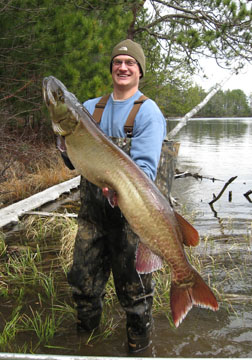
The muskellunge (Esox masquinongy) is one of Wisconsin's most important and unique trophies. It is so highly valued that the State Legislature proclaimed it the official State Fish in 1955. More world records have been landed in Wisconsin than anywhere else. The current state and world record is a tremendous 69 pounds and 11-ounce fish taken from the Chippewa Flowage.
Find a musky water
Fishing for musky
- Where and when to fish
- Releasing musky
- Musky fact sheet
- Identification of muskellunge, northern pike and their hybrids (Pub No. FH 503)
Management
- Muskellunge management update, 2012 (Pub No. FH 508)
Regulations
- For musky fishing season dates, see Muskellunge seasons
- For “Trophy” Musky Waters, see Trophy regulations
- For a complete listing of musky fishing regulations, see the Guide to Wisconsin hook and line fishing regulations.