
Species of Greatest Conservation Need
Wisconsin Wildlife Action Plan
Species of Greatest Conservation Need (SGCN) have low and declining populations and are in need of conservation action. They include plants, lichens, mosses, fish, mammals, reptiles, amphibians and invertebrates like insects, crayfish, snails and mussels that are:
- Listed as threatened or endangered;
- Experiencing threats to their life history needs or habitats;
- Few or low in abundance or distribution; or
- Currently not rare but showing declines in abundance or habitat.
The Wisconsin Wildlife Action Plan also identifies two categories of Species of Greatest Information Need (SGIN). SGIN-Monitoring (SGIN-M) are borderline SGCN that need to be monitored for further population declines. SGIN-Ranking (SGIN-R) refers to species that have uncertainty about their population condition and need information to rank them.
Identifying SGCN and SGIN for the Wildlife Action Plan
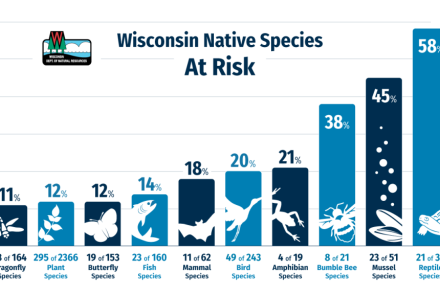
Identification of both SGCN and SGIN for the WWAP relies heavily on NatureServe Conservation Status Assessment Methodology and accompanying rank calculator. The methodology evaluates potential extirpation risk of a species based on rarity, trends and threats at the state level. Vulnerability to environmental change, cultural significance, status in Wisconsin relative to the rest of their range and genetic diversity were also considered.
Over 2000 animals and plants were reviewed using this methodology resulting in 240 animal SGCN, 247 animal SGIN, 429 plant SGCN and 65 plant SGIN.
2025-2035 Animal SGCN and SGIN List
2025-2035 Plant SGCN and SGIN List
Additional SGCN Information
- Wisconsin Wildlife Action Plan 2025-2035. Wisconsin Department of Natural Resources. Submitted Sep. 24, 2025. Approved by U.S. Fish and Wildlife Service, Dec. 2025. See element 1 (E1. Species) for Approach, Methods and Results and a summary of all plants and animals assessed for the plan.
- Downloadable dataset: SGCN and SGIN List[csv] and metadata
- Natural Community and Landscape Associations
- Conservation Opportunity Areas and Actions