
Ribbon grass or gardener's garters
Phalaris arundinacea var. picta
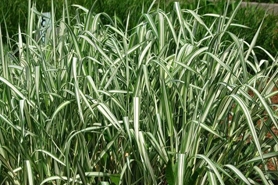
Ribbon grass is 2-9 feet tall. The stem is hairless and stands erect—one of the first grasses to sprout in the spring.
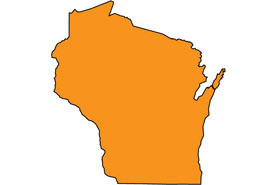
Classification in Wisconsin: Restricted (this restriction does not include the parent type - reed canary grass)
Ecological Threat
- It forms dense, persistent monospecific stands in wetlands, moist meadows, and riparian areas that outcompete desirable native plants.
- Reed canary grass dominates a significant number of wetlands in the Midwest.
Identification
Leaves: Blades are flat and have a rough texture on both surfaces. Leaf blades gradually taper from the base to the tip and are 4-8 inches long and about ½ inch wide. The ligule is unusually large—up to ½ inch long. The top leaves are horizontal.
Flowers: Densely clustered single florets that are green to purple when in bloom (May to mid-June) and turn golden tan as seeds form. The flower branches spread during bloom but draw close to the stem at maturity.
Fruits & seeds: Ripen in late June. Seeds can germinate immediately at maturation. They were dispersed via waterways, animals, humans, and machines.
Roots: Rhizomes with many dormant buds create a thick fibrous mat at or just below the soil surface.
Similar species: Reed canary grass closely resembles orchard grass (Dactylis glomerata; non-native) and native bluejoint grass (Calamagrostis canadensis). Reed canary grass leaves are broader than orchard grass leaves. Reed canary grass has a transparent ligule and bluejoint does not.
Control
Mechanical:
- Small patches may be hand pulled, dug or covered with black plastic for at least one growing season.
- Close mowing three times per year can effectively retard growth and prevent seed set.
- Late spring or fall burns for 5 to 6 years may be effective.
- Soil can also be tilled repeatedly for at least one growing season or the sod can be removed by bulldozer or bobcat making sure to go 8-18” down.
- Combining these methods over a couple of years may be necessary to eliminate a stand.
Chemical:
- Small scattered clones can be controlled by tying stems together just before flowering, cutting off and bagging stems, and applying glyphosate to the cut stems.
- Foliar spray with a solution of glyphosate formulated for use over water.
- Grass-specific herbicides, like sethoxydim and fluazifop-p-butyl, can be used in non-aquatic environments.
- The herbicide imazapic is effective for long-term control.
Resources
Sources for content:
- Czarapata, Elizabeth; Invasive Plants of the Upper Midwest: an illustrated guide to their identification and control. The University of Wisconsin Press. 2005. Pg. 75-78
- Fewless, Gary. Herbarium, Coffrin Center for Biodiversity, UW-Green Bay. Invasive Plants of Wisconsin. Phalaris arundinacea [exit DNR].
- Tu, M. 2004. Reed canary grass (Phalaris arundinacea L.) Control and Management in the Pacific Northwest.
Links for More Information