
Trillion Trees Pledge
The State of Wisconsin recognizes that healthy forests are one of the best nature-based solutions to climate change and joins a wide variety of corporations, governments and non-profit organizations in Forests Plus, the next evolution of the 1t.org US Chapter, hosted by American Forests. Forests Plus builds on the World Economic Forum’s 1t.org Trillion Trees movement, now known as Forest Future Alliance.
On Earth Day 2021, Governor Tony Evers signed Executive Order 112 pledging to protect and restore Wisconsin’s forestland by conserving 125,000 acres and planting 75 million trees by 2030. On Earth Day 2024, with over 32 million trees already planted, Governor Evers signed Executive Order 221 and announced that the state is increasing its Trillion Trees Pledge to 100 million trees by 2030.
The pledge includes providing wildlife habitat, supporting rural economies and equitable distribution of tree canopies in urban areas while continuing to support the responsible management of public and private forestland across Wisconsin. The Executive Order directs the DNR to implement the pledge [exit DNR] in partnership with public, private and non-governmental partners on behalf of the state of Wisconsin.
By 2030, the goals in Wisconsin are to:
- Conserve 125,000 acres of forestland
- Plant 99 million trees in rural areas
- Plant 1 million trees in urban areas
54,265,478
Trees planted in Wisconsin as of Dec. 31, 2025
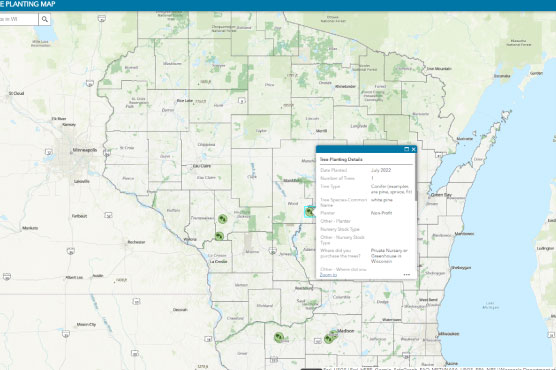
Wisconsin Tree Planting Map
Put your newly planted trees on the map! This short survey will let you count the trees you've planted as part of Wisconsin's pledge toward the Trillion Trees Initiative. Just answer a few questions on the type and number of trees planted and mark their locations on the map.
Use the web map to see how your efforts have helped move Wisconsin closer to its pledged goal.
Background
Wisconsin’s Trillion Trees Pledge renews a commitment by the state to manage our public lands, work with private landowners and engage with organizations across Wisconsin to sustain and grow the benefits that forests offer.
Wisconsin has a more than century-long history of planting trees and caring for forests. The DNR's Reforestation Program has supplied Wisconsin landowners with over 1.6 billion seedlings since 1911, peaking at more than 44 million seedlings in 1959. Tree planting then declined, with fewer than 3 million seedlings distributed in 2019 across the state; however nursery sales have since rebounded to 2013 - 2018 levels with 3.5 - 5.4 million seedlings distributed per year during 2021 to 2025. Check out our Reforestation Program Distribution Report for more information.
Healthy forests, both rural and urban, safeguard water resources by reducing stormwater runoff, erosion, and excess nutrients from reaching waterways, while also reducing flooding. Forestland also provides vital habitat for pollinators, fish, birds, bats, game species and more. Furthermore, Wisconsin’s forests store an immense amount of carbon in the soil, roots and biomass, and sequester approximately 15 percent of the state’s carbon dioxide emissions produced by the use of fossil fuels.
Forest products support 11 percent of Wisconsin’s manufacturing jobs and contributed $41.4 billion to the state’s economy in 2023, sustaining over 1,200 Wisconsin forestry businesses. Durable wood products, like building materials and furniture, keep storing carbon long after harvest, adding a climate benefit in addition to economic benefits. Learn more on UW-Madison Extension’s Forest Carbon in Wisconsin page and on our Forestry and the Wisconsin Economy page.
Wisconsin’s forests support recreation, public health, and the lifeways of Wisconsin’s Tribal Nations. Outdoor recreation linked to healthy forests contributed $12 billion to Wisconsin’s economy in 2024. Forests reduce stress and anxiety, improve air quality, and cool cities; these benefits are especially critical in urban areas where tree canopy is often inequitably distributed in favor of high-income neighborhoods. Urban planting and maintenance can substantially increase carbon storage and energy savings, particularly when targeted at urban heat islands, which disproportionately affect low-income residents and communities of color.
Managing healthy forests in partnership with Wisconsin’s Tribal Nations helps Tribes implement their sovereign rights to hunt, fish, and gather. Healthy forests support deep traditions such as basket making, protecting watersheds and streambanks to support fish habitat and wild rice waters, and promote regeneration of plants like white cedar and black ash.
Gov. Evers’ Task Force on Climate Change recognized that forests contribute vastly to the state’s ecological, economic, and social well-being and recommended forest management as a critical state strategy for mitigating climate change. Wisconsin’s pledge addresses all forestry recommendations listed in the 2020 Governor's Task Force On Climate Change Report including:
- Prioritize forest conservation to “keep forests as forests”
- Pursue reforestation in rural areas
- Encourage tree planting in urban areas
- Implement climate-focused forest management
- Support Wisconsin wood product utilization
For more details, check out our ForestsPlus blog post celebrating five years of the pledge, where you can also learn more about the Supporting Actions the DNR has committed to.
Annual Reports Archive
The annual reports provide more details on our progress toward our pledge:
Get Involved
Check out our Tree Planting at Devil's Lake video to see the pledge in action.
Although we've made great strides towards the pledge so far, we still need your help. Tell us what challenges you’re experiencing, and how can we support your tree planting or forestland conservation efforts in Wisconsin. What could we collaborate on to leverage each other’s resources and benefit the communities we serve? We're excited to build on the momentum of our initial work and explore more ways we can work with partners to create lasting impact.
For more information, contact DNR Trillion Trees Program Coordinator Bobbie Webster at Bobbie.Webster@wisconsin.gov.
Partners
Our state agency and non-profit organization partners are key to successfully achieving the Trillion Trees pledge. The following agencies and organizations have committed to supporting the pledge.
State Of Wisconsin Agencies
- Wisconsin Department of Natural Resources
- Board of Commissioners of Public Lands
- LEAF-Wisconsin's K-12 Forestry Education Program
- Universities of Wisconsin & WI Technical College System
- UW-Madison Division of Extension
- Wisconsin Department of Administration
- Wisconsin Department of Agriculture, Trade and Consumer Protection
- Wisconsin Department of Transportation
- Wisconsin Economic Development Corporation
- Wisconsin Forestry Center
Non-Profit Partners
- Aldo Leopold Foundation
- Alliant Energy Foundation
- Forest Exploration Center
- Gathering Waters: Wisconsin's Alliance for Land Trusts
- Milwaukee Metropolitan Sewerage District
- Savanna Institute
- The Nature Conservancy
- Urban Forestry Council
- Wisconsin Council on Forestry
- Wisconsin DNR Green Tier Charter for Climate Action participants
- Wisconsin Land + Water
- Wisconsin County Forest Association