
Wisconsin Bat Program
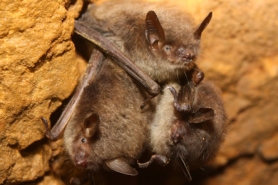
The Wisconsin Bat Program (WBP) monitors and manages bat populations in the state. Bats are vital to many ecosystems and are major consumers of agricultural and forest pests and predators of biting insects. Bats also play an important role in reducing the risk of insect-borne diseases such as the West Nile Virus. Cave bat populations in Wisconsin have declined significantly since 2014 due to the arrival of the devastating fungal disease, white-nose syndrome, that causes extensive mortality in cave-dwelling bats. Although bat populations have declined from the disease, many little brown bat summer and winter colonies in Wisconsin have stabilized with some even increasing in number. As a result, Wisconsin is home to a significant portion of the surviving little brown bats in North America.
In general, bats are difficult to study because they are nocturnal, fast fliers, roost in inconspicuous places and can move great distances in short periods of time. As such, lack of basic bat biology and ecology is one of the greatest limitations to their conservation, and the WBP has turned to community or citizen science for monitoring help. Volunteers have helped the WBP further our understanding of bat species distribution and relative abundance in Wisconsin.
Wisconsin has eight species of bats, all insectivorous and using echolocation to navigate and capture prey. Four species are known as the cave bats and hibernate in caves and mines throughout the winter. The cave bats are all susceptible to the devastating bat disease white-nose syndrome. The other four are known as tree bats, and these bats migrate south to warmer climates during winter.
| Common Name | Scientific Name | Protection Status | Wildlife Action Plan | Group |
|---|---|---|---|---|
| Little brown bat | Myotis lucifugus | State Threatened | SGCN | Cave |
| Big brown bat | Eptesicus fuscus | State Threatened | SGCN | Cave |
| Northern long-eared bat | Myotis septentrionalis | U.S. Endangered, State Threatened | SGCN | Cave |
| Tricolored bat | Perimyotis subflavus | U.S. Proposed Endangered, State Threatened | SGCN | Cave |
| Silver-haired bat | Lasionycteris noctivagans | State Special Concern | SGIN | Tree |
| Hoary bat | Lasiurus cinereus | SGIN | Tree | |
| Eastern red bat | Lasiurus borealis | SGIN | Tree | |
| Evening bat | Nycticeius humeralis | SGIN | Tree |
Get Involved and Help Save Bats
Conduct acoustic bat monitoring surveys
Bats in Wisconsin use echolocation to navigate and hunt. Bat echolocation is in the ultrasonic range, which means it is above human hearing. How bats can fly in complete darkness remained a mystery until the 1930s, when scientists discovered that they use echolocation. Special ultrasonic detection equipment was developed, opening up a whole new method for studying bats.
To conduct acoustic bat surveys in Wisconsin, volunteers are trained to use handheld ultrasonic detectors, affectionately called bat detectors. The system consists of a detector that records ultrasound and a GPS unit that tracks the route and pinpoints each bat call. Data are saved and analyzed in the office. Just like birds, bat species have different calls, and by looking at the frequency, shape, and other characteristics of their calls, the WBP can identify the species of bat recorded.
Volunteers walk, paddle and drive across Wisconsin recording bats.
Learn More
To learn how to conduct surveys, read the Acoustic Survey Protocol.
To see what routes are available and to sign-up, contact us.
Check out the summer acoustic annual summary reports archive.
Submit Your Surveys
If you have conducted an acoustic bat survey and are ready to upload your data, start by submitting survey information on the Acoustic Bat Survey Data Submission Form.
Conduct summer roost monitoring surveys
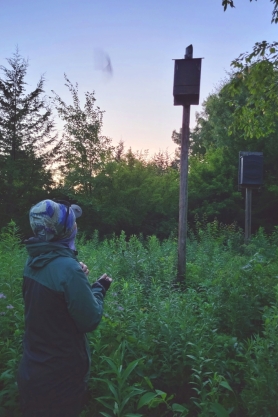
Volunteer counting bats as they emerge from a bat house. Both little brown bats and big brown bats are known to roost in bat houses, attics, barns and other buildings where it stays warm. Generally, these maternity colonies are easily located and monitored because they are in or near human dwellings, and the colonies can be quite large. Knowing the locations and approximate sizes of these bat colonies has helped the WBP gather data about statewide distribution, population estimates and roost preferences before and after white-nose syndrome arrived in the state.
Bat roost monitoring is simple and can be an enjoyable experience. Monitors identify bat roosts and sit outside the roost entrance in the evening to count the bats as they emerge. Bats will start to exit the roost just after sunset and will emerge one or two at a time, making counting easy. The bats will continue to exit for about 40 minutes. How often a roost gets counted is up to the surveyor; the program appreciates at least two counts- one in early June and one in late July during the Great Wisconsin Bat Count. These dates are chosen based on the volancy (flight) of the young born in June and can help us determine reproductive activity in the colony.
Learn More
To learn how to conduct surveys, watch the roost monitoring video.
To report your roost site and to learn more, contact us.
Check out the annual roost monitoring reports archive.
Submit Your Surveys
If you have conducted a roost emergence count, you can submit your results on the Summer Bat Roost Emergence Count Submission Form.
Build bat houses and learn how to safely evict bats from buildings
Bats are beneficial to have around, and many property owners spend a lot of effort attracting them to their area by providing artificial roosts. Like bird houses, a bat house is relatively easy to build yourself or available from a variety of organizations.
Learn how you can build your own bat house.
Have Bats That You Want to Remove From Your Attic or Other Building?
Big brown bats and little brown bats are known to occasionally roost in barns and attics of homes. Bats can be safely evicted from homes via the use of one-way doors that allow bats to leave but not return. Learn more about how to exclude bats using a non‐lethal and widely accepted approach.
How to Exclude Bats From Your Home - An Overview
- Observe the building at about sunset to identify the openings bats are using to get in and out.
- Install a bat house before exclusion to help keep the beneficial insect-eaters around and provide them with another home rather than your house.
- Install one-way doors at the bat exits. Do not restrict exits from June 1 through July 31 during the maternity season.
- Wait at least a week until all bats have exited, then seal bat access points with appropriate materials.
- Enjoy watching the bats emerge from your new bat house.
- Let us know how it worked! We would like to hear your success story about relocating bats from your home to a bat house of their own.
Answers to many frequently asked questions about bats such as excluding bats from buildings and what to do if you have a bat in the house can be found in the Bat FAQ.
Help protect bats from white-nose syndrome
The fungal disease white-nose syndrome was first discovered in New York in 2006 and has spread across the U.S. and Canada, reaching Wisconsin in 2014. White-nose syndrome (WNS) has caused the most precipitous decline of North American wildlife in recorded history. Since its discovery, WNS has affected many species of cave-hibernating bats in the U.S. and Canada, causing declines approaching 99% in some populations. The disease poses a severe threat to all four of Wisconsin’s cave bat species: big brown bat, little brown bat, northern long-eared bat and tricolored bat.
Hibernating bats are vulnerable to disturbance from sound and light in winter, and arousing from torpor can cause them to burn through their fat reserves. Disturbance from humans entering hibernation sites can add to the stress of bats who may already be fighting WNS infection. Do not enter underground sites (caves and mines) with bats from October 1 through May 15 to avoid disturbing hibernating bats.
For up-to-date information on WNS including decontamination information for cavers, visit the White-nose Syndrome Response Team website.
Report sick or dead bats
Though usually rare, people do sometimes find sick or dead bats. Never pick up or handle bats without gloves. If you find one or more sick and/or dead bats, please report them using the reporting form.
If you have immediate questions, contact the DNR switchboard at 608-267-0866 or DNRWildlifeSwitchboard@wisconsin.gov.
If you find a bat hibernating in a building in winter, in most cases, it is best to release it outside in a sheltered location using gloves and the box method. If hibernating bats are found inside homes during extreme cold or weather events and cannot be safely released outside, consider contacting a local wildlife rehabilitation facility in addition to filing a sick/dead bat report.
Donate to the Wisconsin Bat Conservation Fund
You can donate directly to the Wisconsin Bat Program to support bat projects in need of immediate funding. These funds will be used for white-nose syndrome (WNS) research, WNS biosecurity, disease surveillance, inventory, monitoring, applied management and education about the benefits of bats.
On the Endangered Resources Fund webpage, click “Donate Online” and select “Mammals - Bats” from the Special Donation Fund list on the donation details tab.
Learn More About the Bat Program
Visit our outreach and education materials archive:
- The Echolocator - Wisconsin Bat Program Newsletter
- Annual Roost Monitoring Reports
- Summer Acoustic Annual Summaries
Request a Presentation From a Bat Ambassador
The Wisconsin Bat Ambassadors are a statewide group of Master Naturalists and others trained in bat education and outreach and who provide presentations and community bat walks. Contact Jennifer Redell or the Wisconsin Master Naturalist Program to ask about a bat presentation from a Wisconsin Bat Ambassador.
Stay Connected - Sign up for GovDelivery
- Subscribe to receive Bat Program updates
Stay on top of the latest research, follow the progress of Wisconsin's bat monitors and get the dates of our next bat festival. News and events are directed to your inbox from the Wisconsin Bat Program.