
Wisconsin Bumble Bee Brigade
Join the Wisconsin Bumble Bee Brigade (B3), a photography-based volunteer monitoring project, to help monitor bumble bees in your area.
Much remains unknown about the distribution and biology of Wisconsin's bumble bee species. Accurate information on species distributions, habitat requirements, phenology and population status is needed to improve conservation planning and to identify management actions for these important pollinators.
Wisconsin's Native Bumble Bee Species
Submit a Bumble Bee Sighting
We need your help to monitor our native bumble bees! As a volunteer, you will submit photos and additional information on the bumble bees that you observe. You can start sharing your observations with the bumble bee community in four simple steps.
- Step 1: Take a photo of a bumble bee. You can use a digital camera, cell phone or other device.
- Try to take a series of photos of the same bee with views of the head/face, side and top view.
- Check out Bumble Bee Watch’s tips for photographing bumble bees.
- Step 2: Submit your sighting.
- Sign in or create an account on Bumble Bee Watch.
- Select the “WI Bumble Bee Brigade - Incidental” project in BBW to add your sightings (or, if doing a survey, see ‘Conduct a Survey’ instructions below and select the “WI Bumble Bee Brigade – Survey" project in BBW).
- Enter site name and latitude and longitude.
- Step 3: Identify your species.
- When you submit your sightings, you can use the Bumble Bee Watch field guide or Bee Machine to assist with your species identification. We also recommend checking out the bumble bee identification resources.
- Step 4: Your sighting will be verified by an expert.
- You will receive a notification, generally through email, when your sighting is verified.
- Step 1: Take a photo of a bumble bee. You can use a digital camera, cell phone or other device.
Conduct a Bumble Bee Survey
Surveys
Surveys are conducted when you purposefully look for, photograph, count and record the bumble bees you see at a location. Both incidental observations and surveys provide useful information about bumble bees. More information is provided by surveys, but it is not always possible to complete one. Wait to conduct surveys until you can identify bees in the field. Surveys are easiest when done with a partner or in a small group.
Submit your Survey Results
- Sign into your account on Bumble Bee Watch.
- Click “Add a sighting."
- Select “WI Bumble Bee Brigade - Survey” from the project list.
- Enter site name and latitude and longitude.
- On the checklist page, enter the accuracy of your coordinates along with the basic survey information, such as start and end times of the survey, number of surveyors, area surveyed and habitat.
- Add sightings of bumble bees. In the observation notes field, include the number of bees counted. If possible, add the name of the flower the bumble bee was visiting or include a photo of the bee visiting the flower.
Tips for Calculating Area Surveyed in Hectares
- Hectares are a metric unit of square measure, equal to 2.471 acres or 10,000 square meters.
- Traveling/meandering surveys can be calculated by multiplying distance traveled (meters) by average survey width (meters) and dividing by 10,000.
- B3 Small Area Surveys are 30m diameter circles measuring 0.07 hectares.
If you are interested in conducting a survey, read the Wisconsin Bumble Bee Brigade Surveys and Reporting Manual.
Report a Nest Observation
By submitting a photo of the nest and a few additional habitat details, you are contributing to a large database of bumble bees in the United States and Canada that researchers use to improve conservation efforts. Please contact us immediately if you find a rusty patched bumble bee nest.
Add nest observations to the “WI Bumble Bee Brigade – Incidental” or if found during a survey, “WI Bumble Bee Brigade – Survey” project in Bumble Bee Watch.
Nest Information to Report
- Photograph the nest, nest entrance and, if possible, the species.
- Bumble bee species observed
- Sex of bumble bees observed
- Number of bees entering and exiting the nest per minute
- Location of the nest (e.g., underground, hollow cavity)
- Number of entrances to the nest
- Direction the nest entrance faces
- Previous nest use
- Nest materials (e.g., grass, leaves, rocks, wood)
- Nest use by other animals
- Amount of sunshine and shade that the nest gets
- Primary habitat around the nest (e.g., grassland, forest, wetland)
- Main soil type around the nest (e.g., clay, loam, sand)
Attend an Event and Join the B3 Community
- Join the Wisconsin/Midwest Bumblebee Observers Facebook Group.
- Sign up to receive the monthly newsletter or annual report by emailing, DNRFWPWIBumbleBeeBrigade@wisconsin.gov.
- Attend a bumble bee or pollinator event – check out the calendar of events.
Explore B3 Observations
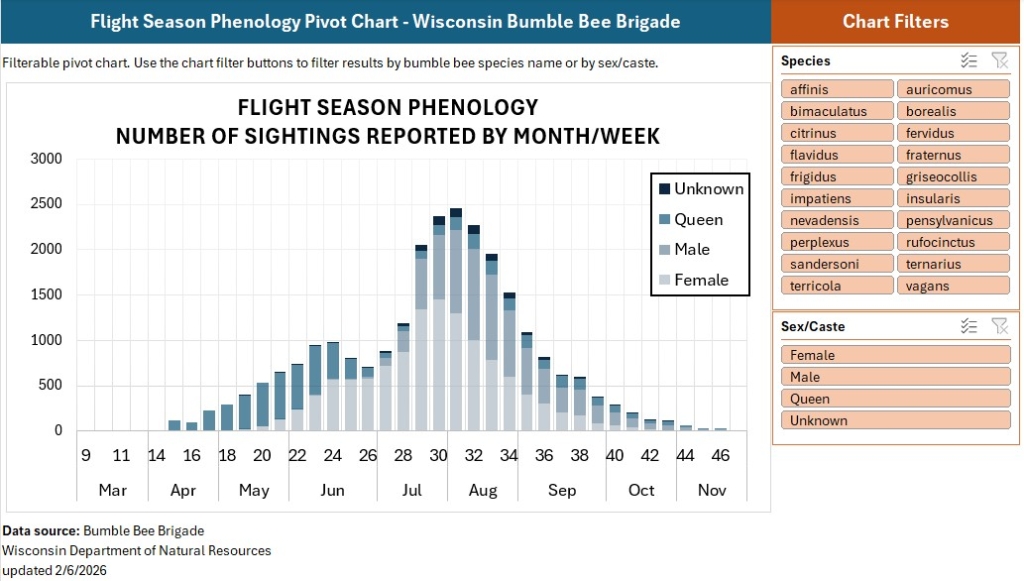
Download observations of bumble bees [Excel] documented through B3 to explore flight season phenology and to create species county checklists. The county checklists also include current and historic records from Bumble Bees of North America dataset, UW Green Bay Richter Museum, iNaturalist and DNR staff.
Learn How to Identify Bumble Bees
Field Guides and Identification Aids
- Bumble Bee Anatomy (Bumble Bee Watch)
- Field Guide (Bumble Bee Watch)
- Minnesota Bumble Bee Field Guide (University of MN)
Recorded Webinars
- B3 ID Webinar: Queens and Workers Recording (Feb 2023)
- B3 ID Webinar: Males Recording (Jul 2023)
- B3 ID Webinar: Advanced Bees and Cuckoos Recording (Feb 2024)
- B3 Advanced Identification Webinar Recording (Jun 2023)
- Ohio State University's Bumble Bee Short Course for Community Scientists - a seven part series on wild bee conservation and importance of community science.
Quizzes to Test Your Knowledge
- B3 Identification Quiz, Beginner Part 1
- B3 Identification Quiz, Beginner Part 2
- B3 Identification Quiz, Intermediate Part 1
- B3 Identification Quiz, Intermediate Part 2
Books
- Bumble Bees of the Eastern United States. 2011. Colla, S; Richardson, L & Williams, P., USDA Forest Service and the Pollinator Partnership.
- Bumble Bees of North America: An Identification Guide. 2014. Williams, P; Thorp, R; Richardson L & Colla, S. Princeton University Press.
Create or Improve Habitat for Pollinators
- Simple Steps to Help Pollinators
- Savings Wisconsin’s Native Pollinators
- Plant Native Plants to Help Nature
- Xerces Society's Bumble Bee Conservation Page
- Judy Cardin & Bob Plamann's Rusty Patched Bumble Bee Floral Phenology Flipbook (December 2022)
- Amy T. Wolf, Jay C. Watson, Terrell J. Hyde, Susan G. Carpenter, and Robert P. Jean "Floral Resources Used by the Endangered Rusty Patched Bumble Bee (Bombus affinis) in the Midwestern United States," Natural Areas Journal 42(4), 301-312, (21 October 2022).
Community-Based Monitoring

The Aquatic and Terrestrial Resources Inventory is a program within the DNR that collects inventory and monitoring data to understand Wisconsin's natural resources better. Data is obtained through individual projects administered through Community-Based Monitoring projects and statewide surveys.